In recent years, Party development work in schools has produced many positive results. However, the process of identifying, training, and admitting high school and university students into the Communist Party still lacks continuity, especially during transition periods between secondary school, university, and post-graduation life.
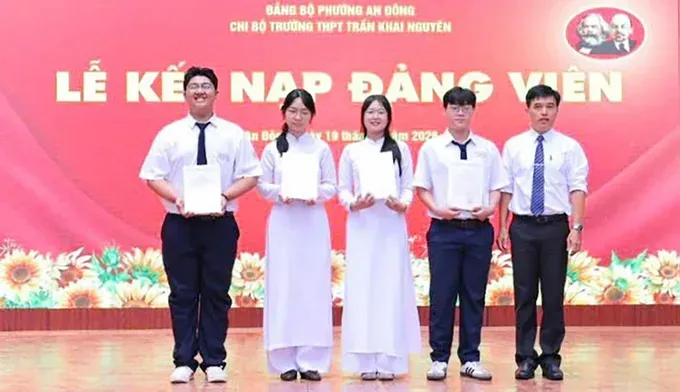
Party member Nguyen Thi Hong Hanh, an ethnic Cho Ro student currently attending Ba Ria–Vung Tau University, was the first student at Ba Ria–Vung Tau Ethnic Boarding High School to be admitted to the Communist Party.
As early as tenth grade, student Hong Hanh had been recognized by the school for her strong academic performance and active participation in extracurricular activities. She was mentored and given opportunities for political development, and once she reached the eligible age under Party regulations, she was admitted while still in high school.
Following student Hong Hanh’s case, the school has since admitted eight more ethnic minority students into the Party.
According to Dao Van Phuoc, Party cell secretary and principal of the school, early Party membership helps students become more mature and confident before entering university.
Being part of the Party and guided by experienced Party members helps these students fully embrace the role of young Party members once they become university students who are energetic, confident, and more mature, principal Dao Van Phuoc said.
Many high schools in Ho Chi Minh City have also proactively developed early recruitment models. At Marie Curie High School, the school launched the “Core Group” model in 2023, bringing together outstanding students selected from 10th grade based on academic performance and conduct. During the 2020–2025 term, the school admitted five students into the Party.
At the university level, recruitment efforts have become more systematic, with large numbers of students admitted each year. During the first four months of the year, the Ho Chi Minh City People’s Committee Party Committee admitted 137 university students into the Party.
At Thu Dau Mot University, the model “One student Party member introduces two outstanding candidates”, along with the “Red Seeds” Club, has supported recruitment efforts by monitoring, mentoring, and verifying applicant records. In the first four months of 2026 alone, the university admitted 20 students into the Party.
Red tape hurts admission to the Party
Despite positive progress, Party recruitment among students still faces procedural obstacles. One major issue is that admission paperwork is often completed after students are no longer formally under the management of their schools.
Representatives from the Party Committee of the University of Economics Ho Chi Minh City said some Party admission files were finalized on June 1, even though students had officially graduated one day earlier. When these cases were transferred back to local authorities where the students reside, complications arose because local officials argued that the Party admission occurred after graduation.
For high school students, Nguyen Van Khanh Bao of Marie Curie High School noted another difficulty.
“Some students are born in the final months of the year. By the time they become old enough for Party admission, they have already left school, forcing them to restart the training process at university, which puts them at a disadvantage”, he said.
Background verification also remains one of the most difficult steps in the admission process. Secretary Le Thi Be of the Party Committee at Hong Bang International University said some verification requests for out-of-province students had gone unanswered for three to four months.
In addition, many students studying in Ho Chi Minh City frequently change temporary residences, making it difficult to obtain local evaluations and comments required for Party admission.
The Central Organization Commission is currently gathering feedback from agencies and organizations to draft new regulations on admitting students into the Party. Party organizations at many schools have proposed reforms aimed at resolving existing obstacles.
Deputy Secretary Tran Van Nam of the Party Committee at Thu Dau Mot University called for simplifying background verification procedures as much as possible in order to facilitate the admission of qualified students.
Regarding continuity in Party membership transfers, representatives from the University of Economics Ho Chi Minh City proposed using students’ graduation ceremony dates as the official reference point so local authorities cannot refuse to receive transferred Party members.
Many universities have also suggested creating more suitable arrangements for Party activities among graduates and extending the transfer deadline from 30 days to six months to allow newly graduated students more time to stabilize their jobs and living situations.
Ho Chi Minh City currently has more than 350,000 high school students and over 600,000 university students. As of the end of March 2026, the city had nearly 1,350 university student Party members.
In recent years, the Ho Chi Minh City Youth Union and the Ho Chi Minh City Student Association have promoted emulation movements, volunteer activities, and scientific research programs to strengthen political education and Party recruitment efforts, including initiatives such as “Five-Good Students” and “Three-Good Students”.