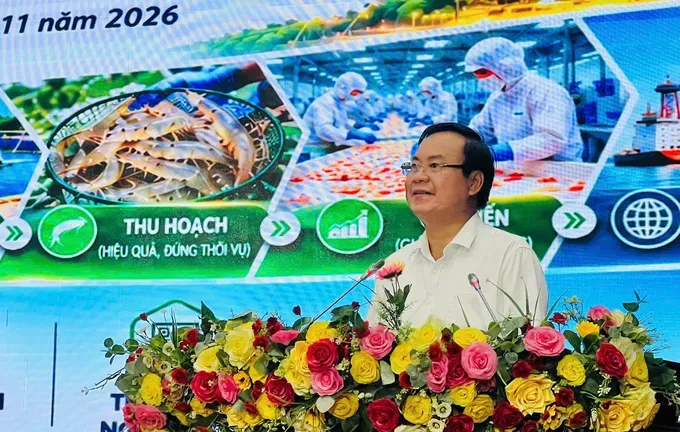
Reporting on the industry's performance, Director Tran Dinh Luan of the Department of Fisheries stated that in 2026, brackish-water shrimp production maintained its growth momentum, exceeding the set targets.Total farming area surpassed 759,500 hectares, reaching 101 percent of the annual plan, while output is projected at 1.4 million tons, up 4.5 percent from 2025 and nearly 105 percent of the 2026 target. The Mekong Delta remains the industry's primary hub, accounting for 94 percent of the total cultivation area and 90 percent of national production. Meanwhile, shrimp exports generated roughly US$4.22 billion in the first 10 months of 2026, marking a 9 percent year-on-year increase.
For 2027, the Ministry aims for a brackish-water shrimp output of 1.5 million tons including over 1 million tons of white-leg shrimp with an export value projected between $4.6 billion and $4.7 billion.
Output rose 4.5 percent despite a mere 0.6 percent expansion in farming area, signaling notable gains in average productivity. Black tiger shrimp spearheaded this expansion in 2026, adding 54,707 tons and accounting for roughly 85 percent of total growth across the brackish-water shrimp sector.
To achieve these goals, the Ministry has urged the 20 provinces and cities engaged in brackish-water shrimp farming to focus on several key measures: reducing production costs and increasing the success rate of farming cycles; ensuring the quality of seed stock and implementing strict biosecurity from the start of the season. Moreover, it aims to translate environmental monitoring data into actionable production decisions, reorganize raw-material production zones and strengthening contractual linkages , increase value-added and adapt to the market.
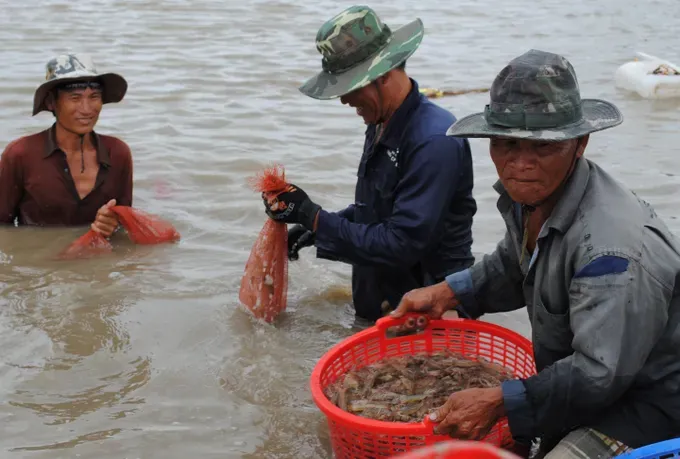
Speaking at the conference, Vo Van Hung, Deputy Minister of Agriculture and Environment, stated that Vietnam’s shrimp industry faces significant development opportunities, yet it must also overcome the limitations of its current growth model.
The industry’s primary challenge is no longer merely scaling up production volume, but enhancing the quality of its growth shifting the focus from market expansion to elevating the value, brand, and global standing of Vietnamese shrimp. Addressing existing bottlenecks and implementing breakthrough solutions will be critical to driving meaningful structural transformation across the sector in 2027 and beyond.