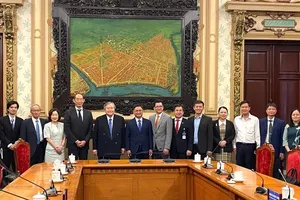
Yesterday, the Ministry of Health held a press conference to provide information on key health policies expected to be formulated and issued in the fourth quarter of 2026. The meeting was chaired by Permanent Deputy Minister of Health Vu Manh Ha.
The Permanent Deputy Minister stated that the Ministry of Health has advised the Government to issue many important decrees on disease prevention, population, allowance regimes in the health sector, and social assistance; while also advising the Prime Minister to issue regulations on conditions to identify individuals exposed to or infected with HIV due to occupational accidents. The Minister of Health has also issued 35 circulars.
According to Permanent Deputy Minister of Health Vu Manh Ha, implementing Resolution 11/2026/UBTVQH16, the Ministry of Health was assigned to lead the drafting of 4 bill projects to present to the National Assembly at the 2nd session, scheduled to take place in October 2026.

The bill projects aim to continue improving health legislation, meeting the requirements of two-level local government organization, administrative procedure reform, digital transformation, and new emerging practical issues.
Reviewing and supplementing health insurance drug list
Discussing the review and expansion of the list of drugs covered by health insurance, Vu Nu Anh, Deputy Director of the Health Insurance Department, said the Ministry of Health has developed criteria to review, amend, and supplement the list of modern drugs, chemical drugs, biologicals, and radiopharmaceuticals covered by health insurance under Circular 37/2024/TT-BYT.

The review focuses on removing drugs no longer in circulation, failing to guarantee safety and efficacy, or no longer appropriate; adjusting payment conditions and rates; and adding new drugs licensed for circulation in Vietnam that ensure quality, safety, and effectiveness.
Deputy Director of the Health Insurance Department Vu Nu Anh stated that the health insurance drug list currently has 1,037 active ingredients. Regulating by active ingredients helps medical examination and treatment establishments choose suitable drugs for treatment needs and funding sources without being limited by brand names.
A new feature in this review is changing the regulation method from hospital grading to technical expertise levels. Accordingly, drug usage will be reviewed to fit each level of medical examination and treatment, with focus on ensuring the drug list at the primary level meets treatment demand.
Notably, the drug list at the primary level is expected to be expanded. While previously there were only over 200 active ingredients, the new list is expected to feature nearly 700 active ingredients, thereby expanding access to drugs for residents right at the primary medical examination and treatment level.
Regarding payment conditions and rates, the Ministry of Health is reviewing toward expanding coverage for drugs that ensure safety, efficacy, competitiveness, and reasonable pricing. New drugs with therapeutic efficacy and advantages compared to existing listed drugs are also considered for addition.
According to Ms. Vu Nu Anh, the Health Insurance Department has conducted a review and drafted the list. However, this process must continue to be updated until submission for issuance, especially regarding drug registration numbers, to ensure the removal and addition of drugs correspond with actual conditions.
Currently, the Health Insurance Department continues to coordinate with relevant units, experts, and medical examination and treatment establishments to review each drug group. The Ministry of Health has established 15 professional councils, reviewing about 20 drug groups.
The review process is being accelerated to finalize the list and meet criteria before submitting it to Ministry of Health leaders for consideration and issuance at the earliest time.
Managing medical equipment prices across supply chain
Discussing medical equipment price management, Director Nguyen Minh Loi of the Infrastructure and Medical Device Administration under the Ministry of Health said medical equipment price management was first regulated in Decree 98/2021. Through implementation, the Ministry of Health identified several inappropriate points that need institutionalization into price management principles at the law level.
According to Director Nguyen Minh Loi, the amended draft is currently open for feedback, including content on managing medical equipment prices. The new feature is managing according to the equipment life cycle and the entire supply chain, from import and licensing to procurement, taxation, customs, bidding, and health insurance payment.
The Ministry of Health is also studying linking data with the identification code of each medical equipment item to increase traceability and transparency in circulation and usage.
Another management approach being researched by the Ministry of Health is online price declaration and listing of medical equipment on the health sector database system.
The system is expected to store information according to legal regulations on prices, while adding specific data for medical equipment to serve traceability, price management, and state administration.
)