During a site visit on November 12 to review the expansion plan for Nguyen Thi Thap General Hospital in Tan My Ward, Deputy Secretary of the Ho Chi Minh City Party Committee Nguyen Phuoc Loc called on the hospital to achieve Grade I status by 2028, two years ahead of its target, to better meet growing healthcare demand.
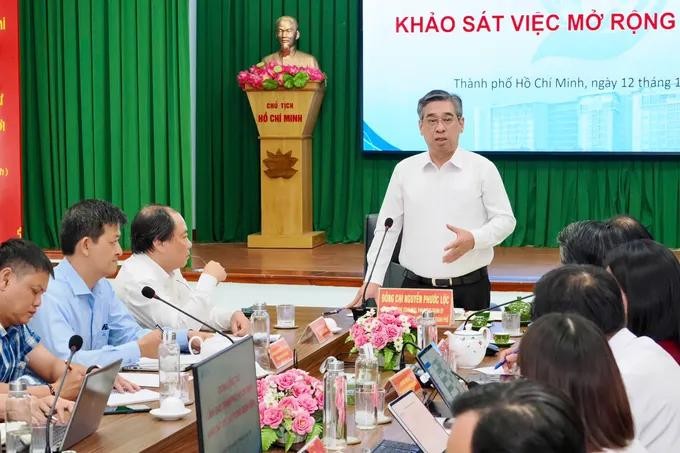
On the afternoon of November 12, Nguyen Phuoc Loc, Deputy Secretary of the Ho Chi Minh City Party Committee and Chairman of the Vietnam Fatherland Front Committee of Ho Chi Minh City, conducted an on-site survey regarding the expansion of Nguyen Thi Thap General Hospital in Tan My Ward.
Medical demand far exceeds designed capacity
Reporting at the working session, Dr. Nguyen The Vu, Director of Nguyen Thi Thap Hospital, stated that the facility currently has 200 planned beds, 17 departments and divisions, and 388 staff members, including 97 doctors, 61 of whom hold postgraduate degrees. Local demand for medical examination and treatment is steadily increasing.
In 2022, the hospital recorded nearly 250,000 outpatient visits; by 2026, that figure is projected to reach over 417,000, up 53.2 percent compared to 2023. On average, the hospital handles about 1,600 to 1,700 visits daily, with 93.6 percent of patients covered by health insurance. Inpatient admissions have also risen continuously, expected to exceed 12,000 cases in 2026.

However, according to Dr. Nguyen The Vu, the biggest current challenge is that existing infrastructure can no longer keep pace with growing demand. The Phase 1 facility, put into operation in 2018, was originally designed to accommodate only 100 beds and about 400 outpatient visits per day. To date, bed capacity has doubled, while actual daily visits are four to five times higher than designed capacity. Forecasts indicate the hospital will receive approximately 1,900 visits per day in 2027 and up to 2,200 visits per day in 2028.
Under its development orientation toward 2030, the hospital aims to become a Grade I general hospital in the Southern Saigon area with a scale of 300 beds, handling an average of 2,000 or more medical visits per day, while developing specialized departments and applying artificial intelligence in professional operations and management.
To achieve this goal, the hospital is awaiting the implementation of two key investment projects: the Phase 1 hospital construction and renovation project with a total investment of VND110 billion, and the Phase 2 hospital upgrade project with a total investment of VND929 billion. Both projects are slated for deployment during the 2026–2029 period.
"The hospital proposes that municipal leaders direct relevant departments and agencies to resolve difficulties and bottlenecks to accelerate the progress of these investment projects. At the same time, we request early consideration to hand over the land plot of the Tan My Ward Health Station (formerly under the Medical Center of District 7) to the hospital to expand examination and treatment space while awaiting project implementation," Dr. Nguyen The Vu proposed.
City pushes Nguyen Thi Thap Hospital to enhance emergency services
Speaking at the working session, Deputy Secretary of the Ho Chi Minh City Party Committee Nguyen Phuoc Loc praised the recent investment in local educational infrastructure, which has basically met development requirements.
Regarding Nguyen Thi Thap Hospital, the year-on-year growth in outpatient visits, inpatient treatments, and surgeries demonstrates improving professional capacity and healthcare quality, gradually reinforcing public trust. Notably, despite significant infrastructure constraints, the hospital has proactively taken on professional support duties for health stations in four wards including Tan My, Tan Hung, Tan Thuan, and Phu Thuan to elevate public healthcare quality.
The Deputy Secretary also stressed the need for the hospital to strengthen recruitment and workforce training, invest in modern medical equipment, and enhance its readiness to respond to epidemics, natural disasters, and medical emergencies. He urged the hospital to accelerate its development roadmap and strive to achieve Grade I hospital status by 2028, two years ahead of the planned schedule. According to the Deputy Secretary, the goal is not merely an administrative upgrade but a key step toward improving treatment capacity, raising professional standards, and delivering better healthcare services to the public.
Regarding implementation, Deputy Secretary Nguyen Phuoc Loc expressed agreement with the policy of studying the arrangement and effective use of land funds to expand the hospital, while requiring agencies and units to strictly follow procedures concerning planning, land, public assets, and construction investment.
He assigned the Department of Health to coordinate with relevant units to finalize the master plan for repairing, renovating, upgrading, and expanding Nguyen Thi Thap Hospital, as well as studying localized planning adjustments and rearranging functions between the hospital and the ward health station.
The Department of Finance was tasked with coordinating reviews and advising on removing obstacles related to investment procedures, total investment capital, and funding sources, including studying a plan to convert the hospital's Phase 2 investment model from a public-private partnership (PPP) to public investment in accordance with regulations.
The Party Committee and People's Committee of Tan My Ward will coordinate with the hospital and relevant agencies to implement the facility rearrangement plan while ensuring the operational capacity of the ward health station is enhanced.
According to Deputy Secretary Nguyen Phuoc Loc, the expansion of hospital space, development of key specialties, strengthening of emergency and treatment capacity, and closer integration with the grassroots healthcare network must be carried out in a coordinated and comprehensive manner. He called on relevant agencies and units to maintain close collaboration, proactively address obstacles, and expedite the completion of plans and procedures within their respective mandates.
He emphasized that the overarching objective is to develop Nguyen Thi Thap Hospital into a high-quality public general hospital with steadily improving professional capacity, capable of better serving the healthcare needs of residents in the southern part of Ho Chi Minh City and surrounding localities.
Nguyen Thi Thap Hospital must prioritize developing key specialties; specifically pediatrics, orthopedics, emergency medicine, and stroke treatment to address critical gaps in local healthcare capacity, according to Deputy Secretary Nguyen Phuoc Loc. Speaking on the pressing medical demands of the densely populated area, he urged the facility to leverage the strengths of the public healthcare system and align its core services with local disease patterns and community needs.
He also noted that alongside investing in physical facilities and improving professional expertise, Nguyen Thi Thap Hospital should promote the historical values and traditions associated with the name of the exemplary female revolutionary cadre who made immense contributions to the Vietnamese women's movement. The hospital should strengthen coordination with the Ho Chi Minh City Women's Union and mass organizations in patient care activities, building a friendly medical environment and gradually shaping a distinct identity worthy of its name.