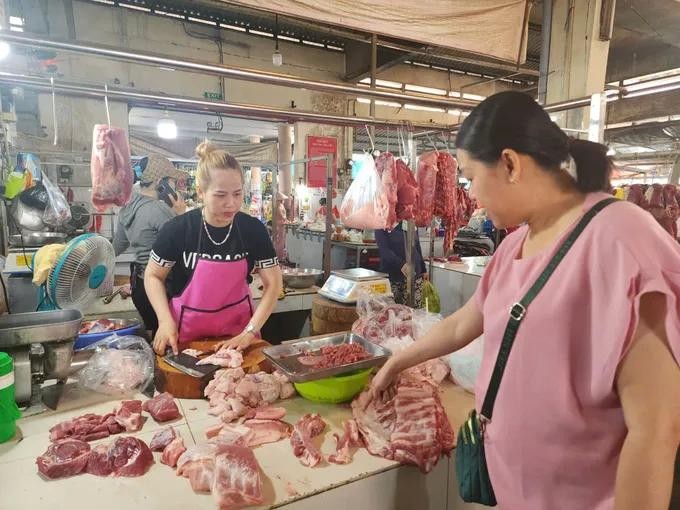
On January 12, surveys across major supermarket chains such as Co.opmart, Big C, WinMart, and Bach Hoa Xanh showed that pork prices had increased slightly for several items. Fresh pork counters were well stocked, ensuring an ample supply. Among surveyed products, pork belly recorded the highest price at VND164,000 per kilogram, followed by pork shoulder at VND158,000, and ground pork at VND106,000, which is the most affordable option.
Nguyen Thi Ngoc Nga, a resident of An Nhon Ward in Ho Chi Minh City, said that she noticed a slight price increase, especially for shoulder and cutlet cuts, but it’s still within an acceptable range.
According to traders, by mid-January, live pig prices from large-scale farming companies supplying Ho Chi Minh City’s slaughterhouses had risen by VND2,000 to reach VND67,500–VND70,000 per kilogram.
At Hoc Mon Agricultural and Food Wholesale Market, the volume of pork carcasses on January 12 increased by 22 tons compared to the previous day, reaching 385 tons. Due to the higher live pig prices, wholesale pork carcass prices climbed by VND6,000 to VND83,000–VND90,000 per kilogram.
Correspondingly, wholesale prices for pork cuts have risen sharply. A kilogram of ham increased by VND2,000 to reach VND9,000, while spare ribs climbed VND5,000 to VND150,000. Pork chops rose VND8,000 to VND90,000, front hocks went up VND2,000 to VND80,000, and hind hocks advanced VND5,000 to VND70,000. Meanwhile, pork belly saw the largest jump, rising from VND10,000 to VND140,000 per kilogram.
Purchasing activity at major wholesale markets in Ho Chi Minh City has also started to rise, reflecting growing demand ahead of the Tet (Lunar New Year) holiday.
The Ho Chi Minh City Department of Finance reported that pork prices under the city’s price stabilization program have been adjusted up by VND2,000–VND12,000 per kilogram, an increase of 1 percent–15 percent, consistent with fluctuations of live pig prices, yet remain 5 percent–30 percent lower than average market prices.
Meanwhile, the city’s Department of Agriculture and Environment noted that pork supply remains stable, as farms have proactively expanded herds and stockpiled inventory to meet not only local demand but also assist other regions facing shortages.
Additionally, the department continues to closely monitor key meat suppliers and, in collaboration with the Ho Chi Minh City Food Safety Department, is strengthening safe food supply chains to ensure quality and hygiene for the city’s consumers in the lead-up to the 2026 Lunar New Year.