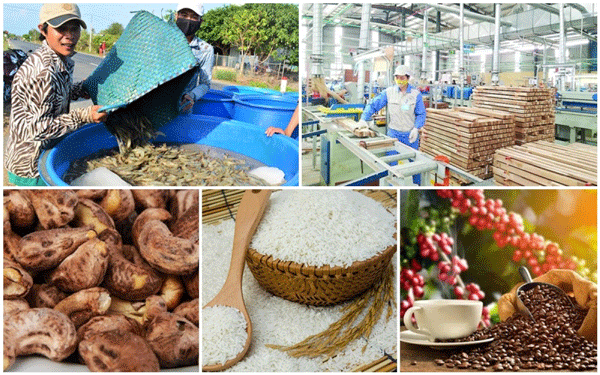
From handicrafts and household goods to consumer products and processed agricultural items, a growing number of Vietnamese businesses are reaching customers in the US, Europe, and Japan through digital platforms. This shift reflects a broader transformation in how exports are being conducted, driven not by scale but by flexibility and access.
Vietnamese businesses have taken small but steady steps
By 2025, Vietnam’s total import–export turnover was expected to surpass US$900 billion, marking a significant milestone amid ongoing global economic uncertainties. Export turnover alone is projected to exceed US$470 billion, up about 16 percent compared to 2024, reinforcing Vietnam’s status as one of the region’s most open and dynamic economies.
Yet behind these encouraging figures lies a shared concern among exporters, as rising pressure continues to mount. Businesses face global economic volatility, high logistics costs, increasingly strict standards in major markets, shrinking order sizes, thinner profit margins, and operating costs that are harder to control. For small and medium-sized enterprises, the backbone of the economy, maintaining traditional export channels has become increasingly difficult. Heavy reliance on a small number of large partners exposes businesses to significant risks when markets fluctuate or orders are reduced.
Against this backdrop, online exporting is no longer an experiment but an inevitable direction. Without the need for large distribution systems or a physical presence overseas, digital platforms allow businesses to connect directly with global buyers and gradually explore markets based on their own capacity. These steps may be small, but they are stable and sustainable.
Although order volumes are still modest, they are sufficient to maintain production, generate employment, and, importantly, help businesses learn how to meet new export standards. Rather than concentrating resources on a few major partners, online exporting enables companies to diversify risks while gradually building their own markets and brands. Over time, this approach strengthens internal capabilities and reduces dependence on intermediaries, moving businesses beyond simple processing or subcontracting roles.
One of the most significant differences between online and traditional exporting lies in access to customer data. Information on purchasing behavior, feedback, and consumer trends, once a luxury under the old model, has now become a valuable asset. With this data, businesses can adjust product design, packaging, and pricing to better suit individual markets. Many companies report that direct feedback from international consumers allows them to improve products faster, better meet demand, and significantly reduce market research costs. Over the long term, data is emerging as a form of “soft capital,” enhancing the value of Vietnamese goods and enabling businesses to sell not only more, but better.
Ample room for growth
Speaking at the 2025 Cross-Border E-commerce Forum, Ms. Lai Viet Anh, Deputy Director of the Department of E-commerce and Digital Economy under the Ministry of Industry and Trade, said that Vietnam’s online import–export turnover reached US$4.1 billion in 2024, with online exports accounting for US$1.7 billion. In 2025, online exports were expected to grow by 18 percent, reaching approximately US$2 billion and pushing total online import–export turnover to around US$4.45 billion.
According to Ms. Viet Anh, these figures signal sustained international demand for Vietnamese products through digital channels. Domestic businesses, especially small and micro-enterprises, are increasingly leveraging digital platforms, cross-border advertising, and online distribution tools more effectively. She noted that continued improvements in institutions, product quality, data standards, and green compliance could create major breakthroughs for cross-border e-commerce.
Sharing this optimism, Phan Manh Ha, Director of External Relations at Shopee Vietnam, said that opportunities for online exports have never been greater. A report by Market Research Vietnam indicates that Vietnam currently has the world’s second-fastest growth rate in cross-border e-commerce, at around 28 percent–30 percent annually. Experts predict that the 2026–2030 period will be critical for e-commerce to scale up, gradually realizing the goal of bringing Vietnamese goods and brands to global markets through digital platforms.
However, challenges remain. Logistics for small, fragmented orders continue to be a major obstacle, pushing up per-unit shipping costs. Human resources also remains a bottleneck. Online exporting is not easy when it comes to standards, as businesses selling directly to consumers must comply strictly with regulations on quality, labeling, product safety, consumer protection, and return policies in each market. Reliance on digital platforms, combined with advertising costs and frequent algorithm changes, demands a long-term strategy to avoid the trap of high sales but low profit margins.
To help businesses move further along the online export pathway, the Ministry of Industry and Trade has rolled out various support programs in collaboration with major platforms such as Amazon and Shopee, focusing on digital skills training and improving the legal framework for cross-border e-commerce. Still, policy serves only as a foundation. The real driving force lies in each business’s own preparedness, from product quality and management capacity to brand building, workforce development, and the ability to adapt to rapid market and technological changes.