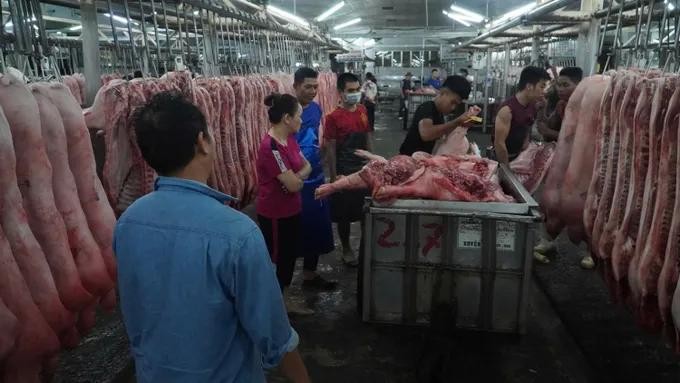
As 2025 draws to a close, there has been a sharp surge in pork consumption particularly this year, after a series of storms and floods killed millions of livestock and poultry. Ensuring sufficient supply and stabilizing prices have therefore become top priorities for both authorities and producers.
Supply remains stable despite losses
In recent days, pork prices have risen in several areas across the eastern part of Gia Lai Province. At a local market in Quy Nhon Nam Ward, vendors reported that the recent floods had caused large-scale livestock deaths among local households, pushing pork prices upward.
At several pork stalls in markets around Quy Nhon, retail prices have climbed by VND2,000–VND5,000 per kilogram compared with late November.
According to Head Le Hong Ha of the Gia Lai Market Management Sub-Department, the agency is working with the Department of Industry and Trade to advise the provincial People’s Committee on coordinating with major suppliers, distributors, and retailers including supermarkets and trade centers to ensure a stable supply of goods for the New Year and the upcoming Lunar New Year (Tet holiday 2026), and to prevent sudden price fluctuations.
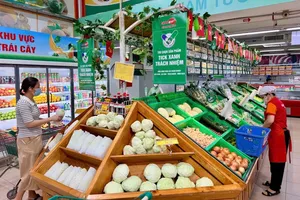
The department has also signed cooperation agreements with major retailers such as Co.opmart, GO!, and Mega Market, requesting that they maintain stable prices and guarantee sufficient supplies of essential goods, particularly pork and poultry products, throughout the year-end period.
According to data from the Ministry of Agriculture and Environment, typhoons Ragasa and Bualoi recently caused total damages exceeding VND8 trillion. In the first ten months of the year, over 1.1 million livestock and poultry were lost nationwide. The November floods further devastated the Central Highlands particularly in Dak Lak Province, where around 3.2 million animals perished.
Floods and outbreaks of African swine fever have damaged many farms and reduced the number of pigs raised in small-scale households to just 35–40 percent of previous levels. However, large farming enterprises have offset much of this decline.
In Hanoi, one of the country’s largest livestock populations, the pig herd remains stable at around 1.5 million head.
Director Nguyen Nam Long of Nam Long Livestock Joint Stock Company said the firm currently raises more than 30,000 market-ready pigs, which will be supplied to northern markets during and after the Tet holiday.
In neighboring Bac Ninh Province, Director Hoang Xuan Thanh of Xuan Thanh Livestock Company revealed that the business imported a large number of piglets in the third quarter of 2025 and expects to supply 50,000 pigs to northern markets by late January, just in time for the Lunar New Year.
In the Southeast region, Vice Chairman of the Dong Nai Livestock Association Nguyen Kim Doan estimated the province’s pig herd at over 4 million head accounting for about one-eighth of the national total enough to meet regional demand during Tet and supply several nearby provinces and cities.
Dong Nai Province’s poultry population also remains robust, with about 40 million birds, nearly ten times the number of pigs, helping to ensure a stable supply of meat and eggs in the peak consumption season. Large-scale farms across Dong Nai Province and the Southeast region began restocking herds two to three months ago to prepare for Tet holiday, securing continuous supply.
Major producers confident in year-end pork supply
Le Minh Tuan, General Director of Vissan Joint Stock Company, said the firm has allocated VND530 billion (up 8 percent year-on-year) to ensure sufficient pork supply for the upcoming holiday season.
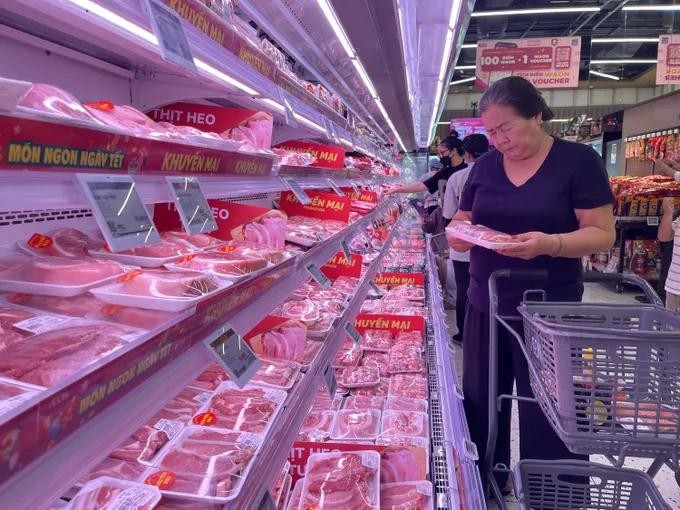
Vissan plans to provide 850 tons of fresh pork, an 8 percent increase compared with last year, along with 3,500 tons of processed meat products. With this preparation, the company is confident it can fully meet consumer demand during the Lunar New Year.
To safeguard against potential market fluctuations, Vissan has also reserved an additional 1,000 tons of frozen pork, packed in 0.5–1 kilogram portions, ready for release if necessary. If the market remains stable, this stockpile will instead be used for processing.
Other major livestock enterprises including C.P. Vietnam, CJ, Japfa, Emivest, and Greenfeed—also expressed confidence in supply capacity, with a combined total of nearly 700,000 market-ready pigs. A wide range of processed pork products such as Vietnamese pork rolls, boneless pork cuts, sausages, and pickled pork ears are being prepared to meet diverse consumer preferences during Tet.
According to Pham Kim Dang, Deputy Director of the Department of Livestock Production and Animal Health under the Ministry of Agriculture and Environment, several key measures are being implemented to secure meat supplies for the year-end and Tet holidays.
In addition to improving breeding, nutrition, and biosecurity practices, the ministry is focusing on stabilizing animal feed sources and strengthening disease control particularly against African swine fever.
The Ministry of Agriculture and Environment has urged livestock enterprises and smallholder farmers to develop detailed production and supply plans to prevent local shortages. Large corporations and industrial-scale farms have been advised to expand herds and increase pork output before and after the Tet holiday.
Meanwhile, importers are being asked to draw up specific import schedules and volume targets to ensure adequate supply in the domestic market as consumption peaks toward the end of the year.
Overall, Vice Chairman Nguyen Van Trong of the Vietnam Farms and Agricultural Enterprises Association said that holiday demand typically rises by 10–15 percent, but farms and agribusinesses have proactively increased production since midyear.
“With industrial chicken taking only 35–45 days to reach market weight, supply can be fully controlled,” he noted. “Alongside domestic production, meat imports have also risen significantly. Therefore, there is no concern about shortages during the upcoming holiday season.”