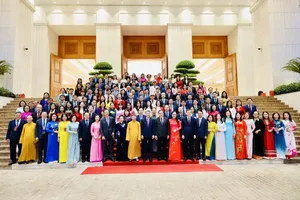
On the morning of November 26, the Industry Agency under the Ministry of Industry and Trade held a conference in Tay Ninh Province to present policies and regulations on managing and developing industrial clusters (ICs) in the Southern region.
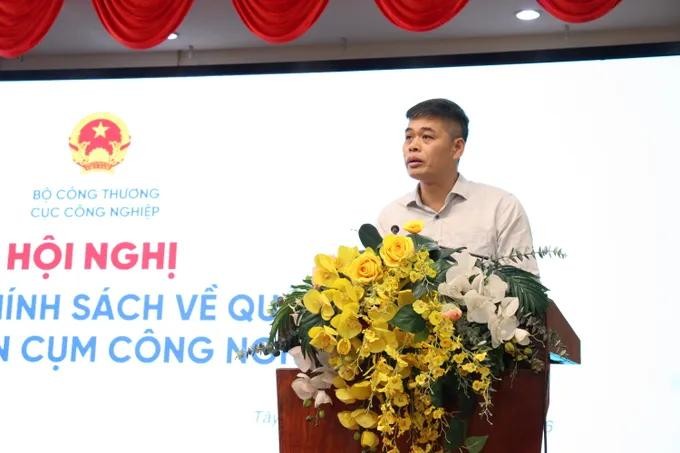
At the conference, Deputy Director Nguyen Van Thinh of the Industry Agency said the Government had issued Decree No. 303/2026/ND-CP on August 1, 2026, amending and supplementing several provisions of Decree No. 32/2024/ND-CP on IC management and development. The Ministry of Industry and Trade subsequently detailed these changes through related documents, introducing breakthrough measures to support IC development.
One notable new provision is the introduction of definitions for eco-industrial clusters, high-tech industrial clusters, supporting-industry clusters, specialized industrial clusters, and craft-village clusters. These definitions provide local authorities with a legal basis for guiding investment attraction, advancing the circular economy, strengthening production linkages, and using resources more efficiently.
New regulations have cleared a major investment bottleneck for industrial cluster infrastructure, allowing local authorities to tap into state budget funds for critical development projects.
Administrative procedures related to industrial clusters have been streamlined. The appraisal period for dossiers at the Department of Industry and Trade is now set at exactly 20 working days, while the decentralization of management and dossier-receipt responsibilities to people’s committees in communes have also been strengthened.
Under the updated provisions, public funds can now be allocated toward building essential utilities including transport networks, power and water supply, drainage, wastewater treatment, and telecommunications in designated industrial clusters.
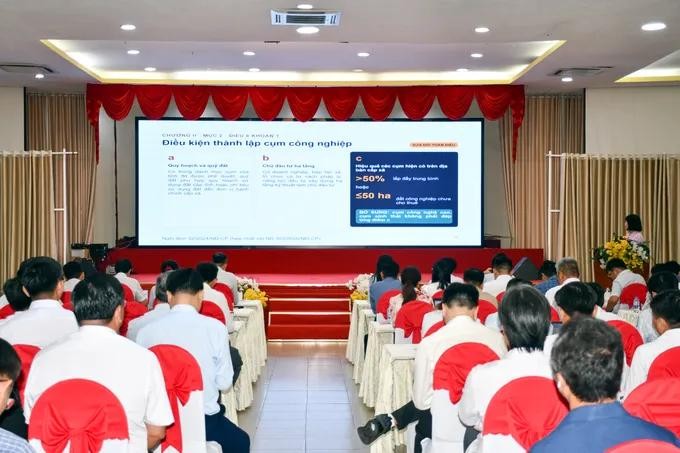
The financial support prioritizes two main categories:
Innovation-driven clusters: Zones that allocate a portion of their developed land via direct lease or sublease to private high-tech firms, small and medium-sized enterprises (SMEs), or innovative startups.
Priority development zones: Clusters situated in areas facing difficult socio-economic conditions, as well as those operating as specialized, craft-village, supporting, high-tech, or eco-friendly hubs.
The new regulations address long-standing asset-handover complications by expanding state-funded technical infrastructure and exempting those facilities from the Law on Management and Use of Public Assets, according to Deputy Director Nguyen Van Thinh.
At the conference, representatives from industrial cluster developers in the Southern region welcomed the regulatory updates, noting that the regulatory updates have eased major operational hurdles for them. Therefore, industry leaders urged authorities to implement the policies promptly and consistently to ensure businesses see tangible results without delay.
The new regulations also strengthen environmental protection requirements. Accordingly, all industrial clusters must complete a compliant centralized wastewater treatment plant before they are permitted to admit secondary enterprises for operation.