AI generated graphic
If it genuinely wants tourism to become a leading economic sector, HCMC can’t merely care about the sheer volume of visitors. The city must craft highly engaging products that compel tourists to stay longer, spend more extensively, and ultimately yearn to return. This is the pressing prerequisite laid out as the city concretizes Resolution No.26-NQ/TW, dated August 22, 2026, issued by the Politburo regarding the development of Vietnamese tourism in the new era.
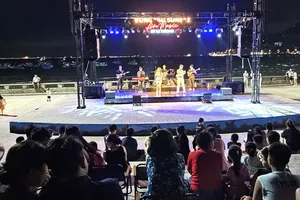
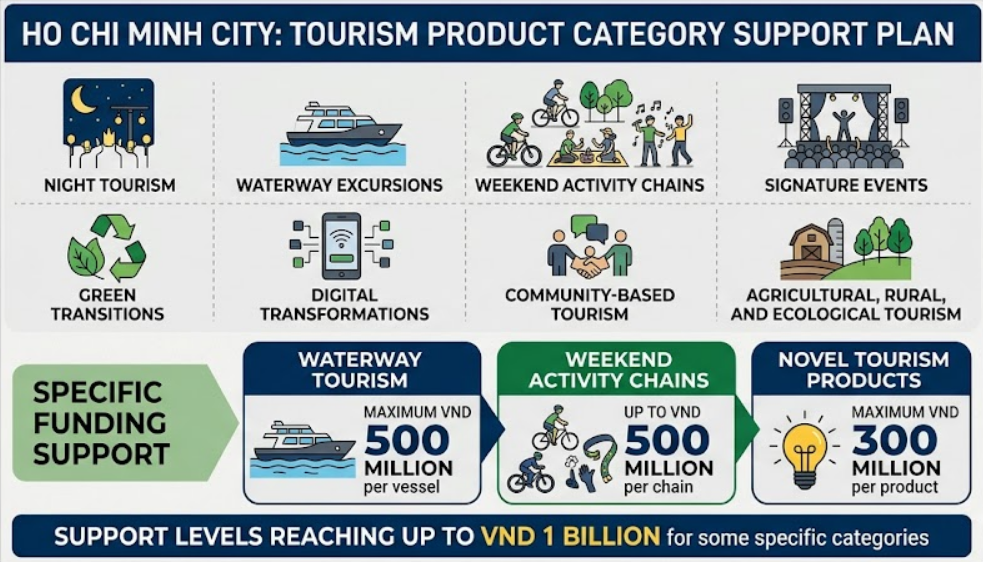
Currently, HCMC is soliciting public feedback on a draft resolution aiming to determine supportive mechanisms for developing tourism service models, products, and activities across the locality through a fairly comprehensive framework. The city anticipates supporting multiple product categories, including night tourism, waterway excursions, weekend activity chains, signature events, green transitions, digital transformations, community-based tourism, as well as agricultural, rural, and ecological tourism.
Some specific categories will enjoy support levels reaching up to VND1 billion (US$38,300). Waterway tourism could receive maximum backing of VND500 million ($19,150) per vessel, while weekend activity chains might secure up to VND500 million per chain, and novel tourism products could receive a maximum of VND300 million ($11,480) per product.
Formulating this support mechanism is undeniably essential, because an expanded developmental space is creating optimal conditions for HCMC to fully leverage its innate strengths in urban landscapes, cultural heritage, island ecosystems, transportation networks, and elite services. Besides, recent reality unequivocally demonstrates that these massive resources haven’t been meticulously organized into products compelling enough to prolong a tourist’s itinerary.
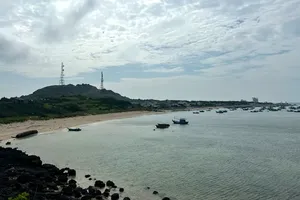
Can Gio stands out as a prime example. This locality boasts lush mangrove forests, pristine beaches, the profound historical values of the Sac Forest, and a vibrant coastal village culture, alongside numerous signature agricultural and aquatic products. However, visitors journeying here primarily depart on the exact same day. High-quality accommodation networks, large-scale entertainment services, and thriving nightlife products remain severely limited.
This appears to be a common challenge for countless destinations as they pivot from merely exploiting natural resources to proactively cultivating sophisticated tourism products. International experience indicates that resources act strictly as the foundational bedrock. The true magnetic allure of a destination heavily relies upon how products are systematically organized, how various stakeholders are seamlessly interconnected, and how these offerings are delivered to the precise target market.
Thailand is developing diverse tourism clusters like wellness and nightlife while fostering local partnerships to target specific niches. Concurrently, Seoul (the Republic of Korea) is helping boutique hotels upgrade services using advanced technology to better accommodate independent global travelers.
With the support policies that HCMC currently plans to roll out, this “seed capital” only holds genuine significance when strictly accompanied by a sufficiently open mechanism, empowering enterprises to boldly invest and localities to proactively synergize their resources. Supported products must rigorously prove their effectiveness through their sheer capacity to attract visitors, prolong their stay, generate local jobs, mobilize grassroots community participation, and comprehensively protect the environment.
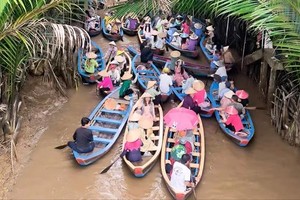
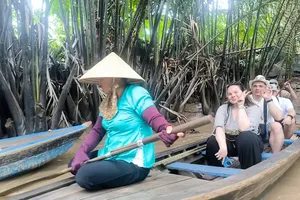
For instance, a waterway tour shouldn’t just be a mundane boat ride down the river; rather, it needs to be intrinsically linked with captivating sightseeing spots, traditional craft villages, exquisite culinary experiences, and elite riverside services. Furthermore, weekend activity chains could seamlessly merge food experience with live music, sports, and cultural immersion, while community-based tourism must remain tightly intertwined with agriculture, OCOP (One Commune One Product) items, and resource conservation.
Only then will the financial support possess the tangible capability to generate additional services, forge a robust value chain, and draw a multitude of stakeholders into the mix.
Alongside these supportive policies, HCMC must avoid a herd-mentality approach. Having a river doesn’t automatically mean one must blindly launch a waterway tour. Simply possessing a nighttime space doesn’t equate to exclusively opening a pedestrian street, and boasting a rural area doesn’t guarantee that every single spot is inherently suitable for community-based tourism.
Ultimately, selecting the right product requires a thorough assessment based on the distinct advantages of each specific locale, genuine market demands, and the tangible capacity to sustain long-term operations.
Throughout this intricate process, management agencies must retain their pivotal role in guiding and connecting all moving parts. This ranges from supplying critical market data and orienting product development to actively untangling frustrating bottlenecks and creating optimal conditions for enterprises, local authorities, as well as the community to cohesively participate.
Only when these readily available advantages are masterfully organized into magnetically attractive products that successfully generate revenue, create steady employment, and effectively retain visitors, will HCMC tourism genuinely inch closer to its ambitious objective of becoming a spearhead economic sector.
)