Their influence reverberates across social media platforms and in everyday life, extending into school corridors, community spaces, and even nationwide campaigns.
16 works arranged as a spiritual cartography of Vietnam
The National External Information Service Awards have long been regarded as the domain of strategic media, journalism, and publishing initiatives designed to promote Vietnam’s image to the world. It therefore came as a compelling surprise when "Made In Vietnam", alongside the “Pride of Vietnam Journey” project by the young creative collective DTAP, comprising Thinh Kainz (born 1996), Kata Tran (born 1997), and Tung Cedrus (born 1998), was honored at the 11th National Awards for External Information in 2025.
"Made In Vietnam" comprises 16 works arranged as a spiritual cartography of Vietnam, a carefully mapped landscape of memory, identity, and cultural consciousness, mapping images of rural villages, bamboo groves, and flags as well as a distinctly Vietnamese temperament: composed, resilient, proud, and supple yet never fragile.
Rather than resorting to illustrative storytelling, DTAP allows Vietnam to resonate organically, reconstructing folk materials within a contemporary musical language. Traditional elements are neither confined to nostalgia nor preserved as static heritage. They are liberated from the label of “tradition” and made to breathe within the pulse of modern life—a crucial factor underpinning the persuasive power of Made In Vietnam.
“My home flies a flag” has become an unexpected cultural phenomenon—not because of a catchy melody or rousing, slogan-like lyrics, but because of the way it reaches into a deep emotional register of the Vietnamese psyche: the quiet ordinariness of patriotism.
There are no grand declarations, no raised voices. Instead, the song rests on an image so familiar it is almost invisible in its intimacy—a national flag hanging at the front of a home. Yet it is precisely this simplicity that opens up a vast space of shared resonance. The flag ceases to be an abstract emblem and becomes part of daily life.
The song was chosen as the theme for the multimedia “Pride of Vietnam” campaign launched by the Ho Chi Minh Communist Youth Union’s Central Committee. That was hardly coincidental. It reflects a convergence of sensibilities among today’s young generation in governance thinking, media strategy, and artistic perception alike.
"Made in Vietnam" stands as an inspiring statement, a vivid testament to today’s young generation that can root itself in the foundations of national culture to create, to engage in dialogue, and to carry that legacy forward.
When young audiences encounter traditional culture through works articulated in their own generational language, the connection becomes instinctive, authentic, and profoundly resonant—forging a bond that is not fleeting but enduring.
If Made in Vietnam is a space for listening, then the “Pride of Vietnam Journey” project becomes a space for living. DTAP’s decision to bring songs about Vietnam along the historic Truong Son route was more than a mobile performance tour; it was a gesture rich in symbolism.
Once burdened with loss, sacrifice, and the indelible memories of war, Truong Son now serves as a setting for a new current of music—youthful yet far from superficial. In this context, music does not seek to reenact history; it enters into dialogue with it.
DTAP does not approach patriotic music in the conventional mold. Instead, their work emerges from personal experience, from genuine emotion, and from materials that have permeated their youth. Therefore, DTAP’s music resonates with young audiences, enabling them to see themselves reflected within it and, from there, to cultivate a sense of pride that feels personal rather than prescribed. Perhaps this marks a compelling shift in how cultural values are transmitted today.
"Made In Vietnam" does not seek to represent Vietnam in any exhaustive sense. It tells stories that are intimate, specific, and deeply personal. Yet from these fragments emerges a multidimensional, vivid, and authentic portrait of the country.
They may also be read as markers of how today’s young generation envisions its homeland—not as an abstract ideal, but as a lived and evolving reality. That, perhaps, explains why the album has found resonance not only domestically but also among international audiences—those drawn to Vietnam not merely for its landscapes but for a culture that is alive, in motion, and being meaningfully carried forward by its youth.
This year’s National External Information Service Awards drew nearly 2,500 entries across eight categories. The recognition of “Made in Vietnam” and the “Pride of Vietnam Journey” project signal a notable shift: the boundaries between artistic creation and national communication are expanding, becoming more fluid, more contemporary, and more attuned to the evolving language of the times.
Musician Huy Tuan said that two years ago, he observed that DTAP and a number of other artists were approaching international standards in both craft and vision. Today, Vietnamese artists are rising to prominence on the strength of their own talent and distinctly Vietnamese music, steadily making their mark on global stages.
“We have every reason to take pride in a generation of artists who dare to dream—and dare to present themselves to the world. Their achievements are setting new milestones for popular music, introducing to international audiences works that unmistakably bear the imprint of ‘Made in Vietnam,’" he added.
Youth and a new language of patriotism

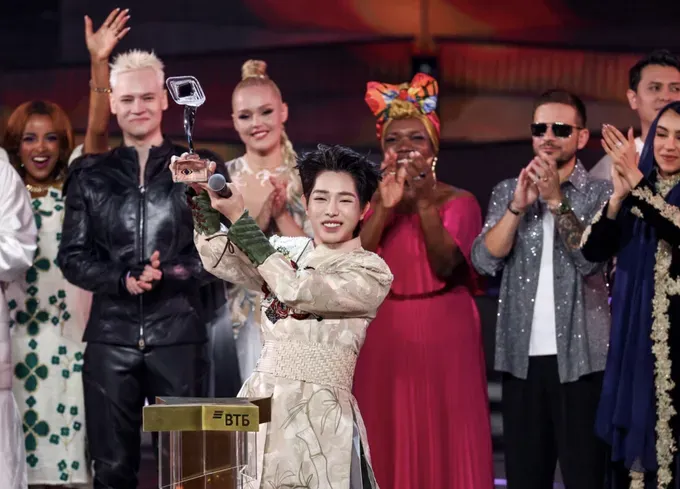
Singer Duc Phuc recalled the surge of emotion he felt when he was crowned champion on the stage of Intervision 2025, a moment he described as both overwhelming and profoundly affirming.
“In that moment, two words surfaced with striking clarity in my heart: ‘homeland’ and ‘Vietnam,’” he said.
It was not only Duc Phuc who felt the weight of the moment. Even now, many viewers have yet to forget the instant when the proud refrain of "Phu Dong Thien Vuong" resounded across the Grand Final of Intervision 2025, held in Russia on the evening of September 20. The performance propelled him past Nomad Trio of Kyrgyzstan and Qatar’s Dana Al Meer to secure the championship title.
Launched in 1965, Intervision has long been regarded as a prestigious international music platform. The 2025 edition brought together standout vocalists from 23 countries. Duc Phuc’s triumph marks the most significant international victory for a Vietnamese singer since 1981, when Ai Van claimed the top prize at the International Music Festival in Dresden, Germany, with “Bai ca xay dung” (Construction song).
Prime Minister Pham Minh Chinh commended Duc Phuc’s achievement, emphasizing that the victory helps affirm the rising stature of contemporary Vietnamese music on the global stage while projecting the nation’s cultural values and spirit to the world. The Prime Minister expressed confidence that Vietnamese artists will continue to harness their talent and creativity to further promote the image of Vietnam and its people internationally.
"Phu Dong Thien Vuong", composed by musician Ho Hoai Anh, draws inspiration from the poem "Tre Viet Nam" (Vietnamese bamboo) by poet Nguyen Duy. Distinguished by its inventive arrangement, the work fuses traditional folk elements with contemporary rap, conveying a message of resilience and national pride. From its musical composition to the distinctly Vietnamese motifs showcased on stage, the performance offered international audiences a vivid cultural introduction to Vietnam. The act was widely covered and praised by leading global media outlets.
At the moment of his coronation, Duc Phuc affirmed that it is the love for his homeland and country that has become his greatest source of spiritual strength.
Also in 2025, prominent artists including Ha Anh Tuan, Tung Duong, My Linh, Phuong My Chi, Hoa Minzy, and Vu continued to captivate audiences nationwide.
On November 7, Tatler Asia announced its Tatler Most Influential 2025 list, honoring exceptional figures who are driving change and inspiring communities across Asia. Among those recognized was Phuong My Chi, the only Gen Z artist from Vietnam to make the list.
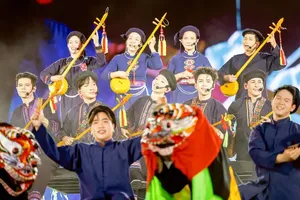
A defining highlight of her year was a top 3 finish at Sing! Asia 2025 is an international music competition that brings together standout performers from across the region. Throughout the contest, Phuong My Chi distinguished herself by reimagining traditional Vietnamese art forms, including cai luong (Southern reformed opera), ca tru (ceremonial singing), quan ho folk singing from Bac Ninh, and hat boi (Vietnamese classical opera), and blending them with contemporary genres. Her performances incorporated traditional instruments such as the dan nhi (two-string fiddle) and the Sona horn, seamlessly fused with modern elements including rap and EDM.
In the finale, performing the song “Chopsticks,” she sang in five languages, including Vietnamese, Chinese, Thai, Japanese, and English, in a gesture that underscored cultural convergence. Grounded in traditional textures yet shaped by a contemporary Disney-pop sensibility, the arrangement resonated with international audiences while preserving a distinctly Vietnamese identity.
The song “Bac Bling” by Hoa Minzy, created in collaboration with comedian Xuan Hinh, Tuan Cry, and producer Masew, blends traditional folk elements with electronic music, generating global buzz and amassing more than 281 million views to date.
The music video showcases a range of iconic landmarks and historical-cultural sites while highlighting distinctive aspects of Vietnamese heritage, from communal house festivals to the once-prevalent custom of blackened teeth and the ritual of betel chewing. Notably, the MV has repeatedly secured international accolades, including the No. 1 spot for Best Debut MV and Best Debut Song. A wave of short-form videos inspired by the track’s dance and sing-along trend has proliferated across social media platforms, drawing participation from audiences in multiple countries.
Vietnamese artists are increasingly asserting their stature and talent, demonstrating the capacity to pursue long-term strategies that bring Vietnamese music onto the global stage. The journey is far from straightforward, but with a new generation of performers willing to think ambitiously, act decisively, and step beyond their comfort zones, the prospect of elevating Vietnam’s musical standing internationally appears more tangible than ever.