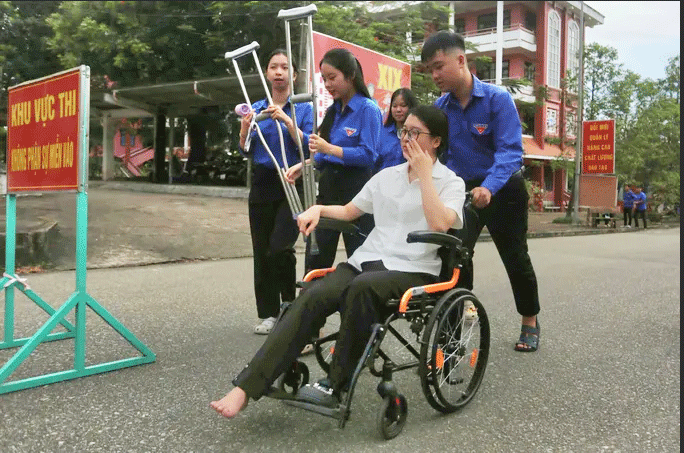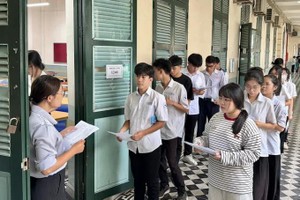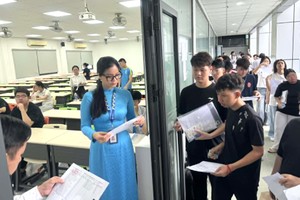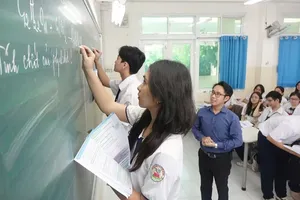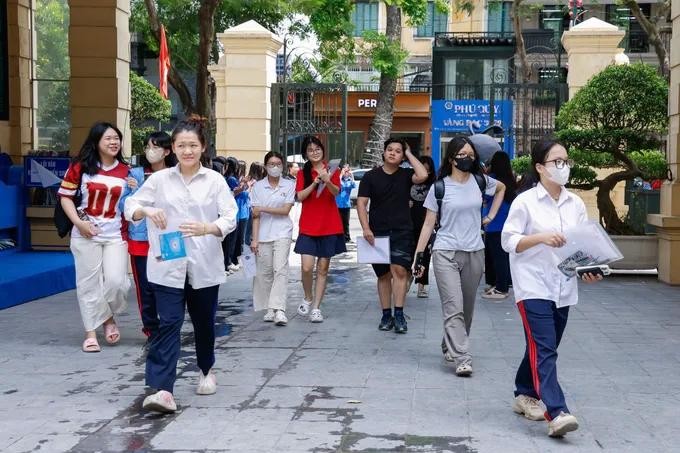
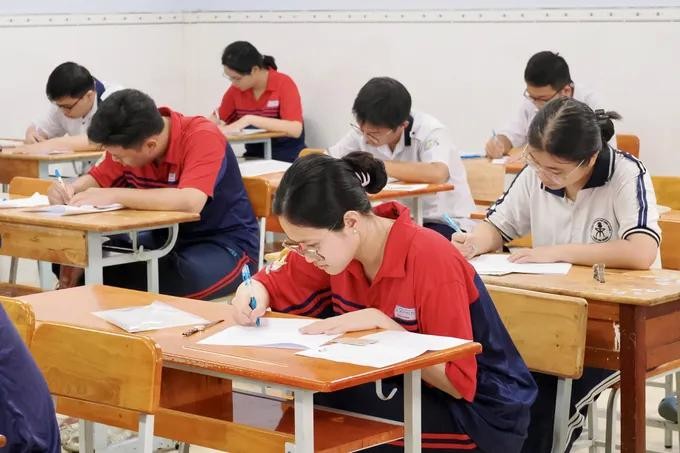
On the morning of June 11, candidates sat for the first day of the 2026 high school graduation exam in the Literature subject, with a duration of 120 minutes. They received the test papers at 7:30 a.m. and began working at 7:35 a.m. In the afternoon, they continued with the Mathematics exam, which lasted 90 minutes.
According to the examination regulations, candidates arriving more than 15 minutes after the official start signal are not permitted to take that session.
Previously, on the afternoon of June 10, the exam procedure session was conducted safely, in an orderly and serious manner, in full compliance with regulations. Weather conditions and traffic were generally favorable, enabling candidates to arrive at exam sites to complete procedures. A total of 1,208,968 candidates completed the exam registration procedures, accounting for 98.79 percent.

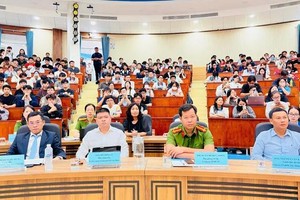
Responding to the press on this year’s examination, Minister of Education and Training Hoang Minh Son stated that regarding the marking process, there are basically no major changes this year, and the Ministry has issued detailed guidance and instructions. For multiple-choice subjects, marking will be conducted in the same manner as in previous years.
As for Literature, the only essay-based subject, particular emphasis is placed on the marking process. Given its characteristics, assessment inevitably involves qualitative factors. Therefore, the Ministry has directed thorough training for marking teams and required marking boards to conduct joint marking sessions, and carefully discuss the answer keys and marking guidelines to ensure consistency within each board as well as nationwide.
The Minister specifically emphasized that the leakage of exam papers is an extremely serious issue. The high school graduation exam papers and answer keys, before their official disclosure, are classified as state secrets at the “Top Secret” level. Any disclosure of exam content constitutes a criminal violation.

The Minister also noted that the reliability of the exam has been increasingly affirmed, making it an important basis for higher education institutions in their admission process. In particular, 2026 marks the first year of implementing Decree No. 179/2026/ND-CP, which sets out scholarship policies for students in basic sciences, key engineering fields, and strategic technology disciplines. Scholarship eligibility will be based on results from the high school graduation exam in Mathematics, Physics, Chemistry, Biology, and English.
In addition, the Ministry of Education and Training has approved 90 talent training programs in the fields of basic sciences, engineering, and technology. These programs will apply higher admission standards, in which results from foundational subject examinations serve as an important criterion from the outset. Accordingly, high school graduation exam results are expected to play an increasingly significant role in selecting and training human resources for STEM disciplines as well as strategic technology sectors essential to national development.
More than 6,000 officials assigned to supervise, monitor the examination
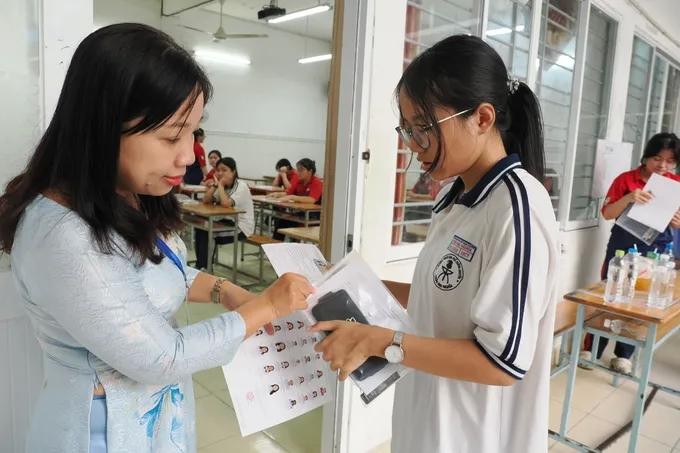
On June 10, more than 6,000 lecturers and officials from higher education institutions nationwide were present at 35 examination councils across the country to begin supporting the 2026 high school graduation exam.
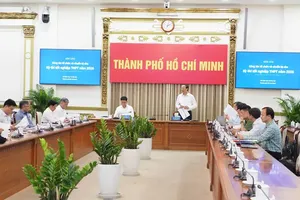
Under the assignment of the Ministry of Education and Training, Ho Chi Minh City University of Technology and Engineering established a working delegation of 81 members to inspect exam supervision at the Ho Chi Minh City Examination Council. The delegation was assigned to inspect 33 exam sites located in communes and wards across Ho Chi Minh City.
Ho Chi Minh City University of Law deployed 35 leaders, lecturers, and staff to perform duties in Khanh Hoa Province and was appointed by the Ministry of Education and Training as the head of the inspection team, coordinating with Da Lat University, Ho Chi Minh City University of Transport, Phan Thiet University, and Eastern International University to supervise exam proctoring in the locality.
Meanwhile, Ho Chi Minh City University of Finance and Marketing was assigned by the Ministry of Education and Training to support the exam in Vinh Long Province. The university’s inspection team for exam supervision consists of 61 members. Nguyen Tat Thanh University dispatched 44 officials, lecturers, and staff to inspect exam supervision at 20 exam sites across 51 communes and wards in Dong Nai City.
Given the importance of the examination and the largest number of candidates to date, the Ministry of Education and Training has established 34 inspection teams for exam supervision and 34 inspection teams for marking, along with additional delegations from ministry leaders, departments, and agencies directly overseeing the exam at local levels. Notably, the Ministry encourages localities to use handheld security devices to promptly detect and prevent the bringing of mobile phones or high-tech devices into examination rooms.
On the afternoon of June 10, Minister of Education and Training Hoang Minh Son inspected the exam site at Nguyen Du–Thanh Oai High School in Hanoi and encouraged candidates ahead of the examination. The Minister reminded candidates to carefully study the exam regulations; prepare all required documents and permitted items for the examination room; and, at the same time, maintain good health, stay calm and confident, and arrive at the exam site on time in order to achieve the best possible results.
He emphasized that the high school graduation exam is of special importance, serving not only as the basis for recognition of high school graduation but also as an important input for university and college admissions. According to Director-General of the Quality Management Department under the Ministry of Education and Training, Huynh Van Chuong, this year’s exam has 1,223,776 registered candidates, an increase of 61,642 compared to last year. Nationwide, there are nearly 50,000 exam rooms. The sample tests and exam structure have been published since October 2023 and have remained stable to date.
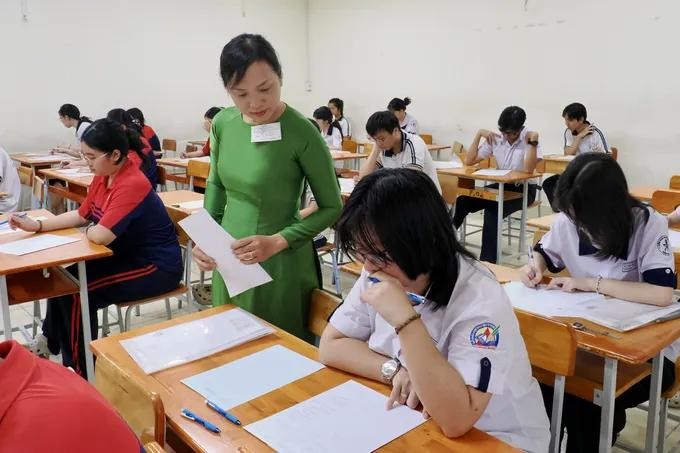
Following the merger of provincial-level administrative units, the number of candidates in many localities has increased significantly: Ho Chi Minh City has nearly 143,000 candidates, up more than 50 percent compared to 2025; Ninh Binh is expected to have around 50,000 candidates, roughly four times higher than in 2025. This places greater demands on management and administration, requiring tighter control. Risks of cheating involving high-tech devices and artificial intelligence applications also remain a matter of special concern.