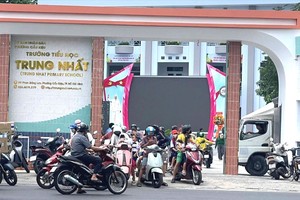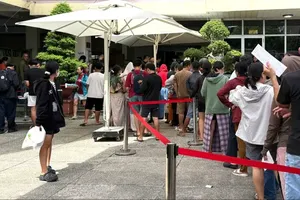
Statistics from the HCMC Department of Education and Training reveal that after a year of rearranging administrative units, HCMC has become the locality with the largest educational scale nationwide. The total number of students across all educational levels stands at 2,524,780
- kindergarten: 469,846 children,
- primary school: 951,312 pupils,
- junior high school: 762,088 students,
- senior high school: 341,534 students.
Head Tran Khac Huy of the Planning and Finance Division under the HCMC Department of Education and Training stated that based on the goal of 300 classrooms per 10,000 school-age residents, the city is grappling with a challenging puzzle regarding physical infrastructure. The 2026-2030 period faces a deficit of 4,669 classrooms compared to actual demand. Notably, 42 key wards and communes bear the brunt of localized overcrowding, where the lack of classrooms stretches across three distinct educational levels.
Phu Loi Ward has a population exceeding 107,000 people, bordering massive industrial parks. This mechanical population boom creates immense pressure on schooling, severely exacerbating the classroom shortage. For instance, Phu Loi Primary School accommodates 1,200 students; but lacking classrooms, it repurposed functional rooms into makeshift classes and organized lunch into three shifts, cutting students’ resting time.
Similarly, Trung My Tay Ward lacks 192 classrooms, Tam Binh 186, Phu Tho Hoa 175, Thoi An 132, An Phu Dong 129, An Phu and Tan Khanh 144, and Di An 122.
To definitively solve the educational supply and demand puzzle, the HCMC Digital Transformation Center has collaborated with the HCMC Department of Education and Training and relevant agencies to deploy digital mapping technology (GIS) and data-driven analytical methods. This aims to tackle the planning and development of the school network within the HCMC megacity area via the Digital Citizen application platform.
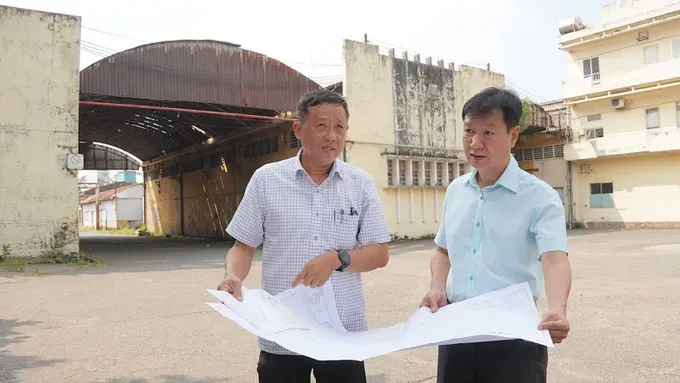
According to Deputy Director Nguyen Tran Phu Thinh of the HCMC Digital Transformation Center, once data sources have been thoroughly integrated and interconnected, each data type plays its own distinct role while closely complementing the others throughout the decision making process.
Specifically, planning data from the HCMC Department of Planning and Architecture helps explicitly identify land plots with suitable functions and development orientations to accommodate schools, guaranteeing strict compliance with overarching urban planning.
Building upon that foundation, land data allows planners to swiftly ascertain current land use status, ownership, and legal standing, thereby shortening the project preparation timeline. Simultaneously, it supports calculating land recovery and compensation schemes at an appropriate unit price.
For Vice Chairman Nguyen Trung Thanh of the Tan Son Ward People’s Committee, the impact is undeniable. “Relying on the digital mapping technology application, Tan Son Ward combined planning, land, residential, and educational data on a unified digital platform. Consequently, this facilitated smooth routing of entry level students and trimmed down the investment preparation process for new classrooms”, shared the Vice Chairman.
Meanwhile, demographic data provided by the HCMC Public Security Department, particularly distribution by age, population density, and spatial population fluctuations, help accurately forecast student demand in each specific area and phase. This forms a crucial basis for avoiding scattered or unsynchronized investments that often result in some places lacking classrooms while others suffer from excess capacity.
Complementing these very factors, the education sector’s data, such as school scale, area standards, organizational models, and educational development orientations, will assist in pinpointing the most suitable school type, whether it’s public, non-public, inter-level, or specialized, ultimately ensuring it meets the citizens’ actual needs.
“Particularly, when data is standardized and routinely updated, the system will promptly reflect highly dynamic shifts like the emergence of new residential areas, planning modifications, or mechanical population surges,” emphasized Deputy Director Nguyen Tran Phu Thinh. “At the end of the day, this empowers the education sector and related agencies to proactively adjust investment blueprints and allocate resources reasonably, rather than passively dealing with the fallout once overcrowding has already struck.”