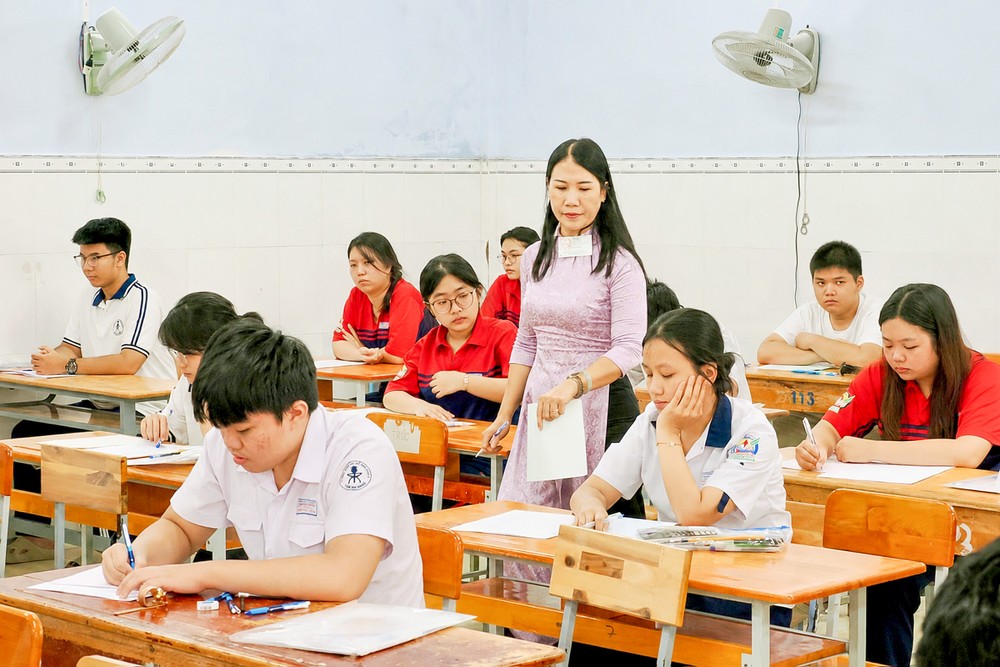
On June 11, students nationwide completed their Literature and Mathematics exams as part of the 2026 high school graduation examination.
Literature exam topic has sparked considerable debate on social media platforms
The Literature exam consists of two parts including Reading Comprehension (4 points) and Writing (6 points). The Reading Comprehension section provides material about the invention of the printing press in 1440, excerpted from the work Code va Cat - Nhung quyen luc cong nghe xoay chuyen the gioi (Code and Sand – Technological powers that change the world) asking students about the relationship between thesis and arguments, and how artificial intelligence (AI) should be used to create intellectual synergy.
In the Writing section, the social argumentative essay mentions Steve Jobs, Mark Zuckerberg, and Elon Musk with technological inventions that contributed to changing the world. Candidates must write a paragraph answering the question: “How can Vietnam have its own Steve Jobs?”
The literary argumentative essay provides the poem Nhung chiec la (The leaves ) by Nguyen Dinh Thi and requires students to produce an analysis of about 600 words.
The literature exam topic has sparked considerable debate on social media platforms. Some argued that it was particularly challenging for students from rural and mountainous areas, who may have had limited exposure to technology and artificial intelligence.
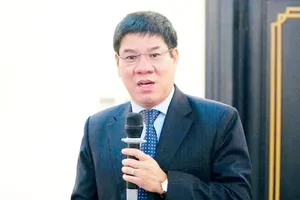
“Should a national high school graduation exam assume that all students know who Steve Jobs, Mark Zuckerberg, and Elon Musk are? Are students in remote and disadvantaged areas, with less exposure to global technology trends, placed at a disadvantage?” asked Hoang Ngoc Vinh, former Director General of the Department of Professional Education under the Ministry of Education and Training.
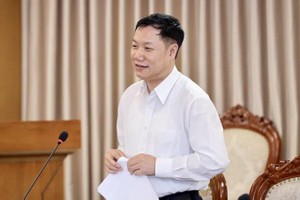
Others, however, contended that the exam encouraged rather than restricted students’ creativity. According to Prof. Le Anh Vinh, Director General of the Vietnam Institute of Educational Sciences, both the reading comprehension text and the poem Nhung chiec la (The leaves) were well-chosen. Students could interpret and respond to the materials based on their own level of understanding and personal reflection.
“In literature, that can sometimes be the best approach, as it allows students to demonstrate their genuine abilities rather than simply reproducing memorized knowledge,” he said.
The inclusion of figures such as Steve Jobs, Mark Zuckerberg, and Elon Musk, along with the prompt asking students to reflect on “how Vietnam can produce its own Steve Jobs,” was also viewed positively by many educators.
The question raises a broader issue: How can Vietnam nurture creative individuals capable of generating innovations with global impact? It is a thought-provoking topic that encourages students to consider the roles of education, the social environment, public policy, and a culture that fosters creativity and innovation.
Many teachers praised the exam for its high practical relevance and ability to differentiate student capabilities. They noted that the contemporary focus on AI and innovation aligns with Vietnam’s current digital transformation era.
Meanwhile, the inclusion of global tech icons sparked discussion on equity. Critics, such as Dr. Hoang Ngoc Vinh, questioned whether the exam disadvantaged students from rural or mountainous areas with less access to global technological discourse. Conversely, Prof. Le Anh Vinh argued that the exam’s design allowed students to showcase genuine analytical skills rather than rote memorization, though he acknowledged that phrasing the prompt more universally focusing on "creative individuals" rather than specific names might have been more inclusive.
Mathematics teachers predict score distribution would peak at around 6 points
The Mathematics exam, held in the afternoon, was generally perceived as more accessible than in previous years, leading to predictions of high scores.
Students noted that the exam was straightforward, with the exception of two complex probability questions that required significant reasoning. Many students expressed confidence in achieving scores between 8 and 9.
Lecturer Bui Ngoc Mai at the British University Vietnam observed that the 2026 exam reflects a clear shift from testing mere knowledge to evaluating competency. By incorporating real-world scenarios such as solar energy storage and agricultural revenue optimization, the exam required students to synthesize information rather than simply perform calculations.
While the technical difficulty remains comparable to 2025, the increased demand for logical reasoning and situational understanding may slightly reduce the number of high-scorers (8+). Experts predict a more distinct distribution of scores, with the peak of the grading curve expected to fall around 6 points, aligning the exam more closely with university-level assessment standards.