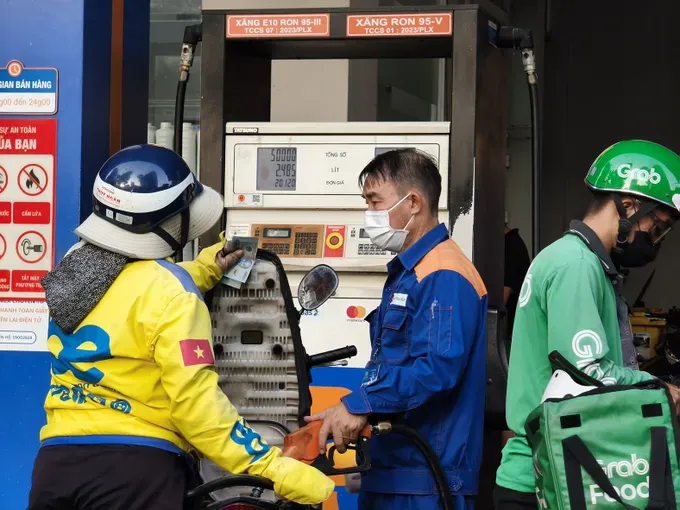
Records from late December show that E10 biofuel sales points have covered many areas. PetroVietnam Oil Corporation (PVOIL) stated that the enterprise deployed E10 business from August 1, 2025.
To date, over 50 stores in the system across the cities and provinces of Hanoi, Hai Phong, Ninh Binh, Thanh Hoa, Da Nang, Quang Ngai, and HCMC are selling E10, with an average consumption volume of about 1,000m3 per month. From January 1, 2026, PVOIL will continue to expand to many other localities nationwide, demonstrating its determination to pursue the biofuel roadmap.
Similarly, Petrolimex is piloting E10 RON95-III business at 40 stores in HCMC and Quang Ngai Province. Consumption volume at these points has gradually increased compared to the initial phase. Customers are primarily administrative agencies using state budgets, transport companies, tech taxis, and service vehicles. In many localities, E10 consumption has increased by about 12-18 percent compared to the start of the pilot, indicating a positive shift in market consumption.
However, when placed beside traditional mineral gasoline, E10 consumption proportion remains quite modest. According to surveys at some Petrolimex stores in HCMC, E10 consumption accounts for only about 10 percent of daily gasoline sales. Phuong Thy Lan, an office worker in Xuan Hoa Ward of HCMC, said she tried using E10 but later switched back to mineral gasoline because she was not yet completely assured.
From a retailer’s perspective, the biggest worry remains the economic equation. Because ethanol is volatile and absorbs moisture in hot and humid conditions, E10 can suffer a loss (shrinkage) of 0.25-0.4 percent per cubic meter per month, while current norms have not been updated for this fuel type. Losses exceeding the norm are not counted as valid costs, nor are they price-compensated or tax-deductible, so businesses must bear the burden and account it directly into the cost of goods sold, meaning a direct loss.
Director Nguyen Xuan Thang of Hai Au Phat Petroleum Co. Ltd. (sited in Lam Dong Province) argued that for businesses to feel secure selling E10, profit margins need to reach 7 percent or higher to cover costs and losses. Simultaneously, retail commissions must be around VND1,400-1,600 (US$0.06) per liter for stores to be profitable and bold enough to expand sales.
Additionally, Giang Chan Tay, Director of Boi Ngoc One-member Co. Ltd., specializing in petroleum trading, cited lessons from E5 biofuel showing that citizens do not oppose biofuel, but they need transparent information regarding benefits, safety, and engine compatibility.
For E10 to go the long haul, barriers must be removed at the root, including unifying technical recommendations, clearly publishing compatible vehicle types, and releasing independent test results. Parallel to this is persuasive communication providing scientific, easy-to-understand information to users.
“Besides general incentive policies, the State needs to soon build specific loss norms for E10, as well as adjust the price mechanism to reflect actual costs. When businesses do not have to bear major risks regarding shrinkage, they will have enough motivation to participate deeply in the distribution network, thereby helping biofuel increase coverage and become more accessible to consumers,” Director Giang Chan Tay recommended.
Although there is still a gap compared to expectations, reality shows the market is welcoming E10 through increased geographical coverage, gradually ticking up volumes in some localities, and the formation of early adopter groups.
However, to cross the market’s “psychological threshold,” there needs to be multiple waves of data-driven communication and persuasive explanations, accompanied by reasonable economic mechanisms for both businesses and consumers.
Roadmap to June 2026
According to Circular No.50/2025/TT-BCT of the Ministry of Industry and Trade:
- From June 1, 2026: Vietnam will widely apply biofuel. Unleaded gasoline (per current national technical standards) must be blended into E10 gasoline for use in gasoline engines nationwide.
- Until December 31, 2030: Continued blending and dispensing of E5RON92 gasoline for use in gasoline engines.
To prepare for this roadmap, Dung Quat Oil Refinery has proactively upgraded its blending system, aiming to be ready to supply 100 percent E10 to the market from June 1, 2026. Currently, the factory mainly produces RON95 (accounting for 83 percent) and RON92 (17 percent) and has begun piloting biofuel blending to ensure a smooth transition.
Simultaneously, Dung Quat Biofuel Plant is preparing to restart in late January 2026 to produce ethanol (E100), meeting E10 blending demands with a maximum capacity of about 300,000m3 per month, creating a stable supply for the market when the roadmap is officially deployed.