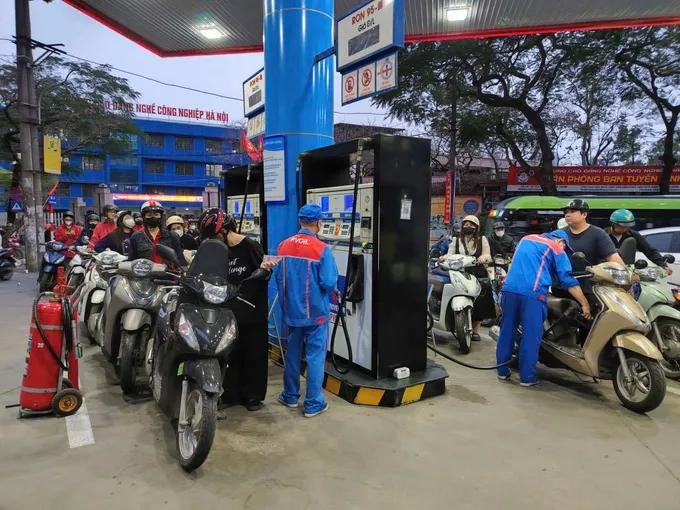
Today, in response to mounting difficulties in the supply of gasoline and diesel caused by instability in the Middle East, the Hanoi People’s Committee issued an official directive to departments, agencies, commune and ward People’s Committees, as well as gasoline and diesel businesses. The document emphasizes the continued assurance of fuel supply across the city and outlines several urgent tasks to be implemented.
Under this directive, the Hanoi People’s Committee has tasked the Department of Industry and Trade with proactively developing and executing solutions to guarantee fuel availability and stabilize the local market. At the same time, the Hanoi Market Surveillance Department has been instructed to intensify inspections and monitoring of gasoline and diesel business activities, ensuring that violations are promptly detected and strictly handled in accordance with regulations.
Functional forces have been directed to concentrate efforts on controlling and addressing behaviors that threaten market stability. These include acts of hoarding fuel, deliberately creating artificial shortages, unreasonably reducing discounts, or failing to supply adequate quantities of gasoline and diesel to retail stations. Such practices, the directive warns, contribute to instability in the market and disrupt the city’s efforts to maintain a steady supply for residents and businesses.
In addition, the Department of Construction has been assigned a critical role in monitoring and managing the impact of fuel price fluctuations on the broader economy. The department is tasked with regularly updating and publishing construction material prices in Hanoi, while simultaneously researching solutions to stabilize costs. It must closely track changes in gasoline and diesel prices and provide timely advice on issuing updated price lists for construction materials. Furthermore, the department is expected to guide investors in adjusting contracts when necessary, ensuring that construction projects can continue on schedule despite rising fuel costs.
The Department of Finance, in coordination with the Department of Industry and Trade, will research and propose support mechanisms for public utility service enterprises significantly affected by rising gasoline and diesel prices, such as Hanoi Transport Corporation, Hanoi Urban Environment Company, Hanoi Drainage Company, Hanoi Green Parks Company, and irrigation companies.
People's committees of communes and wards are responsible for coordinating with market management forces to monitor the developments in the gasoline and diesel market in their respective areas. Strengthen inspections and address the issue of unauthorized gasoline and diesel sales on roads, preventing illegal business activities that disrupt public order and safety and pose a potential fire and explosion risk.
Gasoline and diesel businesses in the area are required to ensure a sufficient and continuous supply to the distribution system and prevent supply chain disruptions at retail outlets. At the same time, retail gasoline and diesel outlets must strictly comply with regulations on measurement and quality of gasoline and diesel; display and sell at the listed prices; open for business during registered hours; and not hoard goods or sell in moderation, waiting for price increases, contributing to market stability and ensuring production and business activities in the capital city.
According to figures released by the Department of Industry and Trade, Hanoi currently has 453 gasoline and diesel business locations operating across the city. As of March 9, only a small fraction of these outlets had encountered disruptions: 14 gas stations temporarily ceased sales, while 7 others limited their supply. The department emphasized that despite these isolated cases, the overall fuel distribution system in the capital remains stable, with the majority of stations continuing to provide uninterrupted service to meet public demand.