On the morning of March 10, the General Department of Vietnam Customs under the Ministry of Finance announced that it had issued Official Dispatch No. 13573/CHQ-DTCBL, calling for stronger control measures to prevent and combat the smuggling and illegal transportation of petroleum products across national borders, as the regional energy market continues to experience significant fluctuations.
According to the customs authority, the international political and security situation has recently become increasingly complex, particularly with the escalation of conflicts in the Middle East. These developments have had notable impacts on the global energy market, affecting fuel supply, price stability, and energy security.
Notably, retail fuel prices in Vietnam are currently lower than those in several neighboring countries sharing land borders. As of March 9, the price of RON 95 gasoline in Vietnam was listed at VND27,047 per liter, compared with around VND31,000 per liter in Cambodia and approximately VND39,000 per liter in Laos.
This price disparity has led to a situation in which residents in the border areas of Laos and Cambodia cross into Vietnam to purchase fuel.
To proactively prevent potential violations, the Department of Customs has instructed the Anti-smuggling Investigation Department and regional customs branches to resolutely implement a range of strengthened control and monitoring measures.
First and foremost, relevant units are required to closely monitor market developments, including supply–demand dynamics and retail fuel prices, with particular attention to price differences between Vietnam and neighboring countries sharing land borders. On that basis, they are tasked with proactively conducting forecasts and assessments to promptly identify potential risks of fuel smuggling and illegal transportation, thereby formulating preventive measures at an early stage and from afar.
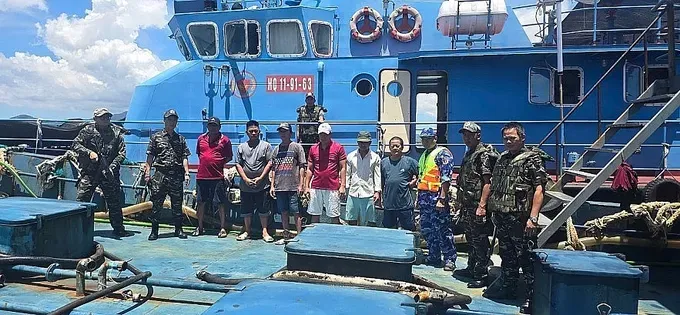
Additionally, the customs force must synchronously employ professional enforcement measures while intensifying patrols, inspections, investigations, and enforcement operations to curb fuel smuggling and illegal transportation along border routes. Particular focus will be placed on inland waterways and land border gates adjoining Laos and Cambodia, as well as maritime areas under Vietnam’s jurisdiction.
The Department of Customs has also called for more targeted inspections and controls of outbound vehicles, including those operating on roads, inland waterways, and maritime routes. Particular attention should be paid to vehicles equipped with tanks, reservoirs, reinforced compartments or holds capable of storing fuel, as well as cases in which fuel supply activities for seagoing vessels or temporary import for re-export are exploited to smuggle or illegally transport petroleum products across borders.
In addition, customs units are required to strengthen information exchange, coordination, and intelligence sharing on smuggling activities along border routes and at sea with other competent forces, thereby improving the effectiveness of detecting and preventing violations.
Alongside enforcement efforts, the customs authority also emphasized the need to enhance propaganda and guidance for enterprises to strictly comply with legal regulations governing the export, import, transit, and temporary import for re-export of petroleum products. This approach is intended to reinforce corporate responsibility in ensuring adequate supply, contributing to market stabilization, and safeguarding national energy security.