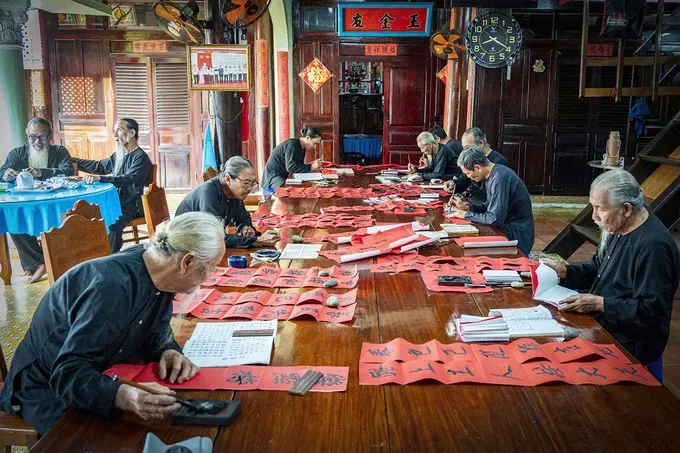
When the old Ochna trees in the garden begin to scatter their blooms, the village elders and officials at Long Son Big House (also known as the Temple of Sir Tran in Long Son Commune of HCMC) busy themselves smoothing “do” paper (a traditional Vietnamese handmade paper crafted from the inner bark of the poonah tree) and weighing ink sticks, preparing to write “Lien” (banners of couplets) to welcome the upcoming spring.
According to Le Thi Kiem (affectionately known as Auntie Ba Kiem), a member of the Long Son Big House management board, the tradition of writing “Lien” dates back to when Sir Tran (real name Le Van Muu) first cultivated the land of Long Son around 1900.
Sir Tran was a master of agriculture, a skilled organizer capable of rallying the people, and a man of great benevolence, integrity, and courage. His lifestyle served as an example for those who followed him to build a new life. Consequently, his teachings were voluntarily practiced and passed down from one generation to the next as a beautiful cultural tradition.
After Sir Tran passed away, his descendants and the local people maintained these old customs. Today, Long Son Big House is one of the rare places in Vietnam that still preserves the custom of writing “Lien” to welcome spring.
75-year-old Le Van Mai, the 4th-generation descendant of Sir Tran, shared that every time the lunar year ends and Tet arrives, Long Son Big House organizes the writing and pasting of nearly 200 square banners, over 60 horizontal banners, and about 300 pairs of long couplets.
“Calligraphy master” Le Van Mai explained that the paper used must be “do” paper. Most couplets are written with thick, black Chinese ink. At Long Son Big House, the couplets are penned by the masters in Chinese characters using the Kaishu (Regular Script) style, which is upright, standard, and neat. This lettering style features exquisite strokes that embody a distinctly Vietnamese calligraphic flair.
Le Van Mai noted that the main content of these banners consists of teachings from ancestors to descendants regarding conduct, treating others with humanity, and preserving righteousness. Although these banners are pasted in many locations such as house entrances, temples, streets, and markets, each location requires a different type of banner, varying in form, content, and even the method of pasting.
In the rear house of Long Son Big House, a pair of couplets reads: “Thien tang tue nguyet nhon tang tho – Xuan man can khon phuoc man duong” (Heaven gains years of age, people gain longevity – Spring fills the universe, blessings fill the home).
Meanwhile, in the main area of Long Son Big House, the two couplet pairs read “Thien huu tu thoi xuan tai thu – Nhon sanh ba hanh hieu duy tien” (Heaven and Earth have four seasons, Spring is the first – Life has hundreds of virtues, Filial Piety must be placed first), and “Tu thoi hoa khi xuan thuong tai – Nhat that an cu khanh huu du” (A year has harmonious air as spring is always present – A house living in peace has great prosperity).
For banners pasted in the market, the form and content depend on the specific goods being sold. For example, at the market gate, they often paste: “Dong tay nam bac tai nguyen tuu – Xuan ha thu dong loi duong thong” (East, West, South, North, resources gather here – Spring, Summer, Autumn, Winter, profits flow smoothly).
Amidst the flow of modern life, the custom of writing spring couplet banners in Long Son Commune persists as a testament to the enduring vitality of traditional culture. These red couplets possess not only aesthetic value but also serve as reminders of moral principles, contributing to the enrichment of spiritual life and embellishing the beauty of the traditional Vietnamese Tet.
“Lien” is derived from the Sino-Vietnamese word “lien” without the tone. Vietnamese people pronounce it as “Lien” with the fifth tine, referring to parallel rhythmic structures, often called “red couplets” in folk culture. These are two parallel lines that correspond to each other word for word, character for character, yet the meanings must be interconnected; the rhyme and tone when recited must be harmonious and attuned, like the changing of seasons during Tet.