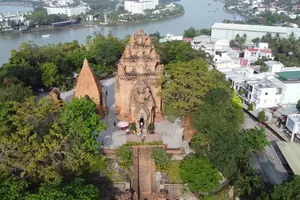
Perched on Trau Hill in the heart of former Phan Rang (now belongs to Khanh Hoa Province), the Po Klong Garai Tower stands majestically against the sun and wind. It’s widely considered one of the most incredibly intact Cham tower complexes remaining in Vietnam.
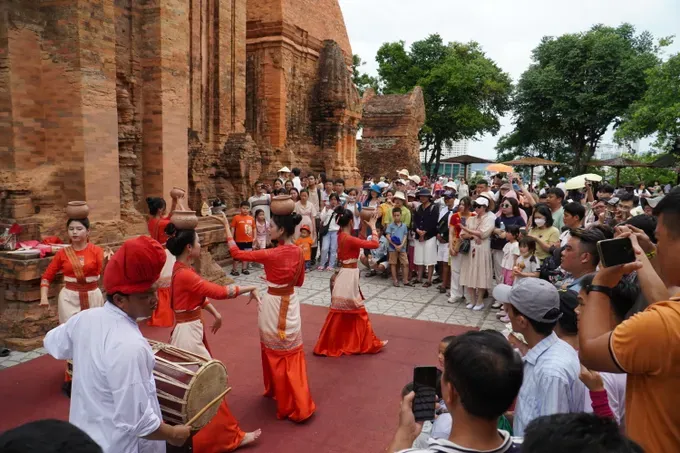
Constructed in the late 13th and early 14th centuries to rightfully worship King Po Klong Garai, this massive complex transforms into a bustling destination every Kate festival season. Resounding with the vibrant echoes of Ginang drums and Saranai trumpets, it passionately attracts thousands of Brahman Cham people gathering to perform sacred ceremonies. It’s precisely these solemn religious rituals, captivating folk dances, and vibrant brocade colors that have transformed this ancient architectural complex into a truly living heritage.
Not far away lies the Po Rome Tower, the final magnificent structure erected under the Panduranga Dynasty. Meanwhile, the Hoa Lai Tower is continuously evaluated by archaeological circles as one of the oldest existing monuments heavily bearing the classic Cham architectural style. Together with the renowned Ponagar Temple, the extensive Cham heritage system across Khanh Hoa brilliantly forms an attractive chain of destinations. This ultimately manages to simultaneously preserve local beliefs and successfully exploit cultural tourism.
Up in Lam Dong Province, the imprint of Cham culture undeniably presents itself in a somewhat different manner. Firmly situated on Ba Nai Hill directly overlooking the Phan Thiet sea, the Po Sah Inu Tower features a distinct Hoa Lai architectural style dating back to the late 8th and early 9th centuries. It remains a highly familiar stopover for countless wandering tourists.
Over recent years, local authorities have frequently organized vibrant Cham art performances to vividly recreate the traditional Kate festival, strategically incorporating this ancient relic into broader Mui Ne – Phan Thiet discovery tours for local tourism.
Pushing further north, the Po Dam Tower complex quietly nestled at the foot of Ong Xiem Mountain is widely considered one of the oldest ancient tower clusters in the South Central region. In Bac Binh Commune, Cham communities across Phan Hiep, Phan Hoa, and Binh Duc areas still strictly maintain numerous traditional customs and deep-rooted beliefs. This collective effort significantly contributes to continuously preserving the indigenous cultural space across multiple generations.
If the towering brick structures serve as the physical body, the local communities and traditional craft villages unquestionably represent the vibrant soul of Cham cultural heritage.
Down in Bau Truc pottery village, Cham women persistently knead clay and shape beautiful pottery entirely by hand. Carefully firing their rustic creations outdoors using straw and firewood, they strictly adhere to ancient methods. Without relying on automated production lines, each finalized product heavily bears the unique imprint of its dedicated artisan.
In 2022, the exquisite Cham pottery craft was officially inscribed by UNESCO onto the List of Intangible Cultural Heritage in Need of Urgent Safeguarding. This momentous event firmly affirmed the value of this traditional craft and opened fresh opportunities to globally promote the heritage, enthusiastically attract tourists, and vigorously develop community tourism.
For Head Dang Chi Quyet of the Community Tourism Board at Bau Truc pottery village, this model has proved extremely beneficial. He explained that it’s wonderfully preserving the ancient craft while forging a stable livelihood for local residents. Every year, Bau Truc supplies more than 17,000 distinct pottery pieces, reliably creating steady jobs for 500 laborers. Meanwhile, in Bac Binh Commune, the traditional Go pottery craft is gradually being restored for immersive cultural tourism.
Another completely fresh highlight is the brilliantly conceived Cham Royal Collection model in Lam Dong Province. It securely houses over 100 precious artifacts, including majestic crowns, royal robes, royal ordinations, ancient swords, and ornate jewelry, alongside numerous antiquities dating back nearly 400 years. Instead of just locking everything away in a dusty warehouse, this specific model openly allows intrigued tourists and dedicated researchers to directly access the fascinating history of the Champa dynasty, thereby heavily contributing to bringing the ancient heritage to life.
According to the Lam Dong Province Department of Culture, Sports and Tourism, numerous travel agencies are currently running test trials to seamlessly connect visits between the Po Sah Inu Tower, the Po Dam complex, the Cham Royal Collection, and the Go pottery village to flawlessly form a highly specialized thematic tour.
Similarly, the Khanh Hoa Province Department of Culture, Sports and Tourism is actively rolling out multiple rigorous projects to repair and beautifully embellish prominent Cham relics. They’re simultaneously building robust cultural tourism programs at both the Ponagar Temple and the Po Klong Garai Tower, tightly coupling this with massive support for developing traditional craft villages to perfectly preserve the heritage while reliably generating local employment.
As stated by industry experts, numerous attractive destinations across Khanh Hoa and Lam Dong provinces are still lacking truly in-depth experiential products. Furthermore, the local workforce possessing extensive knowledge of indigenous culture remains somewhat limited; and worst of all, the underlying infrastructure isn’t quite synchronized yet.
In the long run, local authorities desperately need to pay close attention to adequate investments to sustainably and effectively exploit the colossal Cham cultural treasure trove. By doing so, they’ll inevitably contribute to steadily boosting the overall income for these hardworking local communities.