Many thousand billion dong projects fall behind schedule
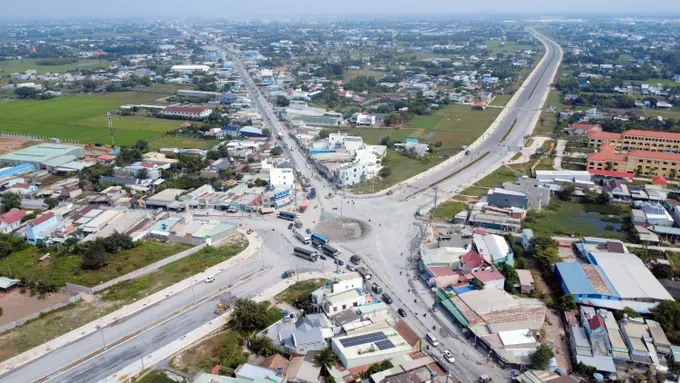
The Rach Soi–Ben Nhat and Go Quao–Vinh Thuan sections of the Ho Chi Minh Road construction project have a total length of 51.9 kilometers. The route passes through the communes of Chau Thanh, Go Quao, Vinh Tuy, and Vinh Phong in An Giang Province, as well as Vinh Loc A Commune in Ca Mau Province. The project broke ground in March 2024 and was initially scheduled for completion in 2025, before the timeline was revised to 2026.
However, the section running through An Giang Province is at risk of falling behind schedule due to site clearance issues. To date, local authorities have handed over 44 kilometers of cleared land out of a total of 45.2 kilometers, equivalent to 97.2 percent, leaving around 1.2 kilometers still unresolved. Specifically, outstanding clearance includes 0.2 kilometers in Chau Thanh Commune involving 14 households; 0.2 kilometers in Go Quao Commune affecting one household; 0.6 kilometers in Vinh Tuy Commune involving 12 households and three business establishments; and 0.1 kilometers in Vinh Phong Commune affecting four households. In addition, the project continues to face obstacles related to infrastructure relocation, including six power line sites, 0.1 kilometers of water pipelines yet to be relocated, and two resettlement areas where contractors have not yet been selected.
There is very little time left to carry out the remaining work, particularly given that the project runs through areas with weak soil conditions. If site clearance is not completed by January 2026, the project will not be able to meet its 2026 completion target,” stressed Mr. Vo Duy Hung, Head of Project Operations Division No. 2 at the Ho Chi Minh Road Project Management Board. In addition to site clearance bottlenecks, the project is currently facing difficulties related to the supply of construction materials.
Meanwhile, Giai Phong 9 Bridge in Rach Gia Ward, one of An Giang Province’s key infrastructure projects, is also experiencing delays, largely because more than 100 households and organizations have yet to dismantle structures and hand over land. The project has a contractual implementation period of 450 days starting from April 26, 2025, with a construction contract valued at over VND550 billion. To date, the completed work volume and cumulative disbursed value amount achieved VND139 billion (US$5.3 million), accounting for more than 60 percent of the allocated capital plan.
Another major project facing delays is Phase 2 of the upgrade and expansion of Provincial Road 948, developed by the An Giang Provincial Project Management Board. The project plays a critical role as a defense and security route in the border and ethnic minority areas, while also enhancing connectivity among tourist destinations, transport networks, and the movement of agricultural goods within An Giang Province. Stretching more than 18 kilometers, the project carries a total investment of over VND1.2 trillion (US$45.7 million) but has reached only 95 percent completion after more than four years of implementation. The primary reason for the delay is the unresolved clearance involving 32 households.
The project owner has transferred the case files to the An Giang Provincial Police to implement enforcement measures for site handover to the construction contractor. The project is now nearly a year behind schedule. If the remaining more than 600 meters of land can be cleared, the contractor would need only about two months to complete the entire route,” said Mr. Hua Van Tai, Head of Regional Project Management Board IV of An Giang Province.
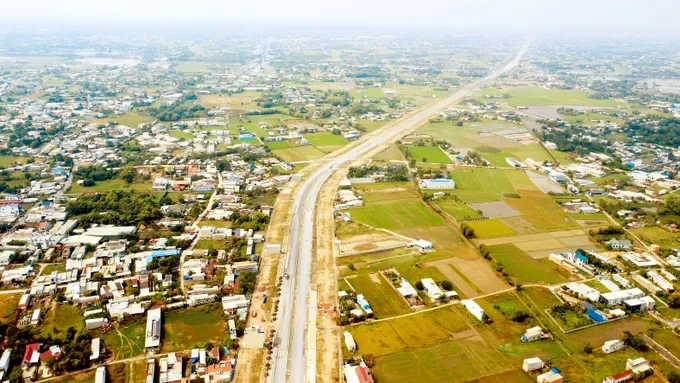
In Tay Ninh Province, the DT823D road project spans more than 14 kilometers and carries a total investment of over VND4.8 trillion (US$182.7 million), including VND3.745 trillion (US$142.5 million) for land clearance and VND1.105 trillion (US$42 million) for construction. Designed as a four-lane roadway, the route is intended to connect the Ho Chi Minh Road, National Highway N2, and key ring-road corridors around Ho Chi Minh City. The project broke ground in late 2021 and is scheduled for completion in 2025. However, to date, individual construction packages have reached only 60 to 80 percent of their planned progress.
Authorities have identified the primary causes of the delays as slow site handover, legal and procedural bottlenecks, and unfavorable weather conditions. In particular, shortages in construction materials, especially stone used for asphalt paving, have further hampered progress, putting the DT823D project behind schedule.
No avoidance or shifting of responsibility
Explaining why many projects have fallen behind schedule, thereby affecting the disbursement of public investment capital, leaders of An Giang and Tay Ninh provinces said that since July 1, 2025, the implementation of a two-tier local government model has required many project owners to undertake handover and reception procedures while simultaneously adjusting a range of project- and agency-related legal processes.
In addition, some project owners have failed to fully exercise the role and responsibility of their leadership, showing a lack of decisiveness in implementing public investment plans. Oversight and supervision have not been conducted regularly, with insufficient pressure placed on contractors to accelerate progress. Project owners have also been slow to proactively identify and resolve difficulties and bottlenecks. Coordination between project owners and local authorities in carrying out site clearance has remained weak and insufficiently forceful, while the handling of obstacles—particularly compensation procedures and the resolution of arising disputes and complaints—has been delayed.
In response to the situation, leaders of the Tay Ninh Provincial People’s Committee have instructed project owners, contractors, and relevant agencies to decisively resolve bottlenecks related to land clearance and construction materials, accelerate construction progress, and ensure the early completion of the DT823D project as well as other key developments in order to support local and regional socio-economic growth.
According to An Giang Provincial People’s Committee Chairman Ho Van Mung, the province has required all levels of government, agencies, localities, and especially heads of agencies to uphold a proactive and accountable approach, without reliance on others. Authorities have been told to strictly implement the Prime Minister’s “six-point clarity” principle, which calls for clarity in responsibility, tasks, timelines, accountability, deliverables, and authority. Project owners have been urged to promptly review each project, draw up detailed implementation plans, identify the causes of delays, and take immediate corrective action. They have also been warned against evading or shifting responsibility in inter-agency coordination.