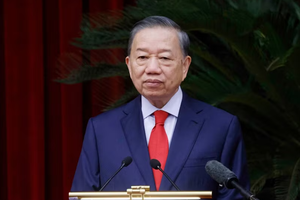
Prime Minister Le Minh Hung on October 12 asked the northern province of Hung Yen to tap its geo-economic position and regional links to become a modern industrial and services hub, with a civilised urban core, a strong marine economy and green, sustainable growth.
PM Le Minh Hung made the request in the province where its People’s Committee announced his decisions to establish the Hung Yen Hi-Tech Park, recognise Hung Yen as a tier-1 administrative unit and adjust its master plan for 2021-2030, with a vision to 2050.
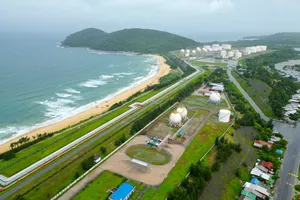
Spotlighting the province’s location, he said Hung Yen sits close to Hanoi and northern Vietnam’s major industrial and service hub while also having sea access, opening major opportunities in the marine economy, industry, energy and logistics.
A fast-improving network of inter-regional links, including the Hanoi-Hai Phong-Quang Ninh expressway, Ring Road No. 4 in the Hanoi Capital Region, the Ninh Binh-Hai Phong expressway and other strategic routes, speeds up connections among industrial parks, cities, seaports and major markets.
The province’s industrial base is relatively strong, anchored by the Pho Noi A, Thang Long II, Lien Ha Thai, Tien Hai and VSIP Thai Binh industrial parks, which support high-tech, supporting industry, processing, manufacturing and green sectors. It also has strengths in commercial and hi-tech farming, with a range of distinctive products. Above all, he said, its most fundamental and lasting advantage is its diligent, dynamic and creative people.
He told the province to organise development space in an integrated, polycentric and multipolar way that maximises each area’s distinctive and complementary strengths. He called for a shift from a management mindset to one that serves and enables development, and from a growth model reliant on capital, land, labour and existing advantages to one driven by science-technology, innovation, digital transformation and a skilled workforce.
People should be placed at the centre and serve as a driving force, with culture as its foundation and internal engine. Economic, social and environmental development should proceed in step with stronger national defence, security and external relations, he said.
On planning, he requested that it be conducted with an integrated, unified and long-term vision, aimed at creating a common development space following local administrative merger.
The province should quickly turn the master plan into specific schemes and projects, with clear priorities, roadmaps, resources, responsibilities, timelines and results. It must link development spaces, define the role of each area, centre and economic corridor, and avoid a scenario in which administrative boundaries are merged while development stays fragmented, he said.
He also called for greater transparency, digitalised planning data and stricter discipline and administrative order, while warning against term-based thinking, scattered investment and piecemeal revisions made to suit individual projects. Planning must lead and steer development, not follow projects or be altered merely to legitimise short-term interests.
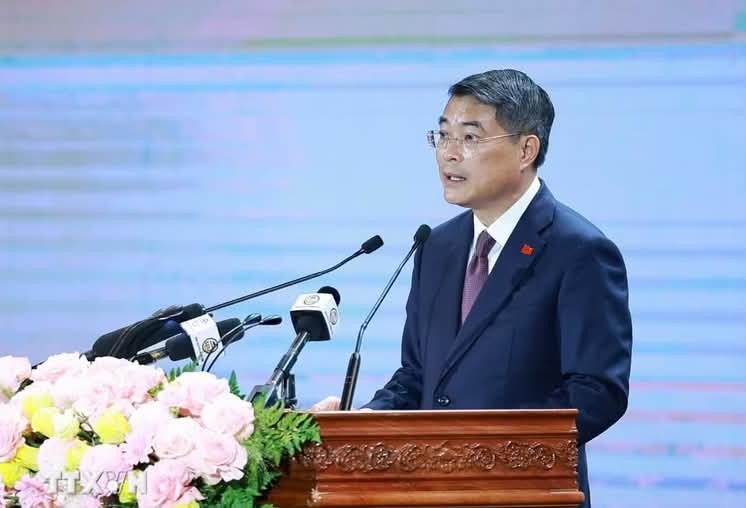
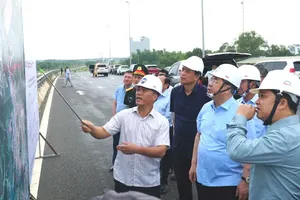
Hung Yen must focus on breakthroughs in strategic infrastructure and regional connectivity, linking industrial parks, economic zones, urban and production hubs and services with expressways, seaports and transport hubs. With limited resources, it should pick priority projects carefully and concentrate investment on those with strong spillover effects that clear bottlenecks, open new space and deliver broad-based impact, he said.
He added that the province must be selective in attracting FDI, using technological sophistication, added value, links with domestic firms and environmental protection as key criteria. Priority services include logistics, trade, industrial support, cultural and eco-tourism, marine economy, coastal industry and services tied to environment protection and national defence-security. It should also move from agricultural production to an agricultural economy, developing hi-tech and ecological farming, deep processing and brands to raise farmers’ incomes.
The province was urged to cut red tape substantially, overhaul its business climate and swiftly settle problems in land, investment, construction and site clearance.
On the goal of becoming a centrally-run city by 2030, it was assigned to review the relevant criteria, identify which it has met and which remain outstanding, and draw up specific roadmaps, tasks, schemes and projects.
The Cabinet leader urged domestic and foreign investors to view Hung Yen as an emerging development space directly linked to Hanoi, major industrial hubs and a promising sea-oriented economic zone.
The Government will keep working with localities and firms to improve mechanisms and business climate, protect the legitimate rights and interests of citizens, companies and investors, and unlock resources for development, he said.
Chairman of the provincial People’s Committee Nguyen Manh Quyen said the former Hung Yen and Thai Binh provinces have been merged in full, land and population, into the new Hung Yen province, following the Party Central Committee’s policy and the National Assembly’s 2025 resolution. The merged locality now covers 2,638 sq.km of land and 487 sq.km of sea, with more than 3.5 million people and 104 commune-level administrative units.
Japanese Ambassador Ito Naoki and representatives of domestic companies commented on the province's investment environment, cooperation opportunities and ways to support local development.
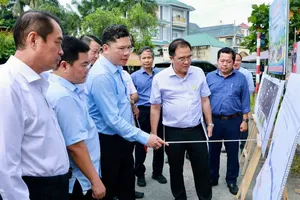
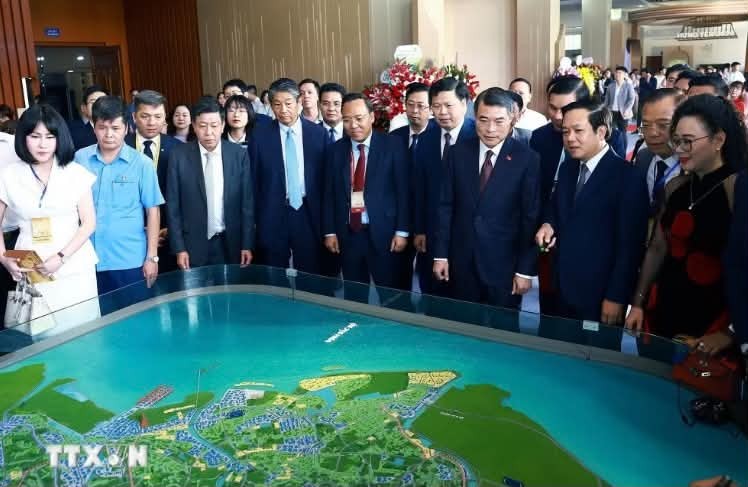
Delegates toured an exhibition featuring a planning model and an AI robot presenting the provincial master plan, among other displays.
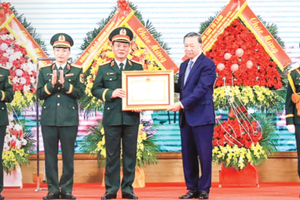
Businesses, entrepreneurs and investors with outstanding achievements and major contributions to local socio-economic development were honoured at the event.