
“Liberal education” represents an educational philosophy elevating independent thinking, critical reasoning capabilities, alongside holistic human development. These values are undeniably positive and definitely need to be encouraged. The pressing issue arises when certain hostile actors misinterpret the “liberal” concept, subsequently implanting extreme, distorted views that heavily impact the youth’s perception.
Recently, concepts like “liberal education” and “humanistic education” have popped up frequently across various hostile websites and social media accounts. The account “American Life Stories” begins with a seemingly sophisticated analysis claiming that liberal education demonstrates superiority, helping learners pose questions, “deconstruct history,” and remain independent in their thinking. Several pages like “Viet Tan,” “Nhat Ky Yeu Nuoc,” and “Chan Troi Moi Media” also beat around the bush, explaining liberal education as a vital tool to “liberate the mind,” foster criticism, and aggressively question authority.
If it merely stopped at the fundamental nature of liberal education, aiming to forge independent thinking capacities, dialogue skills, and a spirit of knowledge-seeking, there wouldn’t be anything wrong. The real problem is that these bad actors implant the notion that being “liberal” is synonymous with having the absolute freedom to say and do whatever one wants, blatantly ignoring legal boundaries and social responsibilities.
Meanwhile, if criticism is severed from its historical foundation, practical realities, and verified achievements, it inherently loses the most crucial root of genuine critical thinking. A social media account named “Giao Duc Nhan Ban” boasting the slogan “Enlighten the mind – lead the way to freedom,” deliberately uses a few isolated incidents to unjustly condemn a highly positive trajectory. Their logical bankruptcy in debate inevitably forces them to rely heavily on fabricated images generated by AI apps.
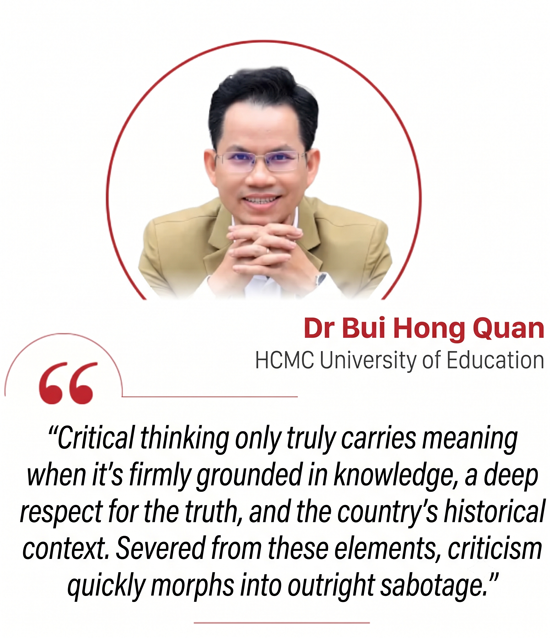
Pointing out evidence of the “attack” from toxic content streams masquerading as “liberalization,” Dr Bui Hong Quan from HCMC University of Education weighed in. “A fairly common manifestation involves establishing clubs or groups labeled as critical thinking forums, yet their content actually aims to negate the regime’s profound efforts and achievements,” he explained.
Pointing to evidence of the “attack” by toxic streams of content masquerading as “liberalization,” Dr Bui Hong Quan of Ho Chi Minh City University of Education said: "A fairly common manifestation involves establishing clubs or groups labeled as critical thinking forums, yet their content actually aims to negate the regime’s profound efforts and achievements.”
Certain ill-intention people even organize classes or youth gathering models to subtly sow extremist agendas. “Faced with these complex manifestations, we must methodically examine each specific case and context, clearly distinguishing between a genuine liberal spirit and the exploitation of liberalization to propagate deviant views, thereby devising appropriate countermeasures.”
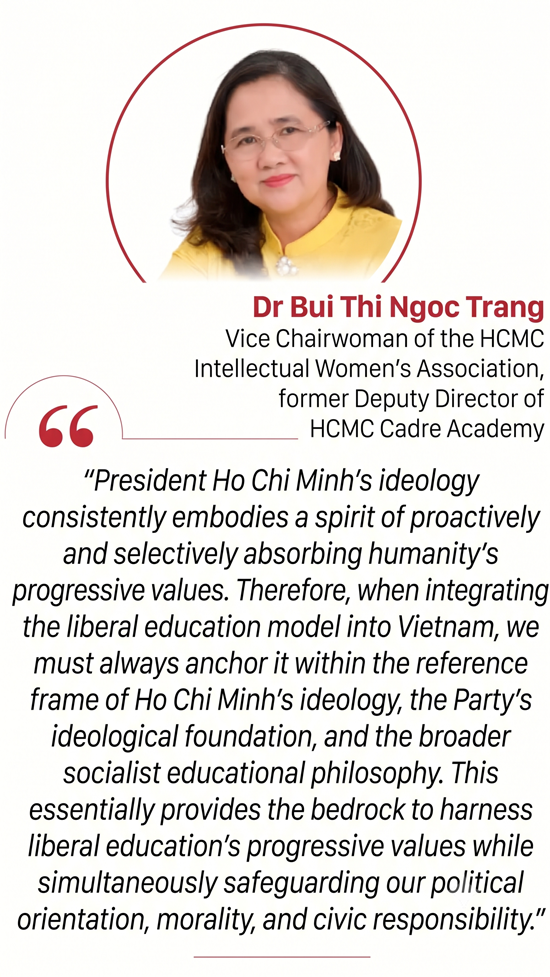
For Vice Chairwoman Bui Thi Ngoc Trang of the HCMC Intellectual Women’s Association and former Deputy Director of HCMC Cadre Academy, schools represent one of the primary environments that can be heavily exploited to manipulate learners’ perceptions. Hostile forces view education as a pivotal battleground within their “peaceful evolution” strategy; they actively seek to manipulate educational philosophies, teaching content, and delivery methods, ultimately aiming to dilute the youth’s political awareness, ideals, and sense of responsibility.
A genuine “liberal” spirit doesn’t inherently stand in opposition to civic duty and community interests. What’s truly alarming is the systematic exploitation of the “liberal” label to absolutize individual rights, completely divorcing rights from obligations toward the community and the nation. They borrow the guise of criticism to negate history; they rely on raw emotion and sweeping generalizations instead of rigorous scientific debate; and they mechanically adopt external ideologies without exercising careful selection based on Vietnam’s historical, cultural, and practical conditions.
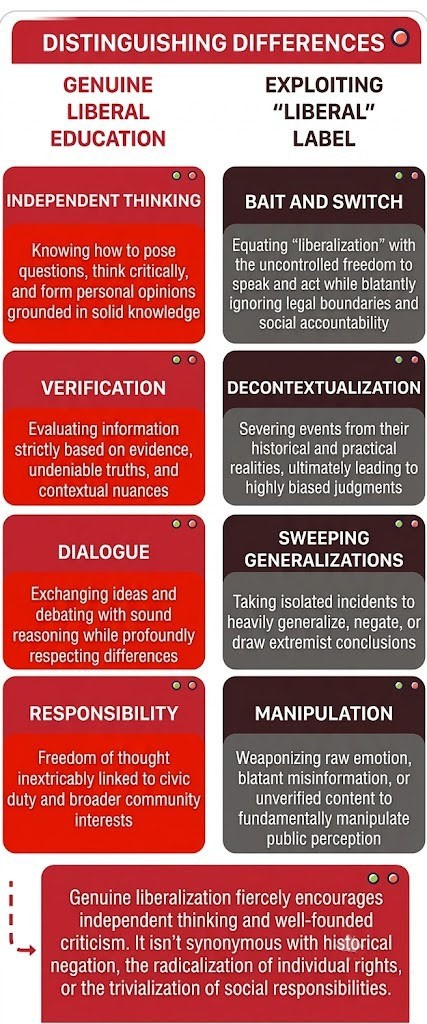

To accurately identify the exploitation of “liberal education,” it’s crucial to delve into its foundational philosophy. Rooted in Greco-Roman traditions, it’s fundamentally geared toward expanding knowledge while developing independent thinking. However, it’s frequently interpreted through diverse tendencies heavily elevating individualism, often failing to consider education’s inherently social nature alongside each nation’s developmental goals.
Consequently, if adopted mechanically without rigorous selection, this model spawns elements glaringly incompatible with Vietnam’s educational objectives. It’s also vital to emphasize that selective adoption doesn’t equate to outright denying liberal education’s intrinsic value. The precarious boundary needing crystal-clear definition here firmly lies between an educational philosophy championing independent thinking versus the absolute weaponization of those very concepts to legitimize blatant misinformation or baseless conclusions.
Dr Bui Thi Ngoc Trang emphasized that President Ho Chi Minh’s ideology essentially gears education toward forging holistically developed individuals while retaining a profoundly populist character. It isn’t a privilege for the few; rather, it must serve the populace, cultivating generations fully equipped with moral and intellectual qualities to defend the Fatherland. “President Ho Chi Minh’s ideology consistently embodies a spirit of proactively absorbing humanity’s progressive values,” she thoughtfully analyzed.
Consequently, when integrating liberal education models into Vietnam, officials must anchor them within President Ho Chi Minh’s ideology alongside the socialist educational philosophy. This reliably provides the bedrock to harness progressive values while simultaneously safeguarding our political orientation plus civic responsibility.
Drawing practical parallels from various educational institutions across Vietnam, the concept of “liberalization” is being standardized and defined in a genuinely academic manner.
Specifically, during the formulation of its educational philosophy, HCMC University of Social Sciences and Humanities (Vietnam National University-HCM) rigorously defined “liberal” with very specific connotations: “Interdisciplinary and cross-disciplinary knowledge; independent and highly creative thinking; the ability to read, infer, and present ideas coherently on a solid scientific basis; robust leadership and management capabilities; scientific curiosity coupled with a passion for discovery; and an insatiable thirst for knowledge driving lifelong learning.”
HCMC University of Technology (Vietnam National University-HCM) has likewise established a liberal spirit boasting a complete, airtight connotation: “Expanding mindsets, unlocking learners’ boundless potential, and forging an environment of academic freedom so students can develop comprehensively, including professional expertise, critical thinking, outstanding character, and a profound responsibility toward society.”
From these practical realities, it’s evident that “liberal education,” when applied correctly, functions as a highly positive educational model empowering learners to innovate and contribute meaningfully to society. However, it’s advisable to remain hyper-vigilant against the malicious bait-and-switch tactics regarding concepts tied to this educational model, which are frequently weaponized for distortion and outright sabotage.
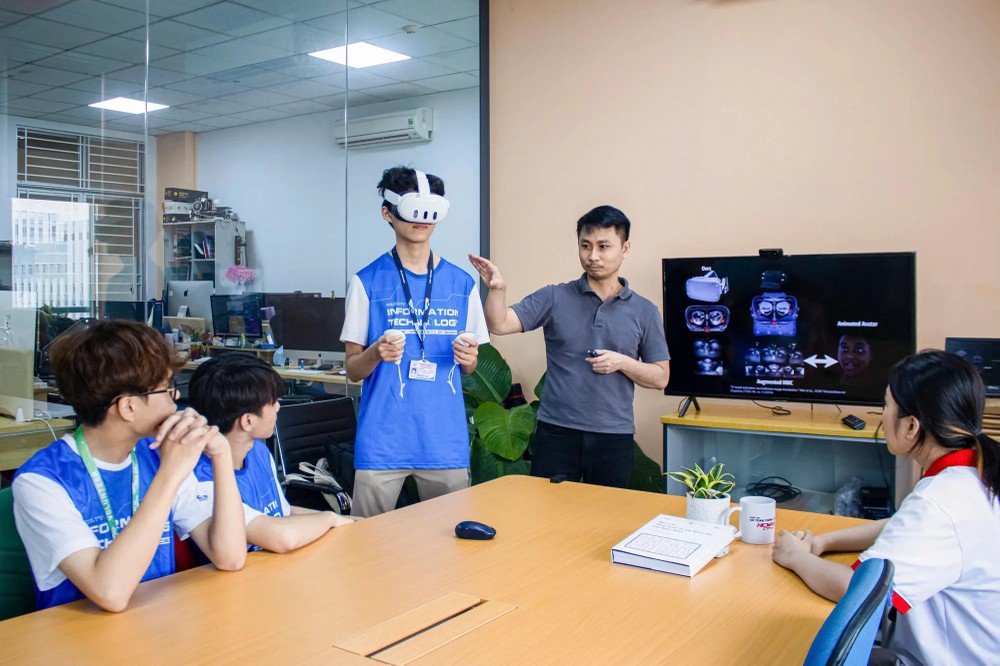
Dr Bui Thi Ngoc Trang issued a stark warning that deviant interpretations of liberal education holding malicious intent can directly manipulate the youth’s perceptions and ideologies. This systematically erodes patriotism and traditional values, promotes selfish individualism, and sows seeds of extreme skepticism, ultimately undermining trust and leaving young people highly susceptible to incitement and division in the digital age.
If misunderstood and radically applied, liberal education can easily plunge learners into a perilous state of questioning all established values, leaving them devoid of the intellectual fortitude needed to shield themselves against toxic information streams. Even more dangerously, these sinister impacts can severely compromise the ideological foundation and the seamless continuation of the revolutionary cause across successive generations.
In the era of a flat world, the fierce battle to safeguard Vietnam’s ideological foundation on the educational front has become more arduous than ever before. As Dr Bui Hong Quan definitively concluded: “Critical thinking only truly carries meaning when it’s firmly grounded in knowledge, a deep respect for the truth, and the country’s historical context. Severed from these elements, criticism quickly morphs into outright sabotage.”
Content: staff writers
Design: Minh Thu
Translation: Thanh Tam