For Ms. Trinh Thi Lan, residing in Dong Hung Thuan Ward, the night approaching the 2024 Lunar New Year remains utterly unforgettable. Her family of five narrowly escaped a devastating blaze inside their combined residential-commercial property.
In the early hours of January 15, 2024, the entire family was sleeping on the mezzanine when they woke up sweating due to a sudden power outage. Opening the door to find blinding smoke, Ms. Lan’s husband rushed downstairs to investigate, but thick, suffocating fumes meant he couldn’t proceed. Consequently, the trapped family couldn’t do anything but scream frantically for help.
Fortunately, proactive neighbors arrived, smashing the glass doors to gain access, successfully rescuing them while containing the flames. Following this terrifying incident, Ms. Lan reportedly spent roughly VND10 million (US$380) renovating her home. She relocated appliances to an isolated area while equipping on-site firefighting tools.
Notably, at the upper-floor emergency exit, she strategically replaced the conventional padlock with a quick-release latch, ensuring it’s effortlessly popped open during emergencies without scrambling for keys. Drawing from her family’s harrowing ordeal, Ms. Lan strongly advises households living in tube houses to maintain at least one backup escape route, absolutely avoiding permanently locking balconies.
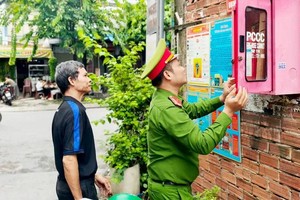
For Ms. Trinh Tuong Vi’s family on Nguyen Bac Street of Tan Son Hoa Ward, their residence previously featured only a single main door exit, while the ground floor accommodated business activities alongside parked motorbikes. After receiving comprehensive guidance from ward police, they’ve consciously opened a supplementary back escape route to preempt sudden fire hazards.
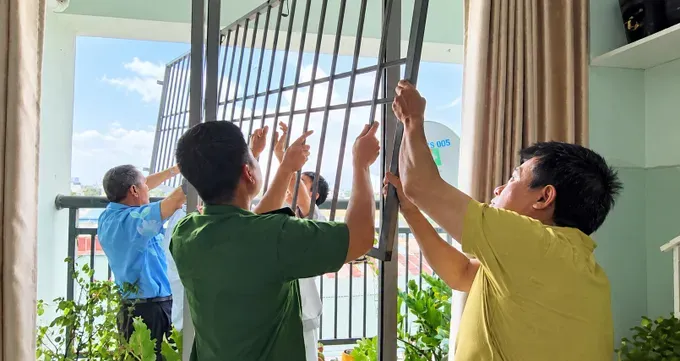
Across various HCMC apartment complexes, citizens are voluntarily dismantling dangerous “tiger-cage-like” iron grills to forge escape routes. For a Tan Son Hoa Ward police official, mobilizing residents to tear down these cages previously presented significant hurdles. “Many households genuinely feared dismantling them would create vulnerabilities, making it remarkably easy for burglars to break in,” he explained.
However, following an exceptionally tragic July 2025 fire in Phu Tho Hoa Ward claiming 8 lives, public awareness shifted drastically. The HCMC Fire Prevention, Fighting and Rescue Police Division also actively persuaded residents to dismantle unsafe structures.
As of June 14, 2026, the city reportedly saw 14,825 out of 15,161 apartments successfully dissemble these cages, hitting an impressive 97.8 percent completion rate. Furthermore, 386 out of 479 apartments completely rectified unauthorized common space expansions. To guarantee stringent safety, local police continually conduct rigorous inspections, uncovering common violations like obscured firefighting equipment, missing escape signage, or notoriously unsafe electrical wiring.
For Mr. Bui Cong Huy, an HCMC civil engineer specializing in residential repairs, the shifting public mindset is highly evident. He noted numerous city dwellers have recently hired him to open balconies and forge secondary escape routes. Take Ms. Ngo Thi Nuong’s family in Dong Hung Thuan Ward as an example. Their one-story tube house had merely a single entrance; the underneath area served as a parking hub for electric motorbikes, leaving the household perpetually anxious.
Consulted on two solutions, either elevating the roof for a steel-framed balcony costing approximately VND100 million ($3,840), or knocking through a wall onto a neighbor’s corrugated iron roof for a few million dong (approximately $150), Ms. Nuong confidently opted for the cheaper, one-day alternative.
According to Architect Ngo Viet Nam Son, numerous HCMC multi-purpose properties still harbor perilous vulnerabilities. Driven by financial pressures, many owners invest the bare minimum despite recognizing inherent risks, especially when they aren’t residing there. Therefore, authorities must strictly reinforce state management rather than relying on spontaneous public awareness.
Primarily, granting business licenses must strictly tie into mandatory prerequisites regarding fire safety, escape routes, alongside alarm grids. Agencies must conduct rigorous physical inspections, solely permitting operations when facilities comprehensively satisfy safety demands. Concurrently, it’s vital to prioritize tightening oversight over commercial townhouses. Structures should boast at least two independent escape routes; balconies must never be hermetically sealed, and paths ought to remain unobstructed.
The HCMC Fire Prevention, Fighting and Rescue Police Division stressed that secondary escape routes only prove genuinely effective when strictly meeting three fundamental requirements. They must be entirely separate from the main exit to evade toxic smoke; the door must always remain ready for immediate deployment without requiring a key; and it must lead directly to a secure area.
Division PC07 strongly recommends that if “tiger-cage-like” iron grills can’t be dismantled just yet, residents must cut open a 60cm by 60cm hatch, utilizing an internal quick-release latch while avoiding padlocks. Households should rapidly swap traditional keyed locks for simple lever handles.
Every household needs to proactively equip themselves with portable fire extinguishers, smoke detectors, demolition tools, alongside smoke-filtering masks. While these items can’t miraculously replace professional firefighters, they decisively help citizens prolong their survival window.
Many families heavily procrastinate on renovations because they dread exorbitant expenses or fear compromising security. However, when a catastrophic inferno erupts, a tightly sealed exit rapidly becomes the unforgiving boundary between life and death. Modifying a home to guarantee fire safety isn’t merely an optional extra; it’s practically a foundational responsibility owed to one’s family. Every renovated house effectively carves out a vital lifeline while weaving an extra layer of defense for the neighborhood.