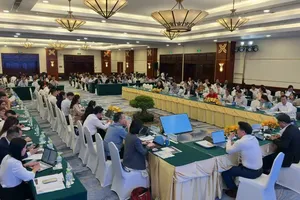
Thu Dau Mot University hosted the conference, aiming to review the region’s role in Vietnam’s renewal process and propose development directions for the new phase.
The scientific conference was convened at a time when the country was preparing for the 14th National Congress of the Communist Party of Vietnam.
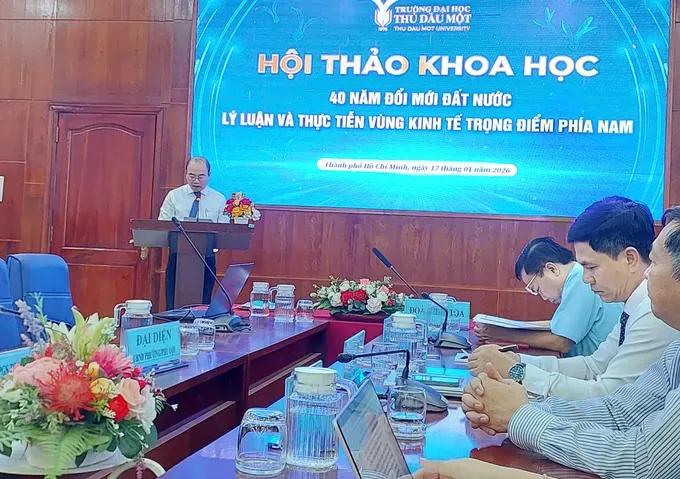
In his remarks at the event, Associate Professor Dr. Ngo Hong Diep, Vice Rector of Thu Dau Mot University, emphasized that the Southern Key Economic Region is one of the most dynamic areas in the country, serving as a major growth engine and a practical testing ground for the formation and diffusion of innovative mechanisms and policies.
In this context, Ho Chi Minh City plays a pivotal role as the region’s economic nucleus and as a national center for finance, trade, science and technology and innovation, while also making substantial contributions to the state budget.
Sharing the same view, Mr. Nguyen Tan Thanh from the Ho Chi Minh City University of Transport stated that the Southern Key Economic Region currently contributes about 43–44 percent of the national GDP, accounts for nearly 60 percent of total state budget revenue, and attracts around 45 percent of total foreign direct investment (FDI). However, he cautioned that the growth model based on low-cost labor and industrial expansion is gradually reaching its limits, necessitating a significant shift toward science and technology, innovation, and the digital economy.
Assessing Ho Chi Minh City’s role, Dr. Luong Thi Can from Thu Dau Mot University emphasized that following the merger, Ho Chi Minh City remains the region’s driving force for development. However, the city also faces challenges related to fragmented governance, the lack of sufficiently strong coordination mechanisms, and an interconnected infrastructure that has not kept pace with population and economic growth. Therefore, Dr. Luong Thi Can proposed that Ho Chi Minh City shift toward a multi-center development model, accelerate investment in regional transport connectivity, establish a distinctive urban governance mechanism, and regard digital transformation and urban data as key drivers for effective governance in the new phase.