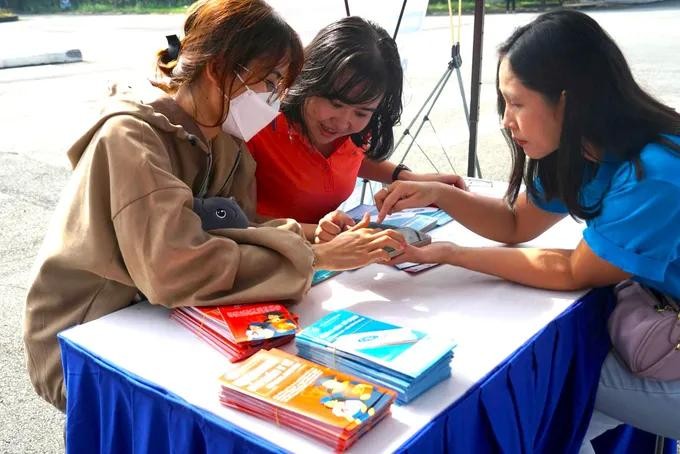
The Resolution of the 1st Congress of the Ho Chi Minh City Party Committe for the 2025–2030 term clearly defines the goal of developing a multi-tiered, comprehensive social security system. It sets out specific targets for multidimensional poverty reduction and universal coverage of health insurance and social insurance, reflecting the city’s commitment to improving the quality of life for its residents.
Foundation at the grassroots level
One afternoon at Tan Phuoc fishing port in Long Hai Commune, Ho Chi Minh City, a 48 year old fisherman, Huynh Van Hoa, from Phuoc Hiep Hamlet, returned to work after undergoing appendicitis surgery. He still vividly remembers the severe pain that recently led to his emergency hospitalization and operation. The total treatment cost exceeded VND12 million. Thanks to his participation in household health insurance, most of the expenses were covered by the insurance fund, helping his family overcome a difficult period.
In Long Hai Commune, as of November 2025, the health insurance coverage rate was just over 80 percent. Chairman Ngo Thanh Phuc of the People’s Committee of Long Hai Commune stated that under pressure to achieve a coverage rate of over 95 percent, local authorities implemented a range of coordinated measures. These included mobilizing the entire political system, collaborating with mass organizations, religious groups, and businesses, and promoting social investment efforts to support vulnerable groups. As a result, Long Hai has now achieved health insurance coverage for over 95 percent of its population. More importantly, public awareness has fundamentally shifted from reluctance to contribute to a proactive mindset of self-protection.
Meanwhile, in Con Dao Special Zone, the case of Mr. Truong Cong Lam in Residential Area No. 9, the first individual to receive a pension after completing 15 years of voluntary social insurance contributions, has emerged as a compelling example illustrating the tangible benefits of participating in the social insurance system. Following years of consistent contributions, he began receiving a stable monthly pension in September 2025.
According to Mr. Tran Van Dien, Deputy Director of Con Dao Social Insurance Office, the recent policy adjustment reducing the minimum contribution period from 20 years to 15 years has significantly broadened access to pension benefits. This change is particularly impactful for groups such as fishermen and informal sector workers, whose incomes are often irregular. To date, health insurance coverage in the area has reached 100 percent, while participation in voluntary social insurance has shown steady annual growth.
However, significant challenges remain. Geographic distance from the mainland continues to hinder access to information, while a segment of the population lacks the financial capacity to sustain long-term contributions to health and social insurance. In response, social insurance agencies have intensified outreach efforts through direct, door-to-door engagement, expanded the use of information technology, and strengthened coordination with postal and banking services for benefit disbursement, thereby helping to narrow the service gap between mainland and island communities.
Policy enhancement
In line with the goals of the Resolution of the 1st Congress of the Ho Chi Minh City Party Committee for the 2025–2030 term, the city aims to achieve a health insurance participation rate of over 95 percent by 2026 and move toward universal coverage by 2030. Social insurance participation is targeted to reach 62 percent of the labor force, and poverty—based on the city’s standards—is to be eliminated.
To realize these goals, Ho Chi Minh City has issued various direct support policies. Notably, under Resolution No. 84/2025/NQ-HDND, in addition to central government support, individuals from poor households participating in voluntary social insurance receive an additional 30 percent subsidy on contributions, while near-poor households receive an additional 25 percent. The estimated annual budget for this support exceeds VND14 billion.
Tran Dung Ha, Deputy Director of Ho Chi Minh City Social Insurance, noted that alongside Resolution No. 84/2025/NQ-HDND, the City People’s Council has issued several resolutions to support policy beneficiaries and reduce the burden of health insurance for vulnerable groups. These include Resolution No. 56/2025/NQ-HDND on health insurance subsidies for the elderly and students; Resolution No. 75/2025/NQ-HDND expanding free health insurance coverage to additional special groups; and Resolution No. 66/2025/NQ-HDND on healthcare policies for certain priority groups. These policies demonstrate a consistent approach to social security, with a strong focus on public health care.
In addition to social and health insurance policies, Ho Chi Minh City emphasizes the mobilization and effective use of resources to protect, care for, and improve the health, physical stature, longevity, and overall quality of life of its residents. The city also prioritizes sustainable social development, ensuring social progress, equity, social security, and human security.
During a voter meeting held in Hoc Mon Commune on March 5, Chairman Nguyen Van Duoc of the Ho Chi Minh City People’s Committee underscored the city's dedication to establishing a comprehensive, multi-tiered social security system that offers universal coverage. The focus is on providing support to policy beneficiaries and vulnerable populations, alongside enhancing the quality of sustainable poverty alleviation. The unwavering guiding principle is that economic growth should be aligned with the assurance of social security, ensuring that the advantages of development are equitably distributed among the populace.