Demand for construction materials in Ho Chi Minh City is projected to rise sharply from 2026 to 2030 due to the simultaneous rollout of numerous key infrastructure, traffic, and public investment projects.
However, supply constraints are directly affecting the progress and costs of these projects, particularly key municipal works.
Material shortages threaten key projects
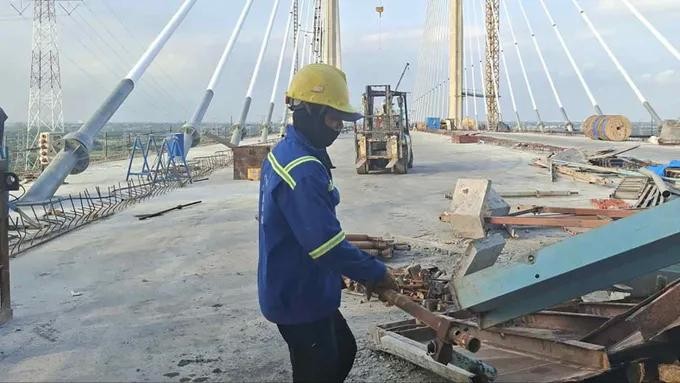
Following years of suspension, construction has resumed on the Phuoc Khanh Bridge package along the Ben Luc - Long Thanh Expressway, managed by a joint venture between Bac Trung Nam Infrastructure Construction Company and Freyssinet Vietnam Company. The bridge spans the Long Tau River, connecting Can Gio in Ho Chi Minh City to Nhon Trach in Dong Nai.
Nguyen Huu Thiem, a construction materials engineer for Bac Trung Nam Infrastructure Construction JSC, reported that sand prices rose from approximately VND385,000 per cubic meter in late 2025 to nearly VND500,000 per cubic meter currently. Construction stone prices climbed from VND594,000 to VND700,000 per cubic meter, while steel prices in the Southern region grew by over 10 percent since the beginning of 2026, slowing on-site construction.
Similarly, the western section of the Ho Chi Minh City Ring Road 3 project running through Cu Chi, Hoc Mon, and Binh Chanh, with a length of approximately 32.6 kilometers, is facing severe material shortages. The original plan aimed for technical traffic clearance by December 31, 2025, and full operations by April 30, 2026.
The revised deadline requires the route to open before June 30, 2026. With less than a month remaining, multiple sections remain unfinished. A contractor representative for construction packages XL8 and XL10 stated that only 30,000 cubic meters of stone have been supplied out of a required 88,000 cubic meters.
The Tham Luong - Ben Cat - Nuoc Len Canal renovation project, which broke ground in February 2023, faces similar delays. Multiple road sections remain unpaved or unrolled due to material scarcities. The Ho Chi Minh City Urban Infrastructure Construction Investment Project Management Board, serving as the investor, noted that meeting the completion target by the end of this year is highly unfeasible due to high material prices and low supply stability.
Canal upgrades are slowed by soaring construction materials
The Vietnam Association of Road System Investors (VARSI) recently noted that prices for essential materials like sand, stone, cement, and steel have risen sharply across multiple provinces, driven up by fuel and transport costs. Supply remains unstable across several southern areas, creating financial risks for contracts signed under fixed or outdated adjusted unit rates.
VARSI Chairman Tran Chung stated that the association petitioned the Government to stabilize fuel and material prices, accelerate the release of updated construction price indices, and allow contract price adjustments to share risks between the state and businesses.
Chairman Dinh Hong Ky of the Ho Chi Minh City Construction and Building Materials Association noted that businesses plan to shorten price update cycles and factor in transport distances more accurately. However, the sector still prioritizes stability and transparency to prevent sudden price spikes from disrupting client operations.
To address the severe sand shortage, Ho Chi Minh City People's Committee Vice Chairman Bui Xuan Cuong directed the Department of Agriculture and Environment to survey and map sea sand mines as alternatives to natural river sand. The city instructed strategic investors and capable enterprises to deploy sea sand washing projects for public investment works.
Concurrently, the city plans to increase the capacity of construction stone quarries to boost crushed sand production. The municipal government also tasked the Department of Construction with tracking material prices monthly to curb market anomalies, while urging investors and contractors to secure additional legal or imported sand sources to safeguard project timelines.