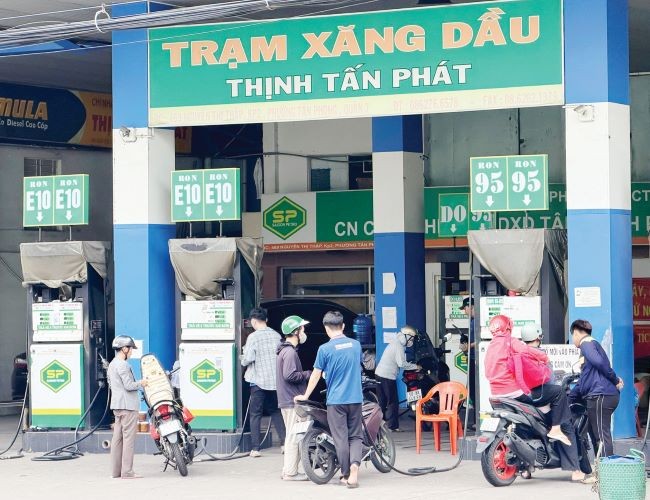
Biofuel E10 officially rolled out nationwide at midnight on June 1, replacing traditional mineral gasoline RON 95 across the official distribution network in accordance with the Ministry of Industry and Trade's roadmap.
Under current regulations, all unleaded gasoline used for petrol engines must be blended into E10, while E5 RON 92 will remain on the market until December 31, 2030.
Smooth transition to E10 as traditional RON 95 sales end
May 31 marked the final day of traditional RON 95 sales before the widespread launch of E10. Reports from multiple provinces indicated stable trading activities with no signs of hoarding or supply disruptions.
In Ho Chi Minh City, the largest fuel market in the Southern region, sales at stations operated by Petrolimex, PVOIL, Saigon Petro, and other enterprises proceeded normally. Traffic flowed routinely at fuel stations along major thoroughfares such as Dien Bien Phu, Vo Van Kiet, Pham Van Dong, and Nguyen Van Linh.
The city was among the first localities to finalize its E10 commercial infrastructure, having upgraded and synchronized its storage facilities, tanks, and pump systems since 2025. By late May, most urban fuel stations had proactively switched to E10. Remaining inventories of mineral gasoline were sold only at a few small-scale suburban stations before the regulation officially took effect.
A similar transition occurred in Hanoi. Over the past two weeks, numerous downtown fuel stations ceased RON 95 sales to transition to E10, leaving leftover mineral gasoline stocks concentrated primarily in suburban areas.
Stable conditions were also recorded in Quang Ninh, Dong Nai, and Lam Dong. Many truck, taxi, and tourist vehicle drivers reported smooth operations using E10.
Proactive measures by major wholesale enterprises served as a critical factor in ensuring a seamless transition. Following a pilot phase launched in August 2025 in Ho Chi Minh City and select localities, Petrolimex deployed E10 across its entire system on May 25. Similarly, PVOIL introduced E10 to nearly 1,000 stations nationwide after upgrading its storage systems, blending equipment, and transport fleets.
Government reaffirms E10 safety, orders preparations for nationwide rollout
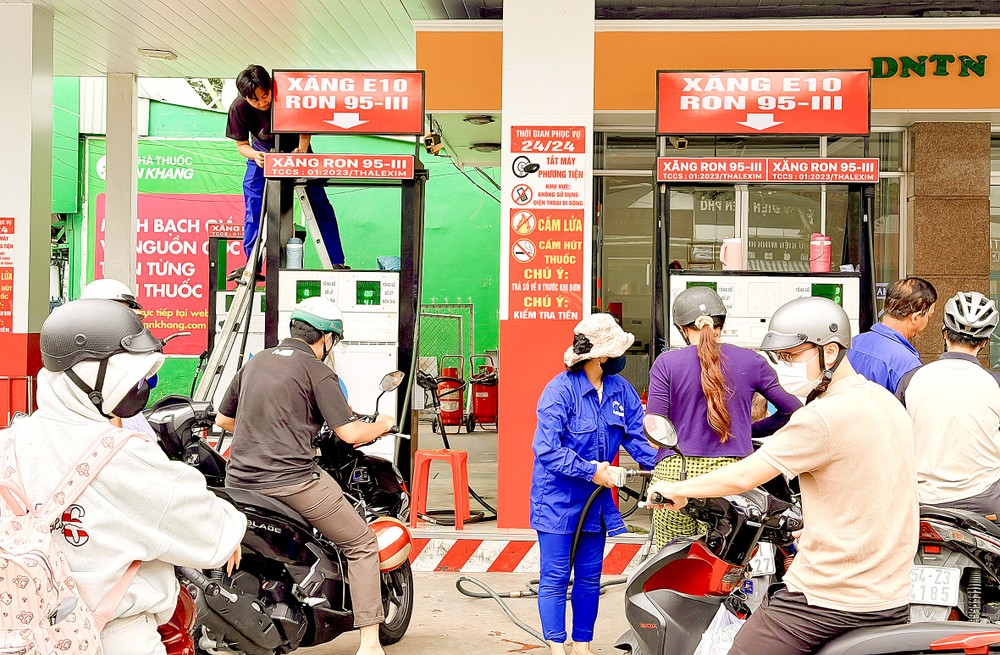
The Ministry of Industry and Trade said Vietnam has joined more than 60 countries using biofuels for road transport. Biofuels have been used worldwide for decades. Brazil uses gasoline blended with ethanol at rates ranging from E18 to E27.5, while the United States, the European Union, China, Canada, Australia, Thailand, and the Philippines have also adopted biofuels in road transport.
Addressing consumer concerns regarding vehicle compatibility, the Ministry confirmed that E10 is compatible with most gasoline-engine cars and motorcycles in Vietnam. The Vietnam Automobile Manufacturers' Association, the Vietnam Association of Motorcycle Manufacturers, and various automakers confirmed that vehicles meeting standard technical requirements can safely use this fuel.
Chairman Bui Ngoc Bao of the Vietnam Petroleum Association cited scientific research and international practices showing that E5 and E10 do not harm engines. Any potential issues relate primarily to older fuel systems with long-term sediment buildup or poorly maintained vehicles.
The association added that E10 production utilizes automated blending systems to ensure ethanol is uniformly mixed with mineral gasoline at precise technical ratios, dismissing unscientific rumors of manual blending.
To maintain a smooth transition, the Ministry of Industry and Trade directed wholesale traders, producers, and distributors to secure supplies and accelerate blending and distribution to prevent shortages. Deputy Minister of Industry and Trade Nguyen Sinh Nhat Tan affirmed that the biofuel rollout stems from sustainable development requirements, energy security needs, emission reductions, and Vietnam's international commitments to green growth.