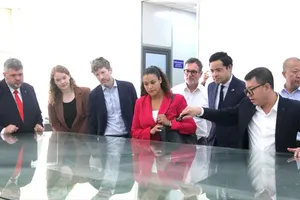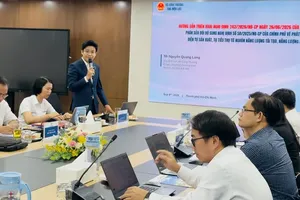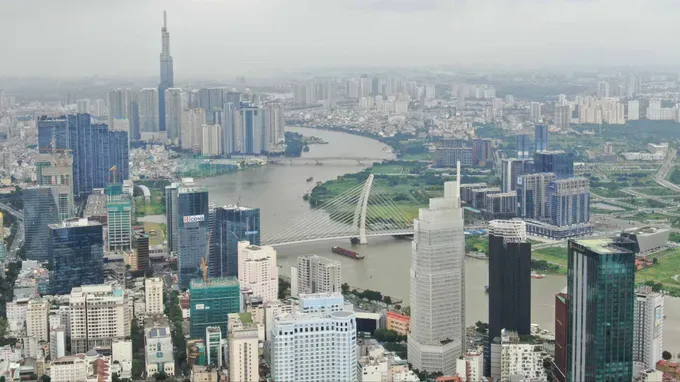
During a working session with General Secretary and State President To Lam on April 27, Secretary Tran Luu Quang of the HCMC Party Committee affirmed his fierce determination to propel the city toward double-digit growth. Concurrently, he emphasized striving to elevate the budget collection scale past the monumental VND1 quadrillion (US$39.3 billion) milestone.
It appears the issue isn’t merely about raw numbers. Boosting revenue can’t solely rely on land anymore. At the end of the day, the city is strategically pivoting to accumulate alternative resources, placing a special emphasis on leveraging derivative financial instruments as well as revenue streams from novel developmental spaces and robust international capital flows.
To genuinely materialize that ambitious goal, experts look toward a potent duo of strategic and legal frameworks to get the ball rolling. This entails Resolution No. 09-NQ/TW regarding the construction and development of HCMC in the new era, coupled with specific mechanisms currently being drafted within the HCMC Special Urban Law.
It’s widely anticipated that this combination will forge a brand-new capital mobilization ecosystem, possessing enough muscle to spearhead and disseminate strategic resources throughout the city.
A particularly notable point is that policymakers are reportedly shaping a relatively comprehensive capital operation chain consisting of three successive phases, each of which is firmly backed by legal mechanisms:
- generating seed capital,
- creating financial leverage,
- mobilizing large-scale funding.
During the seed capital generation phase, Resolution No. 09-NQ/TW lays out the overarching policy to construct and efficiently operate the Vietnam International Financial Center (VIFC) following a new-generation model right in HCMC, seamlessly forging deep connections with international capital markets.
This isn’t just another rudimentary financial institution; rather, it acts as a robust tool to establish initial funding through international financial activities, fintech, and burgeoning new markets like carbon credits. The truly exceptional aspect is that the revenue generated from this seed capital will be retained at 100 percent for the first five years, and the total revenue derived from carbon credits will also be entirely retained to reinvest heavily in core infrastructure, digital networks, and serve as reciprocal capital for arduous site clearance tasks. This constitutes the exact mechanism for initial capital accumulation, empowering the city to forge entirely new developmental resources.
Building upon that solid foundation, the city gracefully transitions into the phase of engineering growth leverage via novel economic models. It appears the newly established legal space permits the piloting of digital asset exchanges, crypto assets, and a Sandbox framework explicitly aimed at attracting venture capital streams from foreign investors. Alongside this, foreign direct investment (FDI) streams pouring in from VIFC members will enjoy considerably more relaxed mechanisms regarding bureaucratic investment procedures.
For massive financial corporations and strategic investors belonging to the elite Fortune Global 500 club, a dedicated fast-track mechanism is being designed to drastically shorten procedures. This includes waiving investment licenses in a handful of specific scenarios and allowing the advance of infrastructure funds to be directly deducted from land lease fees. The ultimate goal is to generate a gravitational pull strong enough to lure international capital streams to enthusiastically select HCMC as their premier strategic destination.
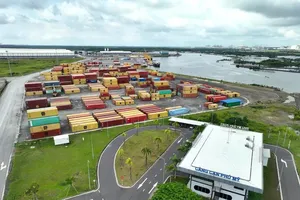
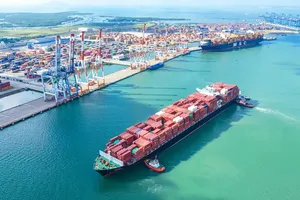
The two aforementioned stages will undoubtedly build momentum for the large-scale capital mobilization phase, executed by issuing prominent debt instruments onto the international market, such as municipal bonds, green bonds, and project bonds. This will inherently serve as an incredibly vital resource for strategic mega-projects like the massive Can Gio International Transshipment Port, the sprawling metro network, critical anti-flooding initiatives, and transit-oriented development (TOD) models.
Among these ambitious activities, TOD is universally regarded as an exceptionally crucial breakthrough. While Resolution No. 09-NQ/TW paves the way for the efficient exploitation of land resources to generate development investment funds, the mechanism of capturing the sheer added value from land plots surrounding metro stations is the exact step that materializes that grand policy. This will also constitute a major legal breakthrough rigorously deployed by the HCMC Special Urban Law Draft.
Furthermore, the intricate capital mobilization mechanisms are explained quite clearly. For robust maritime economy and logistics projects, such as the Can Gio International Transshipment Port or the Cai Mep Ha Port ones, the city can actively issue international project bonds to lure in heavyweight strategic investors within the maritime sector.
If executed efficiently, it’s believed these novel mechanisms won’t merely generate resources for developmental investments, but will progressively forge a brand-new capital conduit for HCMC. Once that happens, the city’s growth won’t be desperately reliant on land revenue anymore. Instead, it’ll be firmly propped up by capital markets, international funding streams, and fresh economic drivers. This provides the exact solid foundation HCMC needs to sustain double-digit growth in a profoundly resilient and long-term manner.