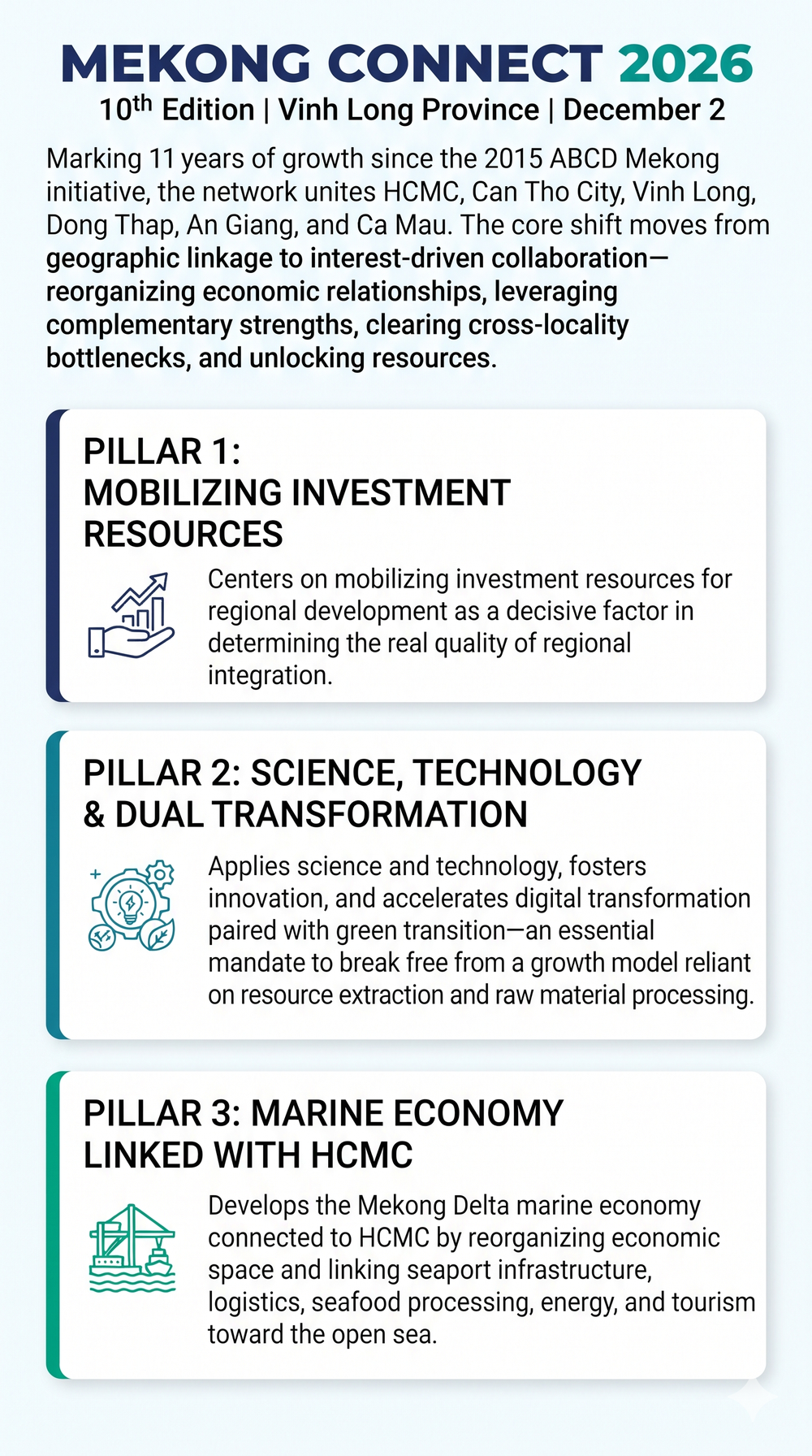
Taking place in Vinh Long Province on December 2, Mekong Connect 2026 marks its 10th edition, after 11 years of formation and growth since the 2015 ABCD Mekong four-locality linkage initiative. This year’s network brings together HCMC, Can Tho City, and the provinces of Vinh Long, Dong Thap, An Giang, and Ca Mau.
What matters most isn’t merely expanding geographic boundaries, but reorganizing economic relationships, tapping into complementary strengths, and clearing bottlenecks that stretch beyond any single locality’s jurisdiction, ultimately unlocking resources and shifting from geographic linkage to interest-driven collaboration.
The first pillar of Mekong Connect 2026 centers on mobilizing investment resources for regional development. It’s a decisive factor in determining the real quality of regional integration. While the Mekong Delta boasts vast potential across agriculture, fisheries, the marine economy, tourism, and energy, its capacity to attract, absorb, and convert resources into genuine competitiveness remains somewhat limited.
HCMC, by contrast, possesses a robust ecosystem spanning finance, banking, commerce, technology, and services, backed by a business network capable of plugging into major markets. These complementary advantages must be knitted together to forge cohesive inter-regional value chains.
More than a decade of sustaining Mekong Connect has displayed the vital role of business associations and organizations in pooling initiatives, bridging government agencies with the market, and channeling policy recommendations.
Now, the forum needs to move well beyond mere dialogue, steering toward concrete cooperation programs and inter-regional projects equipped with clearly designated stakeholders, funding, and implementation accountability.
The second pillar focuses on applying science and technology, fostering innovation, and accelerating the dual transformation, namely digital transformation paired with green transition. This represents an essential mandate if the Mekong Delta hopes to break free from a growth model heavily reliant on resource extraction and raw material processing.
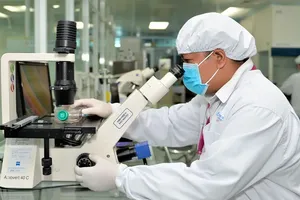
Initiatives expected to debut at Mekong Connect 2026 illustrate how technology is opening fresh development routes, ranging from developing product and applying biotechnology to agricultural produce, to linking scientists directly with farmers. Their common thread lies in elevating the value of indigenous raw materials, boosting production efficiency, and adapting to climate change.
The real challenge isn’t a shortage of bright ideas; rather, it’s the capacity to take initiatives beyond showcase stages and turn them into viable commercial products and business models. The Mekong Delta serves as an ideal testing ground for piloting and scaling up green and circular economy models.
HCMC can step in as a crucial bridge for research, capital, technology, and market access. After all, producing high-quality goods without commanding market reach or tapping into modern distribution systems means added value will rarely stay with local enterprises and communities.
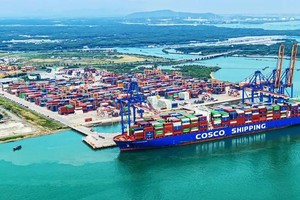
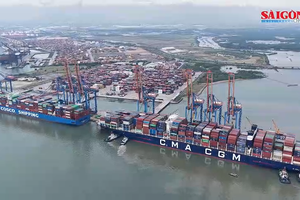
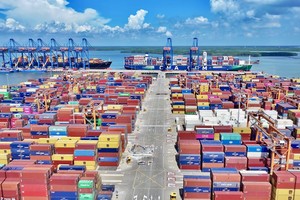
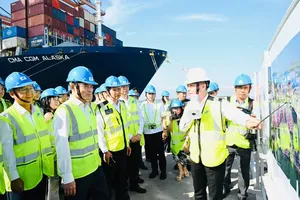
The third pillar targets developing the Mekong Delta’s marine economy connected to HCMC. This isn’t just about capitalizing on coastal advantages; it involves reorganizing economic space and linking seaport infrastructure, logistics, seafood processing, energy, and tourism to reach out into the open sea.
Although the Mekong Delta enjoys an extensive coastline, abundant fishery resources, and strong potential for renewable energy and coastal tourism, these strengths remain fragmented, lacking synchronized links among production, processing, transport, and markets. Forging tighter ties with HCMC and the broader Southeast economic region can unlock substantial new room for growth.
The Southeast’s financial capability, maritime services, logistics, technology, and distribution networks need to be smoothly connected with the Mekong Delta’s production, processing, and marine economic hubs.
The three strategic pillars of Mekong Connect 2026 share an organic relationship where:
- investment capital enables technology and infrastructure build-outs;
- science, technology, and innovation drive up productivity and added value;
- the marine economy widens market horizons while strengthening international connectivity.
Public–private partnerships, high-tech agriculture, logistics–marine economy links, and business–market connections must all be situated within a unified framework.
A new development space demands a new mindset for connectivity. HCMC simply can’t fulfill its role as the nation’s economic locomotive without a dynamic backup behind it. Likewise, the Mekong Delta will struggle to break through if it remains on the sidelines of major capital, technology, and market flows.
What’s expected once the forum wraps up goes far beyond policy petitions sent to central ministries or routine business networking. It’s tangible cooperation programs rolled out on the ground, commercialized innovations, and actionable fixes for inter-regional bottlenecks.
Ultimately, the true yardstick of Mekong Connect's success lies in its ability to turn today’s connections into tomorrow’s shared competitiveness and lasting development value.