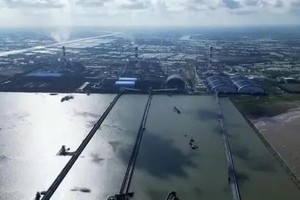
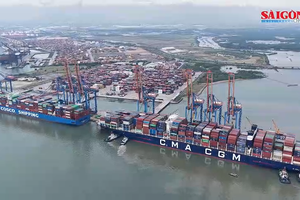
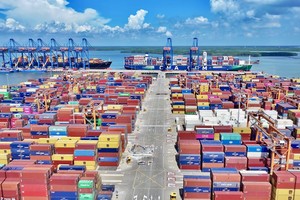
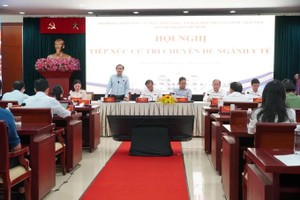
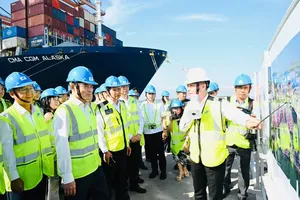
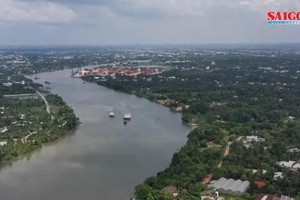
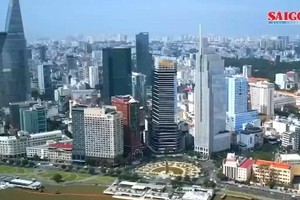
During a meeting with seaport investors on the morning of November 25, leaders from Ho Chi Minh City's Tan Phuoc Ward pledged to hand over the site for the Cai Mep Ha port project by December 10, and to finalize the documentation confirming cleared land for the second phase of the Gemalink project no later than December 31.
Relevant municipal departments and agencies clarified the timelines for submitting applications for land and water-surface leases, as well as plans for connecting the Cai Mep - Thi Vai port complex via road, rail, and waterway networks.
Authorities move to clear port development hurdles
At the meeting, Director Nguyen Thanh Binh of Gemadept Corporation stated that it plans to invest approximately VND100 trillion (US$3.87 billion) in Ho Chi Minh City between 2026 and 2030. With a strategic focus on the maritime sector, Gemadept requested that the city expedite administrative procedures, site clearance, land handover, and the leasing of water surfaces, specifically for the remaining 14 hectares required for the development of Gemalink Phase 2.2. This phase is expected to become operational in the fourth quarter of 2028, following the completion of Phase 2.1 which is scheduled for the third quarter of 2027.
The company also proposed the development of river ports and satellite logistics hubs, the strategic planning of logistics centers, and the promotion of investment in an international maritime hub connected to both Gemalink and the Cai Mep - Thi Vai port complex.
According to Chairman Nguyen Van Chuyen of the Board of Directors of the International Transportation and Trading Joint Stock Company (ITC Corp), construction progress on the Cai Mep Ha General and Container Port project has faced obstacles. ITC Corp is a member of the investor consortium, alongside Geleximco Group and SCIC, developing the project within the Cai Mep-Thi Vai deep seaport cluster.
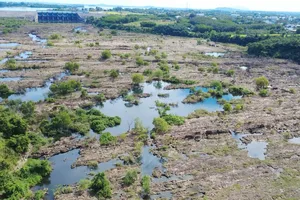
Chairman Nguyen Van Chuyen explained that work, which is moving from the outer perimeter inward, has been hindered by local residents engaging in unauthorized activities, such as installing fishing gear and driving stakes into the water for oyster farming. Furthermore, in a 28-hectare forest land area allocated to a business for development through an auction process, some local households continue to obstruct the winning bidder from clearing the site.
In response to these concerns, Secretary Duong Ngoc Chau of the Tan Phuoc Ward Party Committee stated that local authorities have established a Site Clearance Steering Committee that meets every two weeks to address ongoing issues.
By December 31 at the latest, the ward will submit all documentation confirming that the site for Phase 2 of the Gemalink Port project is clear and free of encumbrances to the Department of Agriculture and Environment.
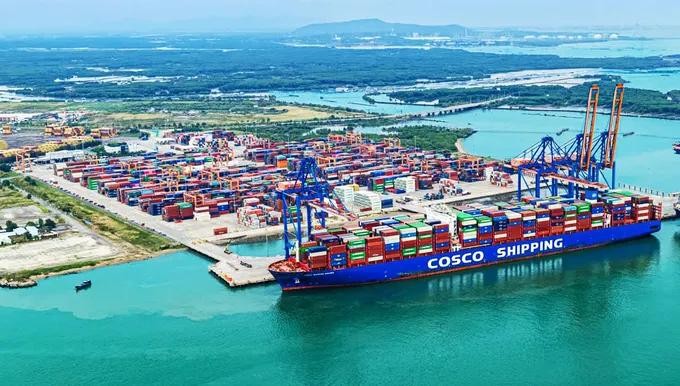
Regarding the 14 hectares of protection forest land designated for the Cai Mep Ha Port project, the ward has committed to handing over the site by December 10, while also addressing residents' concerns in accordance with established regulations.
Director Nguyen Toan Thang of the Department of Agriculture and Environment pledged that within seven days of Tan Phuoc Ward handing over the remaining 14 hectares for Phase 2 of the Gemalink Port project which is scheduled for December 31, the Department will finalize the procedures to submit the land and water surface lease request to the competent authorities for approval.
According to him, the Department is speeding up vegetation clearance across the 14 hectares of forest land to ensure the site is handed over by December 10, five days ahead of the Cai Mep Ha Port project’s schedule. For Phases 2 and 3, which cover approximately 228 hectares combined, the Department will complete a consolidated handover and submit the approval documents within seven days after the local authority finalizes compensation payments in December.
HCMC maps out Cai Mep infrastructure push
Alongside site clearance efforts, leaders from various Ho Chi Minh City departments and agencies have outlined a road map for completing connecting infrastructure and urban planning to maximize the operational capacity of the Cai Mep-Thi Vai deep seaport complex.
Director Tran Quang Lam of the Ho Chi Minh City Department of Construction noted that the existing road network connecting the port complex via National Highway 51 and routes 991B and 992 is largely sufficient for current operational needs. Meanwhile, the Ring Road 4 project is currently a priority for investment, with a target completion date of 2029.
Regarding rail infrastructure, Becamex Group is finalizing a study for railway line Bau Bang-Cai Mep or Bau Bang-Bien Hoa-Cai Mep. The project is proposed as a hybrid model utilizing both public-private partnership (PPP) and state budget funding, while incorporating a Transit-Oriented Development (TOD) approach. The proposal will be submitted to the Ministry of Construction and the Government for review.
In terms of inland waterway transport, the movement of goods from the Binh Duong area toward Ho Chi Minh City and the port complex has become significantly more efficient following the successful raising of the vertical clearance for Binh Trieu and Binh Phuoc bridges. The city is also advancing investments in Long Binh Port, an inland container depot (ICD), and an inland waterway port near the Ring Road 3 area—all structured as PPP projects (with construction expected to begin in 2027)—to accommodate cargo diverted from the Truong Tho port area.
On terminal and yard planning, the Director of the Ho Chi Minh City Department of Construction said that, after discussions with the Vietnam Maritime Administration, all parties had agreed to a private-sector proposal to modify the layouts of Gemadept and Cai Mep Ha terminals. The proposal replaces the “sawtooth” (pier-finger) configuration with a continuous quay design to improve the terminals’ ability to accommodate mega-vessels. Documentation for the proposed changes is expected to be submitted for approval as early as December 2026.
Director Truong Trung Kien of the Ho Chi Minh City Department of Planning and Architecture noted that under the Law on Urban Development, the city can utilize a mechanism to incorporate updates directly into the master plan. This approach serves to replace lagging sectoral plans, thereby establishing a streamlined legal framework that enables seaport projects to proceed according to their scheduled timelines.