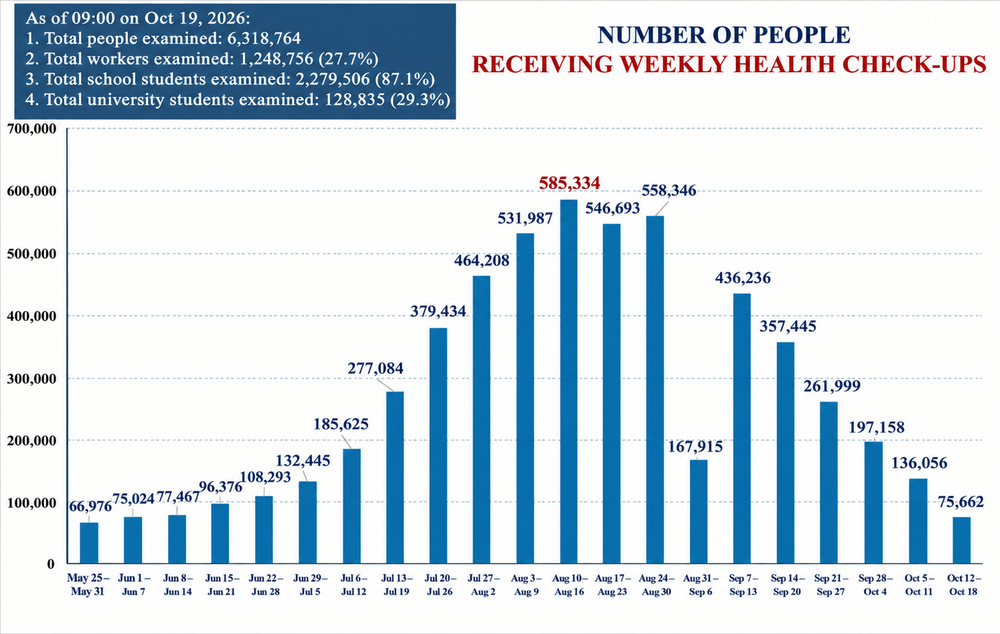
The municipal Department of Health reported on October 20 that the total included 1,248,756 workers, representing 27.7 percent of the target group; 2,279,506 school students, or 87.1 percent; and 128,835 university students, or 29.3 percent.
The department said screening coverage among school students had reached a relatively high level, while greater efforts were needed to reach workers and university students in the coming period.
Of the city's 168 wards, communes, and special administrative zones, 86 had achieved cumulative screening coverage of at least 50 percent. Among these, 47 localities had reached 60 percent, 22 had reached 70 percent, and seven had surpassed 80 percent. Only two localities remained below 30 percent: Cau Ong Lanh Ward and Phu Thanh Ward.
As part of efforts to ensure service quality, the department had inspected and assessed 50 healthcare facilities by October 19. Of these, 22 received Grade A ratings, accounting for 44 percent, while the remaining 28 were rated Grade B. No facility received a Grade C rating.
Notable performers included Binh Duong General Hospital, People's Hospital 115, Cu Chi Regional General Hospital, Di An Regional Medical Center, and Le Van Thinh Hospital.
Initial results indicate that healthcare providers have made considerable efforts to organize screenings and meet the requirements of the national quality assessment criteria for public health examinations, the department said.
The department plans to extend quality assessments to private general clinics, provide guidance and support for service improvements, and identify effective practices that could be replicated across the city.
Meanwhile, the municipal People's Committee has approved expanding eligibility for free periodic health examinations under Official Dispatch No.10110/UBND-VX, dated October 17, 2026.
Under the expanded policy, Vietnamese citizens who do not yet qualify for permanent or temporary residence registration in the city will be eligible if their current residential information in Ho Chi Minh City is verified through a Level 2 electronic identification account on the VNeID platform.
The measure is intended to ensure that people actually living in the city can access the program, broaden coverage, and reduce the risk of eligible residents being overlooked.
The Department of Health has called on all 168 local administrations to maintain and accelerate screening activities, prioritizing workers, university students, and other groups not yet examined. Local authorities have also been asked to update beneficiary lists, coordinate with local police to verify residence information through VNeID, prepare budget estimates, and organize examinations in accordance with regulations.












)