The Ministry of Health has requested that 11 provinces and cities, along with 5 hospitals, pilot the draft guidelines for remote medical examination and treatment. The focus will be on follow-up consultations, monitoring of stable chronic illnesses and post-discharge care.
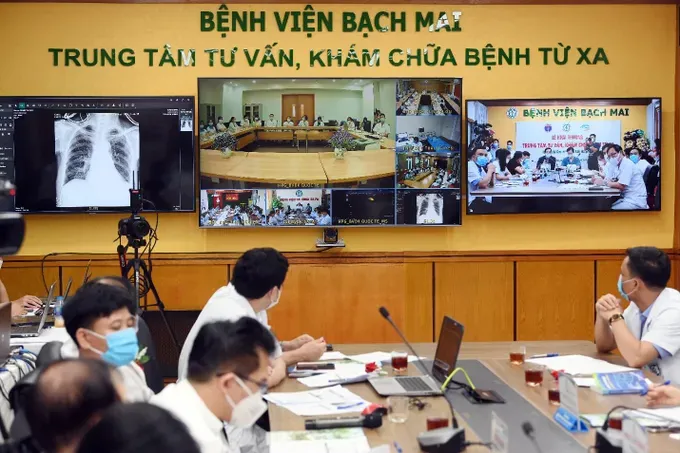
In Official Dispatch No. 7780/BYT-KCB, the Ministry of Health invited the relevant entities to pilot the draft guidelines for remote medical services and support. This initiative aims to identify challenges and obstacles before the documents are finalized and officially issued.
The Ministry of Health has invited the Departments of Health from 11 provinces and cities, including Hanoi, Ho Chi Minh City, Tuyen Quang, Thai Nguyen, Lang Son, Lao Cai, Lai Chau, Tay Ninh, Can Tho, Vinh Long, and Ca Mau, to participate in the pilot.
Additionally, five hospitals have been asked to take part including Bach Mai Hospital, the National Children’s Hospital, Hanoi Medical University Hospital, Cho Ray Hospital, and the University Medical Center Ho Chi Minh City. The list also includes two international cooperation projects focused on the application and development of remote medical service capabilities.
The Ministry of Health has requested that these entities review the guidelines, select specific healthcare facilities to test them, and document the implementation process along with any areas requiring adjustment. A report on the pilot results must be submitted to the Ministry of Health by November 15, 2026, to facilitate the finalization of the guidelines for official issuance.
The draft guidelines outline two models for remote medical consultation and treatment. Under the first model, physicians provide consultations, examinations, and treatment guidance directly to patients through an information technology platform.
The second model incorporates support from a healthcare worker at the patient’s location. In this role, the healthcare worker helps connect patients with physicians, measures key health indicators, and compiles medical histories, clinical records, and test results. The information is then transmitted to the physician, enabling a more comprehensive assessment of the patient’s condition and informing treatment decisions.
By allowing healthcare workers to assist in collecting and transmitting clinical data, the second model is designed to enhance the quality and accuracy of remote consultations, particularly for patients who require closer medical supervision.
The draft also identifies several situations in which remote consultations may be prioritized, including follow-up appointments, monitoring of patients with stable chronic illnesses, post-discharge care, evaluations of treatment adherence, and community-based health management.
In addition, teleconsultations can be used as an initial screening mechanism, enabling healthcare providers to assess a patient’s condition and determine whether an in-person examination or treatment at a medical facility is necessary. This approach is intended to improve access to care while helping optimize the use of healthcare resources.
The choice of model must be based on the patient’s health status, their ability to use equipment, the availability of connectivity, and their capacity to provide relevant information and health metrics; it must also align with the professional expertise and technical capabilities of the healthcare facility.








)