Hospitals across Ho Chi Minh City are actively connecting and collaborating with commune, ward, and special zone health centers to elevate primary healthcare capacity, enabling residents to access quality healthcare services right in their communities.
Enhancing professional capacity for grassroots facilities
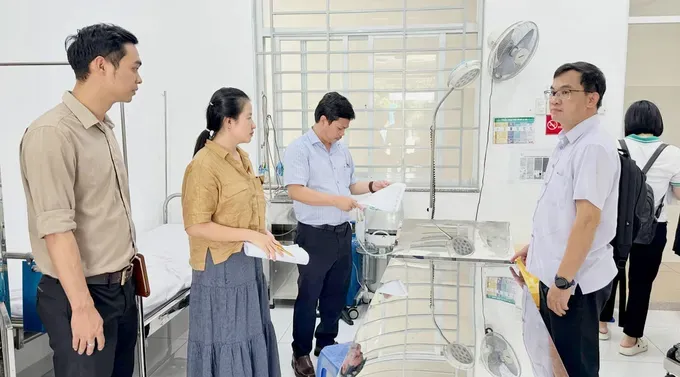
In mid-October 2026, a working delegation from Nhan Dan Gia Dinh Hospital directly surveyed several ward and commune health centers, including Tan Phuoc, Tan Hai, Phu My, Tan Thanh, Ben Thanh, Binh Loi Trung, and Chau Pha, to assess human resources, equipment, and professional support needs. Based on the survey findings, the hospital is developing coordination plans tailored to local conditions and healthcare demands.
Similarly, Hoc Mon Regional General Hospital launched a connection and professional support program for four commune health centers, Hoc Mon, Ba Diem, Dong Thanh, and Xuan Thoi Son, to serve more than 500,000 residents.
Binh Phu General Hospital surveyed four health centers in Binh Phu, Phu Lam, and Binh Tien wards and Can Gio commune to formulate suitable support plans.
Dr. Nguyen Khac Vui, Director of Binh Phu General Hospital, said the hospital has prepared personnel, equipment, and necessary conditions, ready to send doctors to reinforce local health centers. This initiative aims to help residents access medical examination and treatment services directly in their localities, contributing to easing the burden on higher-level hospitals.
Earlier, Nhan Dan 115 Hospital dispatched working groups to conduct status assessments at six wards and commune health centers, including Hoa Hung, Tan Hoa, Tan Thoi Hoa, Tam Thang, Phuoc Hai, and Con Dao Special Zone.
According to Dr. Tran Van Song, Director of Nhan Dan 115 Hospital, working delegations are urgently conducting detailed evaluations of each unit's needs to formulate appropriate support plans for better community healthcare.
Each health center has its own unique characteristics, with no uniform standard. Therefore, a tailored plan for each individual center will be built. For areas where a center is already performing well, support will focus on other domains. This plan aims not only to transfer medical techniques and improve professional capacity in specific fields at the local level but will also be incorporated into the KPI evaluation criteria for the hospital's board of directors, Dr. Tran Van Song stated.
Building a sustainable support network
Field observations show that many health centers still face shortages of doctors and equipment, with facilities failing to meet requirements while workloads continue to mount. Consequently, leaders of local health centers are proactively reviewing operational and personnel difficulties as well as community healthcare demands to collaborate with supporting hospitals in formulating appropriate plans.
Notably, doctor rotations are intended not only to address immediate staffing shortages but also to integrate on-site training, technology transfer, and the enhancement of initial emergency response and community patient management.
According to Assoc. Prof. Dr. Tang Chi Thuong, Director of the Ho Chi Minh City Department of Health, the hospital-to-health center connection program for the 2026–2030 period is being implemented across 168 commune, ward, and special zone health centers. Each health center will be paired with a general hospital or regional medical center for regular support, alongside access to specialized hospitals for in-depth assistance when needed. A novel feature of the program is the establishment of a two-tier support mechanism, comprising local general hospitals providing territorial support and a network of specialized hospitals offering field-specific assistance.
The goal is not to perform tasks on behalf of local health centers but to enable them to independently execute more medical techniques, elevate treatment quality, and maintain long-term capacity. Under this model, the 168 health centers will gradually become "extended arms" of the city's healthcare system, enabling residents to access quality medical care directly in their communities and easing the burden on higher-level hospitals.
Hospitals must complete their needs assessments at health centers and submit support plans, along with the proposed list of doctors for the first rotation phase, to the Department of Health by this October. The Department will lead and coordinate with relevant units to organize training on the duties of health centers and rotating doctors. The handover ceremony for the first batch of doctors and the rollout of rotation activities are scheduled for October 30, Assoc. Prof. Dr. Tang Chi Thuong shared.










)