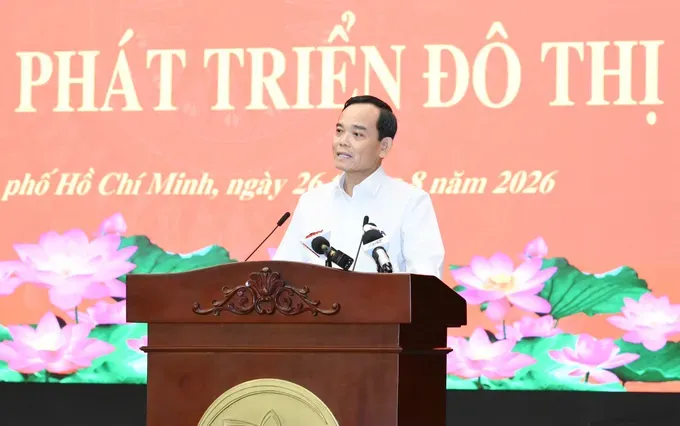
Secretary of the Ho Chi Minh City Party Committee Tran Luu Quang stressed that the success or failure of implementing mechanisms and policies ultimately lies with the city’s 168 communes, wards, and special zones, where laws are put into practice for the benefit of people and businesses.
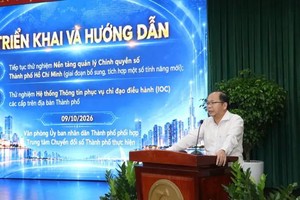
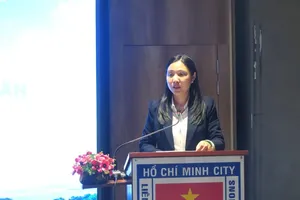
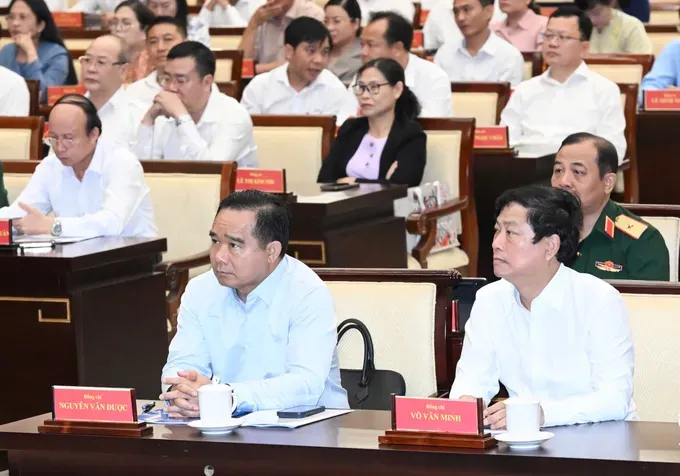
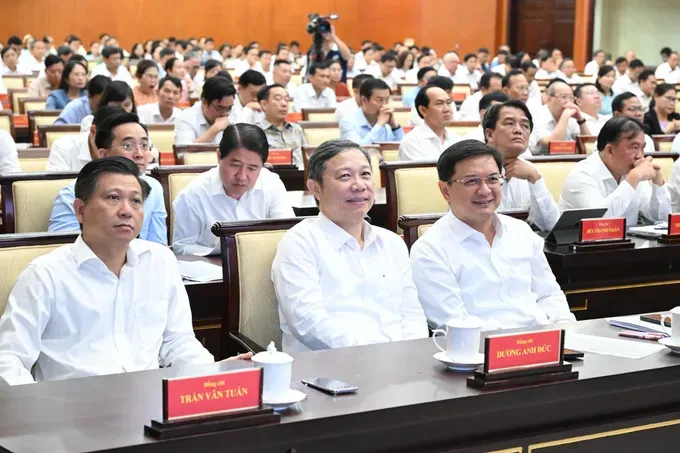
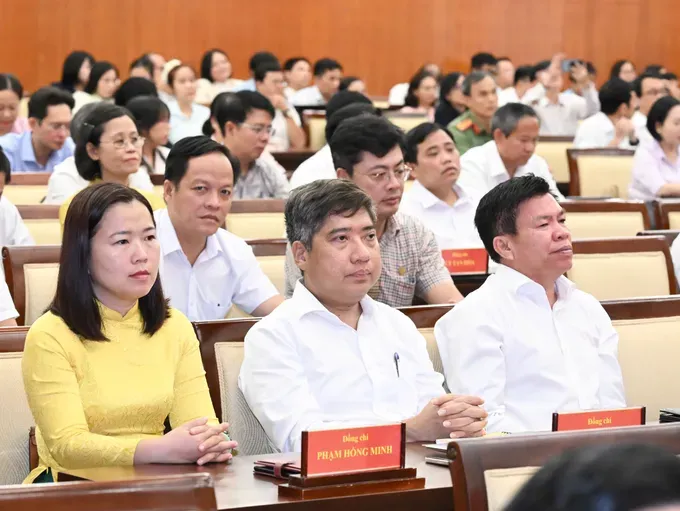
On August 26, the Ho Chi Minh City Party Committee held a conference, both in person and online, to disseminate and implement the Law on Urban Development. The event was connected to Party committees directly under the Ho Chi Minh City Party Committee, as well as those of communes, wards, and special zones.
In his concluding remarks, Secretary of the Ho Chi Minh City Party Committee Tran Luu Quang emphasized that the Law on Urban Development’s greatest value lies, first and foremost, in changing the way urban development is perceived and approached. In his view, urban areas should not merely be objects of management but must become drivers of growth and development.
Localities decide, act, and take responsibility
According to Secretary of the Ho Chi Minh City Party Committee Tran Luu Quang, the Law on Urban Development brings three particularly important benefits to Ho Chi Minh City.
The first is substantive decentralization and delegation of authority, guided by the principle that “localities decide, localities act, and localities take responsibility.” The law grants and defines authority over 240 matters under the purview of the People’s Council, the People’s Committee, and the Chairperson of the Ho Chi Minh City People’s Committee, thereby providing the city with greater autonomy in implementation.
He placed particular emphasis on the principle that the Law on Urban Development takes precedence when its provisions differ from those of other laws governing the same matter. He described this principle as being as valuable as “a diamond,” as it would prevent the specific mechanisms granted to Ho Chi Minh City from being easily overridden by general provisions in other laws.
“I consider this an extremely significant value, because conflicts among legal documents are an issue that you all understand very well and one that has occurred quite frequently in recent times,” Mr. Tran Luu Quang said.
Second, the law creates room for Ho Chi Minh City to implement new policies and economic models. According to the city’s Party Secretary, the current requirement is no longer to pilot mechanisms to determine “whether they can work,” but to put effective mechanisms into stable, long-term implementation and generate tangible value.
Now is no longer the time for experimentation; it is time to put things into practice, he stressed, noting that the overarching principle is to transform the resources already available to the city into new drivers of development.
Third, the law enhances the speed and efficiency of implementation. With the authority granted under the law, Ho Chi Minh City can proactively issue regulations rather than passively waiting for direction.
According to Secretary of the Ho Chi Minh City Party Committee Tran Luu Quang, the law gives the city a major opportunity, but the outcome will depend on its capacity to organize and implement it effectively.
Infrastructure is the runway, capital is the fuel, and institutions determine whether Ho Chi Minh City can take off, he affirmed.
Against this backdrop, Mr. Tran Luu Quang requested that immediately after the conference, all agencies and units begin implementing the law through concrete actions. Every official, in their respective position, must be able to answer three questions: What powers does the law grant us and our agency? What products or results can we deliver with those powers? If we fail to act or perform ineffectively, who will be held responsible?
The city’s Party Chief expected each of the officials to provide clear answers to all three questions. The KPI for them will basically revolve around these three questions, he stressed.
At the city level, he asked the Chairperson of the Ho Chi Minh City People’s Committee to focus on translating the 240 areas of authority granted under the law into 105 legal documents, comprising 73 resolutions of the Ho Chi Minh City People’s Council and 32 decisions issued by the Ho Chi Minh City People’s Committee and its Chairperson. The goal is to ensure that by October 1, 2026, when the law takes effect, the city will have a complete legal framework in place for immediate implementation.
For departments and agencies, he requested that they clearly identify key areas for priority action and proactively design solutions within their respective authority, rather than merely proposing solutions to individual issues on a case-by-case basis.
He also called for an end to the practice of documents seeking comments being passed back and forth among departments and agencies, unnecessarily prolonging the processing time. He said the responsibility of agencies, units, and their heads would be considered if the situation persists.
Authority must go hand in hand with responsibility
Secretary of the Ho Chi Minh City Party Committee Tran Luu Quang stressed that the success or failure of implementing mechanisms and policies ultimately rests with the city’s 168 communes, wards, and special zones—the places where laws are translated into tangible benefits for people and businesses.
Therefore, local authorities must urgently formulate action programs and plans to address obstacles and create new momentum for development in their respective areas.
According to Mr. Tran Luu Quang, authority must always be accompanied by mechanisms to oversee its exercise, while greater authority must go hand in hand with greater responsibility. The guiding principle is to shift from control through prior approval to control through openness, transparency, and accountability.
The HCMC Party Secretary warned of two tendencies that could easily lead to mistakes in implementation. The first is delay and procrastination—having authority but failing to exercise it and having opportunities but failing to seize them. The second is a failure to fully understand regulations, resulting in incorrect application or abuse of authority.
However, for officials who make decisions within their lawful authority, act transparently and without self-interest, and work for the common good but whose results fall short of expectations, the city will stand behind and protect them to the fullest extent. Conversely, those who exploit mechanisms for personal gain or group interests, causing public resources to be wasted or lost, will face strict action, with no exceptions.
The city will periodically make public a set of indicators for assessing governance effectiveness and the exercise of delegated authority while conducting both regular and ad hoc inspections in localities.
In particular, the Secretary of the municipal Party Committee emphasized that personnel work is a decisive factor. Officials will be evaluated through three channels: a system of indicators assessing their capacity and outputs (KPIs); assessments by their agencies, leaders, and colleagues; and, most importantly, assessments by people and businesses.
“Anything that cannot be measured will not be counted as an achievement,” he stated.
According to the city’s Party Chief, tangible achievements include the number of documents issued on time, the number of administrative procedures streamlined, the number of days saved for businesses, and the number of projects launched, among other measurable results.
He also outlined three messages regarding personnel work:
First, officials who deliver results and produce tangible outputs will be recognized and rewarded, with timely opportunities for promotion and appointment. They will not necessarily have to wait for the regular review cycle or follow rigid seniority-based procedures.
Second, officials who dare to think, act, and take responsibility for the common good but make mistakes in the course of innovation will receive the city’s protection and its commitment to stand behind them to the end. This is not merely an encouragement, he stressed, but a principle established by law that will be further specified through regulations.
Third, officials who avoid taking action, shift responsibility to others, fear accountability, and seek to protect themselves by refusing to make decisions will have to leave.
“We do not grant authority to those who dare not exercise it,” Mr. Tran Luu Quang stressed.
He affirmed that success should not be measured by how much authority an official is granted but by the concrete results generated through the exercise of that authority.
The authority is in place, the mechanisms are in place, and time waits for no one. What remains is our own capacity to implement them, measured by tangible results in each locality and over time,” he stressed, calling on local authorities to get to work immediately.