In recent days, consumers have clearly felt the pressure of increased spending as prices of some services and food items have risen. However, the industry and trade sector, along with retail businesses and small traders, are implementing many solutions to try to maintain price stability and stimulate consumer demand.
Consumers feel pinch as costs rise, traders strive to keep prices stable
Resident Le Quy Mai in Thu Duc Ward, Ho Chi Minh City, said that family living expenses are trending upwards. “For breakfast, a bowl of vermicelli or a cup of coffee has increased by about VND5,000. Buying fruit at the market has also increased by VND5,000-VND10,000 per kg, depending on the type. It feels like money is being lost,” Ms. Mai said.
Not only consumers are feeling the pressure of increased spending, but many small traders also say that their businesses are facing many difficulties. Ms. Trang Thai, a small trader at An Dong Market in An Dong Ward, Ho Chi Minh City, said that input costs such as gasoline, gas, and transportation have all increased, so some goods have to be adjusted in price. However, to retain customers, she and many other small traders try to reduce costs, accepting lower profits to maintain reasonable prices.
"Business is not easy at this time; if we raise prices sharply, customers will buy less. Therefore, we have to consider very carefully how to manage costs while maintaining good prices for regular customers," Ms. Trang Thai shared.
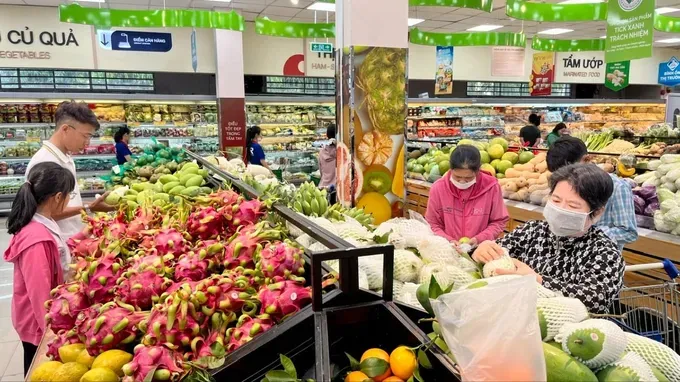
A survey at wholesale markets in Thu Duc, Binh Dien, and Hoc Mon shows that prices have not fluctuated significantly compared to nearly three months ago. Many items have even seen sharp price reductions, such as oranges from VND59,000 per kg to VND30,000 per kg, a decrease of VND29,000 per kg, equivalent to a decrease of about 49 percent; dragon fruit from VND20,000 per kg to VND12,000 per kg, a decrease of VND8,000 per kg (a decrease of 40 percent).
Deputy Director Nguyen Nguyen Phuong of the Ho Chi Minh City Department of Industry and Trade stated that the prices of goods within the market stabilization program remain consistent, approximately 5 percent to 10 percent lower than the prevailing market price. The Department of Industry and Trade encourages businesses to take proactive measures in securing supply sources and formulating suitable pricing strategies to uphold prices, alleviate challenges, and assist consumers.
Concurrently, the department continues to collaborate with and support businesses in stabilizing supply sources, thereby contributing to the maintenance of stable prices. Additionally, it closely monitors the supply of gasoline, diesel, and gas, and promptly provides advice to the Ho Chi Minh City People's Committee and the Ministry of Industry and Trade regarding management solutions, addressing challenges, ensuring energy supply, and prioritizing the execution of market stabilization measures.
Notably, pork prices are trending downwards. Specifically, pork ribs are currently priced at around VND130,000 per kg, a decrease of VND20,000 per kg; boneless pork belly is around VND120,000 per kg, a decrease of VND10,000 per kg. This development has somewhat helped balance food spending for many families. Meanwhile, some vegetables have seen localized price increases, but not excessively high, keeping food prices relatively stable.
Retailers launch big promotions to ease consumer burden
Supermarket chains and major retailers across Vietnam are rolling out large-scale discount programs from no-profit watermelon sales to steep cuts on essential goods in an effort to stabilize prices and support household purchasing power amid rising living costs.
To maintain purchasing power amidst rising living costs, many retail businesses have proactively implemented large-scale promotional programs. For example, the GO! and Tops Market supermarket systems of Central Retail Vietnam are running a program to consume Gia Lai watermelons. Accordingly, red-fleshed watermelons are being offered for sale without profit, with a price of VND7,500 per kg at GO! supermarkets located in the Central region, and VND8,500 per kg at GO! and Tops Market outlets in the Southern and Northern regions. Director Nguyen Thi Bich Van of Communications at Central Retail Vietnam, stated that they are ready to support the market for agricultural products and help stabilize prices.
In addition, many large retail systems, such as Saigon Co.op, SATRA, and MM Mega Market Vietnam, are also increasing promotional programs to support consumers. At Saigon Co.op's system, many essential goods are discounted by 15 percent-50 percent.
The "Green Vegetable Festival - Buy Now, Great Deals" program also offers many promotions; for instance, buying one get one free, items priced at VND9,900, or discounts of around 30 percent on some types of vegetables. According to retailers, these programs not only help stimulate consumer demand but also contribute to maintaining stable market prices amidst fluctuating input costs.
In response to concerns over oversupply and price instability, the Gia Lai Provincial Department of Industry and Trade has urged localities, businesses, supermarket chains, and wholesale markets nationwide to step up efforts in promoting and connecting watermelon consumption, thereby helping stabilize output for farmers. Acting on this call, GO! and Tops Market—part of Central Retail Vietnam—have introduced a program to support Gia Lai watermelon sales, offering red-fleshed varieties at non-profit prices of VND7,500 per kg in the Central region and VND8,500 per kg in the Southern and Northern regions.
The program started on March 7 and will continue until the end of this year's watermelon season. Within the framework of the program, GO! supermarket system and Tops Market are expected to consume approximately 200 tons of watermelons from farmers in Gia Lai Province, thereby supporting the market for the product during the peak harvest season.
According to the Department of Industry and Trade of Gia Lai province, the province currently has about 2,733.9 hectares of watermelon cultivation. To date, about 300 hectares have been harvested with a yield of nearly 12,300 tons; the remaining area of more than 2,400 hectares will be harvested in March and April 2026, with a common yield of 38-50 tons per ha, which could lead to a rapid increase in supply in a short period.