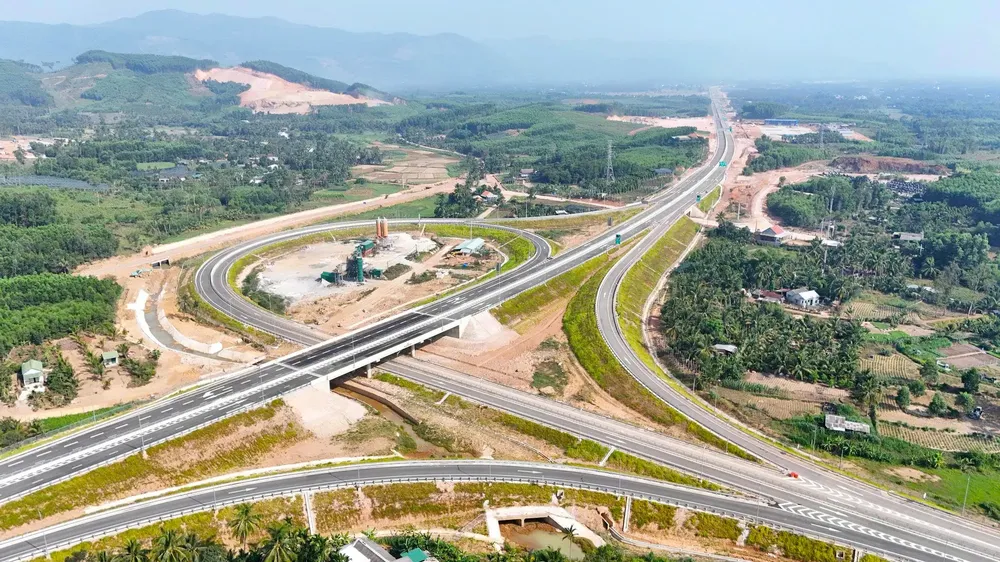
During the 2026–2030 period, Vietnam has identified the development of modern infrastructure as one of its three strategic breakthroughs to reshape its growth model, with a strong focus on transport infrastructure. Large-scale public investment, digital transformation, science and technology, high-value agriculture, and major transport projects are seen as crucial “engines” that serve as a foundation for economic expansion.
Aviation takes the lead
In a modern transport system, airports are not merely transit points but strategic hubs that enhance regional connectivity, attract investment and enable deeper participation in global value chains.
For Vietnam, a country stretching along a north–south axis with a vast coastline, the aviation network is becoming ever more critical to long-term development.
According to the Civil Aviation Authority of Vietnam and Airports Corporation of Vietnam (ACV), international passenger traffic reached 46.2 million in 2025. The recovery of international routes has been particularly strong in key markets. Building on this momentum, the aviation sector expects to serve 95 million passengers, up 13 percent and handle 1.6 million tons of cargo, up 15 percent, in 2026.
Vietnam currently operates 22 airports, including nine international and 13 domestic ones, with a total designed capacity of 106.5 million passengers annually. Among them, Noi Bai and Tan Son Nhat international airports serve as the two primary hubs connecting domestic and international routes.
Widely viewed by global partners as a driver of the next growth phase, the Long Thanh International Airport project will depend heavily on strong connectivity. Dr. Nguyen Thien Tong highlights the importance of a metro link connecting downtown Ho Chi Minh City with the airport. It is essential to view the airport as a national, multi-regional project, not simply a local one.
Therefore, its transport connections must be planned comprehensively, including direct routes from the Mekong Delta without passing through central Ho Chi Minh City. The Ben Luc–Long Thanh Expressway is expected to play a crucial role in easing regional traffic congestion.
Under the national airport development master plan for 2021–2030, Vietnam aims to expand to 30 airports, including 14 international ones, with a total capacity of 294.5 million passengers annually. This reflects the urgent need to upgrade aviation infrastructure amid rapid growth and increasing congestion at major airports.
Road infrastructure as a breakthrough
Road transport infrastructure has marked significant progress, becoming a cornerstone of the country’s infrastructure strategy. Numerous large-scale projects are being implemented simultaneously and accelerated toward completion.
A notable highlight in 2025 was the launch, inauguration, or technical opening of 234 projects across 34 provinces and cities on December 19, commemorating the 14th National Party Congress. These projects span key sectors such as transport, energy, urban development, industry, and logistics, with transport infrastructure at the center, including expressways, ring roads, major bridges and interregional connections.
A prime example is the eastern North–South Expressway, a backbone project spanning about 2,063 kilometers from Huu Nghi Border Gate in Lang Son to Ca Mau. This uninterrupted corridor marks a historic infrastructure breakthrough, forming a solid foundation for sustained high economic growth.
At the same time, the Lao Cai–Hanoi–Hai Phong railway project carries both economic and geopolitical significance. Spanning over 419 kilometers with 18 stations, it will connect directly to China’s railway system at Hekou North Station and terminate at Lach Huyen Port, a strategic export gateway in northern Vietnam. With an investment of over VND203.2 trillion (US$7.7 billion), the double-track railway will operate at speeds of 120–160 kilometers per hour. The first component began construction on December 19, 2025, while the second is expected to commence later this year.
According to Dr. Tran Huu Minh of the National Traffic Safety Committee, transport infrastructure has achieved breakthrough progress, creating a long-term growth engine for Vietnam’s economy. Major projects like the North–South Expressway help unlock new development spaces and significantly reduce long-standing logistics bottlenecks.
Synergy from seaport infrastructure
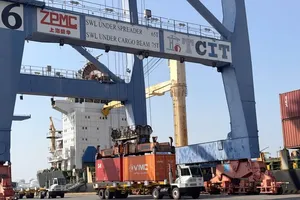
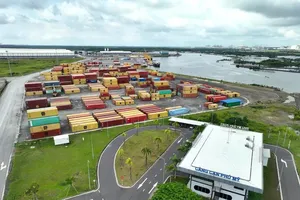
The country’s seaport system is also a critical component of its transport infrastructure. By 2030, total investment demand for seaports is estimated at VND359.5 trillion (US$13.6 billion), including VND72.8 trillion (US$2.7 billion) for public maritime infrastructure and about VND286.7 trillion (US$10.9 billion) for port terminals.
In the North, Hai Phong Port, classified as a special seaport, serves as the main import-export gateway, with plans for 70–74 berths and an annual capacity exceeding 215 million tons of cargo by 2030. In the south, Ho Chi Minh City operates the country’s largest port network with 99 berths, targeting 253 million tons of cargo and 16.25–18.25 million TEUs annually by 2030.
According to logistics expert Prof. Dang Dinh Dao, seaports function as the “heart valves” of the export-import economy. While Ho Chi Minh City’s port cluster remains the largest, the strategic focus has shifted eastward to the Cai Mep–Thi Vai deep-water port complex. With over 14 kilometers of berths, it is one of the few ports in the region capable of accommodating large vessels traveling directly to Europe and North America without transshipment.
Located near major international shipping routes, particularly trans-Pacific lanes, Cai Mep–Thi Vai enjoys a significant competitive advantage, enabling direct connections with global hubs such as Singapore, Hong Kong and European ports. This strategic positioning reinforces its role as a key international gateway, boosting Vietnam’s trade and economic growth.
Resolution No. 79-NQ/TW issued on January 6, 2026, by the Politburo sets a clear goal of developing a modern, synchronized system of strategic infrastructure by 2030. The focus is on completing large-scale, nationally significant projects that enhance interregional and global connectivity. The resolution emphasizes the leading role of the state sector in driving infrastructure development, creating a strong foundation for breakthroughs in transport, logistics, energy and digital infrastructure.
Experts believe this policy framework will provide a strong boost, making transport and seaport infrastructure projects more attractive to investors.
Minister of Construction Tran Hong Minh highlighted the importance of encouraging private investment and public-private partnerships (PPP) in key sectors such as seaports, airports and urban transport.

The ministry is also pushing for reforms in investment procedures, land policies and planning, while ensuring balanced risk-sharing in PPP projects. At the same time, efforts are being made to master technologies in high-speed and urban rail, reduce dependence on foreign contractors, and develop a synchronized digital infrastructure system as the backbone of the digital economy.
Together, these initiatives position transport infrastructure as a central pillar supporting Vietnam’s ambition for rapid and sustainable economic growth in the years ahead.