Amid increasingly complex developments of hand, foot and mouth disease, on March 29, Deputy Minister of Health Nguyen Thi Lien Huong led a working delegation to Children’s Hospital 2 and the Pasteur Institute in Ho Chi Minh City to assess the situation, strengthen surveillance, enhance treatment capacity and improve early outbreak control.
Reporting at the working session, Doctor Nguyen Dinh Qui, Head of the Infectious Diseases Department at Children’s Hospital 2, said that in the first three months of 2026, hand, foot and mouth disease has shown an increase in severe cases. Notably, test results indicate that the main causative agent is EV71, a highly virulent strain capable of causing serious complications, particularly neurological ones.
While EV71 appeared rarely in 2025, it has re-emerged widely in the community in 2026. This strain can directly affect the central nervous system, with symptoms such as high fever, startle responses during sleep, limb tremors and neurological damage.

Over the past three months, Children’s Hospital 2 has hospitalized 330 cases of hand, foot and mouth disease, including 52 severe cases classified from grade 2b and above, accounting for 15.7 percent. The disease mainly affects young children, with nearly 97 percent of cases occurring in those under five years old. Among severe cases, children aged 2–5 account for the highest proportion (59.6 percent), and boys represent up to 75 percent of infections.
In addition to patients from Ho Chi Minh City, the hospital has also treated many cases referred from neighboring provinces such as Dong Nai and Lam Dong, placing increasing pressure on central-level facilities.
In response, the hospital has proactively developed flexible response scenarios, expanded treatment rooms and bed capacity, and adjusted patient allocation based on case numbers. Preventive measures have been consistently implemented with close coordination across departments, while ensuring adequate supplies of medicines, equipment, and materials.
From an epidemiological perspective, Doctor Le Hong Nga, Deputy Director of the Ho Chi Minh City Center for Disease Control, reported that since the beginning of 2026, hospitals have recorded nearly 11,000 cases nationwide, including 221 severe cases. In Ho Chi Minh City alone, nearly 8,200 cases have been reported, an increase of 209 percent compared to the same period in 2025, with four deaths recorded. The situation is also worsening in other localities, including Can Tho, which reported 954 cases, up 125 percent and one death.
Assoc. Prof. Dr. Nguyen Vu Thuong, Deputy Director of the Pasteur Institute in Ho Chi Minh City, noted that the disease is currently concentrated in Ho Chi Minh City and Dong Nai Province, with EV71 being a particularly concerning strain due to its rapid spread and potential to cause severe complications.
He warned that case numbers may continue to rise due to weather conditions favorable for viral transmission. However, preventive efforts at the grassroots level still face challenges, including limited surveillance capacity at local health stations, procedural bottlenecks in the supply of medicines and disinfectants, and insufficient coordination between schools and healthcare facilities, leading to delays in case detection and reporting.
Concluding the working session, Deputy Minister of Health Nguyen Thi Lien Huong warned of the risk of “multiple outbreaks” as hand, foot and mouth disease coincides with rising cases of dengue fever and meningococcal disease.
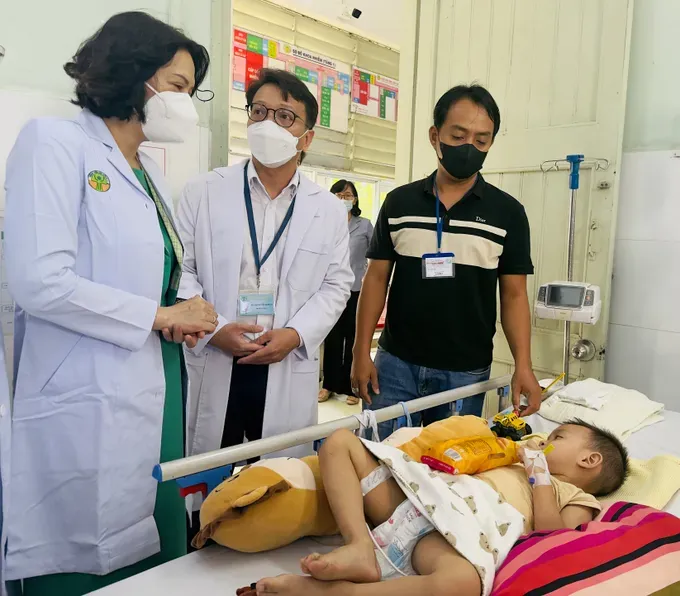
She urged local authorities to strengthen surveillance, ensure early detection and timely response to outbreaks, and review guidelines for close contacts to control transmission. Hospitals were also instructed to tighten infection control measures to prevent cross-infection, while ensuring adequate staffing, medicines, and disinfectants. Localities were asked to proactively prepare treatment resources and continuously update and train frontline healthcare workers.




)