Transformation from pressure
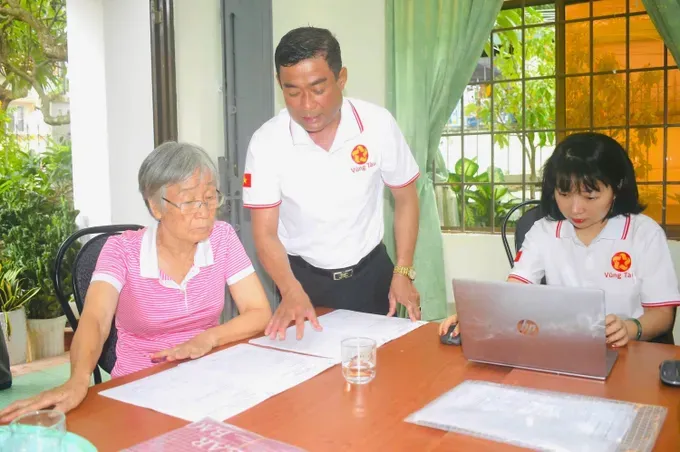
A weekend morning in Vung Tau Ward HCMC began with an announcement from the neighborhood loudspeakers: “Officers from the Vung Tau Ward Public Administration Service Center are currently in the neighborhood to assist residents with administrative procedures. Citizens are invited to bring their ID cards for guidance.”
Inside the office of Neighborhood No.6, the ward’s judicial-civil status officers meticulously were guiding residents through the steps of uploading documents to the system.
According to Nguyen Minh Dang, a resident of Neighborhood No.6, coming for administrative paperwork, such small tasks used to take an entire morning, or he even had to ask his children for help. Now, thanks to the proactive approach of the ward cadres, procedures have been simplified to the point where the work is finished before he can even warm his seat. “Everything is fast now, no need to travel back and forth, I’m very happy,” Mr. Dang said.
Beyond direct support, HCMC wards are expanding feedback channels and convenience. In Long Truong Ward, officers provide enthusiastic remote phone support, helping residents like Ms. Nguyen Thao Thuan navigate the National Public Service Portal without visiting the center.
Similarly, Tang Nhon Phu Ward is piloting eight decentralized intake points within neighborhoods to maximize access, a model also applied effectively in O Dien Commune of Hanoi. At Tan My Ward, specialized desks guide residents through technical procedures, while volunteers provide “hand-held” digital assistance to the elderly, helping them with tasks ranging from mouse movements to document attachments.
Furthermore, Phu Loi Ward has deployed hotline models and home delivery services for dossier results. These initiatives collectively demonstrate a robust shift toward proactive, citizen-centric administrative services that prioritize accessibility and hands-on support for all demographics.
The workload pressure at the grassroots level following the rearrangement of administrative units makes these changes even more commendable. These positive shifts demonstrate a service-oriented mindset. However, to maintain and replicate this enthusiasm, the grassroots cadre corps faces a significant challenge regarding workload volume and the requirement to enhance capacity post-rearrangement, necessitating an upgrade in the quality of grassroots staff.
- After rearrangement, the whole country has 3,321 commune-level units.
- Following review, the Ministry of Home Affairs proposed 36 job positions at the commune level, including 8 leadership/management positions and 28 professional positions arranged by sector/field (according to Dispatch No.9395/BNV-CCVC).
- Besides previous tasks, after rearrangement, the commune level must assume 1,065 tasks transferred from the district level.
Timely reinforcements
Following the administrative unit arrangement, the scale of many wards and communes has changed. Populations have increased and management scopes have widened, while the number of permanent staff remains unchanged. Consequently, workload volume has skyrocketed, with the majority being new tasks.
In HCMC, according to the municipal Department of Home Affairs, out of 1,065 current tasks, up to four-fifths are newly assigned to the commune level. This creates immense pressure but also poses an urgent requirement to upgrade the grassroots cadre corps to ensure the smooth operation of the two-tier local government model.
At the Tay Nam Ward Public Administration Service Center, for instance, officers face immense pressure handling complex, unfamiliar tasks ranging from business registration to land compensation. To cope, many wards are proactively innovating. Solutions include deploying guide robots, establishing digital support teams directly in residential areas, and organizing mobile support points available outside office hours. These measures aim to alleviate the burden on civil servants while ensuring citizens can easily access essential services.
Meanwhile, HCMC has been training over 16,000 cadres in digital transformation to meet modern management demands. Addressing specialized shortages, the city seconded 512 construction inspectors and 96 environment officers to grassroots levels, alongside establishing three high-level steering groups for public investment. These strategic reinforcements aim to prevent bottlenecks, ensuring wards and communes effectively deploy major tasks and maintain smooth operations during this critical transition.
Nationwide reforms are following HCMC, accelerating with a focus on “citizen convenience.” Quang Ngai Province deployed online appointment software featuring mobile booking and OTP verification at the commune level. Similarly, despite a population of 97,500, O Dien Commune in Hanoi maintains high efficiency by using QR codes for quick access and organizing home support teams for the elderly and disabled.
To address personnel gaps, Ha Tinh Province seconded provincial officers and rotated leaders to grassroots positions, while Bac Ninh Province mobilized employees from service centers.
These initiatives, ranging from digital tools to proactive support, create significant momentum. They transform wards and communes from mere implementation levels into vital fulcrums for a professional, effective administration that truly serves the people.
Placed within the requirements for the 14th Party Congress, with the mindset that “grassroots cadres are where policy is directly realized”, small deeds become even more significant. Grassroots cadres are no longer just signers and stampers; they have become builders of trust. Every explanation, every timely support is a step in fortifying the bond between the government and the people.
Broadly speaking, these small actions represent a transformation in management thinking, from “processing files” to “creating convenience,” and from “administrative execution” to “serving the people.”






)