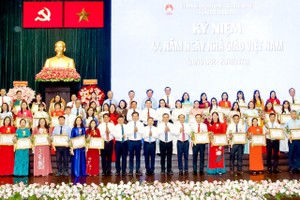
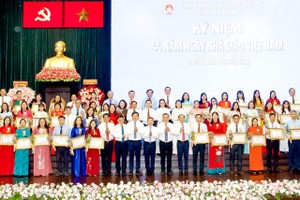
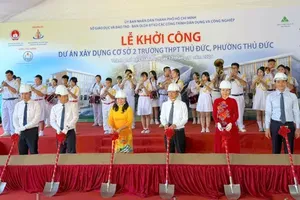
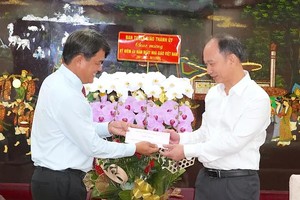
On the occasion of Vietnamese Teachers’ Day (November 20), Associate Professor and Doctor Nguyen Tan Phat, Director of the Ho Chi Minh City Department of Education and Training, spoke with reporters from Sai Gon Giai Phong Newspaper about the opportunities and challenges facing the city’s education sector in the coming years.
Translating special policy mechanisms into concrete measures
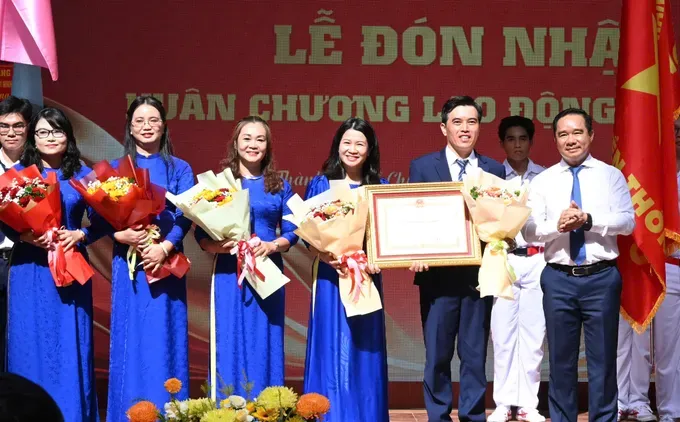
According to Nguyen Tan Phat, Director of the Ho Chi Minh City Department of Education and Training, the Law on Urban Development, together with the special mechanisms granted to Ho Chi Minh City by the National Assembly and the Government, is not merely an instrument for managing the economy and infrastructure but also a legal framework for developing a high-quality workforce – the foundation of a smart and sustainable city.
In line with the policies of the Ho Chi Minh City Party Committee, People's Council and People's Committee, the Department of Education and Training has translated the newly granted powers into a set of proposed policy measures as soon as the law takes effect. These include six draft resolutions of the Ho Chi Minh City People's Council and six draft decisions of the Ho Chi Minh City People's Committee. The documents are expected to be submitted in December 2026 and finalized in 2027.
The proposed measures focus on four key areas, including first, mechanisms for governance, financing and resource mobilization for different types of educational institutions; second, policies supporting comprehensive education, including scholarships and preferential incentives for gifted and talented individuals; third, support for learners, teachers and education administrators to pursue further studies, conduct research and undertake visiting lectureships in priority fields; fourth, the development of educational partnerships with foreign institutions and the introduction of education programs tailored to the city, while ensuring quality standards and upholding national education objectives.
The Department of Education and Training is also advising on investment policies for key educational and training institutions; the modernization of selected key colleges and high-quality vocational institutions; and tuition support for learners enrolled in priority fields and occupations, with the aim of bringing training standards closer to advanced regional and international levels.
Ho Chi Minh City is continuing its additional income policy for more than 117,000 public employees in the education sector. The department is also proposing support policies for school healthcare staff, school information technology personnel and teachers working far from home.
Restructuring the network of educational institutions has been the most challenging task facing the sector in 2026, bringing about changes to the structure of the entire system. The number of public educational institutions has fallen from 2,188 to 1,486, while the number of principals and vice principals has decreased from 5,874 to 3,129. Of those affected, 2,462 teachers have moved from management positions back to teaching roles, directly strengthening the teaching workforce.
With a people-centered approach and a commitment to leaving no one behind, the Department of Education and Training has implemented a comprehensive range of measures to safeguard the rights and interests of its workforce.
First, the criteria for assigning education administrators to new positions were made public before implementation, based on their professional capabilities, reputation, and sense of responsibility. Administrators who relinquish their positions or move to jobs with lower position-based allowances will have their previous leadership allowances preserved in accordance with the Government's and Ministry of Home Affairs' guidelines.
The department is reviewing each case individually, including those who have yet to be assigned new positions and those seeking transfers between communes and wards. Staff streamlining will only be considered after all options, including reassignment and transfers, have been reviewed and no suitable position can be arranged.
Ho Chi Minh City's education sector is committed to completing the stable placement of all education administrators affected by the restructuring in the coming period. It will also ensure that teachers do not experience delays or interruptions in the payment of salaries, allowances, or additional income due to changes in their workplace assignments.
Protecting and honoring teachers

With more than 2.6 million students enrolled in the 2026–2027 academic year, the scale of education in Ho Chi Minh City presents significant challenges for the sector. The Department of Education and Training is implementing measures to help teachers overcome mounting pressures and meet the demands of comprehensive education reform.
Ho Chi Minh City's education sector has a strong foundation, with more than 117,000 dedicated teachers, alongside new policy mechanisms introduced under Politburo Resolution No. 71-NQ/TW and the Law on Urban Development. Nevertheless, the sector frankly acknowledges three major groups of challenges.
First, pressures arising from the scale of education and the need to ensure equity. Continued growth in the city's migrant population is placing considerable pressure on school infrastructure and classrooms, resulting in localized teacher shortages in subjects such as Information Technology, foreign languages, and the arts.
Second, there is a need to strengthen professional capabilities in response to emerging technologies. The rapid development of artificial intelligence (AI) and the goal of gradually making English a second language require teachers to renew their teaching methods and enhance their digital and foreign-language skills. They must shift from simply imparting knowledge to fostering students' qualities and competencies.
Third, socio-psychological pressures. High expectations from parents, coupled with the multifaceted impacts of the online environment, underscore the need to safeguard teachers' reputation and professional dignity.
To address these challenges, the Department of Education and Training is focusing on several key groups of solutions. First are policies on recruitment, retention and professional development.
The department will continue advising the Ho Chi Minh City People's Committee to submit policies to the Ho Chi Minh City People's Council aimed at attracting, retaining and developing the teaching workforce.
In particular, the sector will shift from mass training to targeted professional development through specialized training courses with clearly assessed learning outcomes for teachers in STEM, artificial intelligence (AI), information technology and foreign languages.
The department will issue a framework guiding the safe application of AI in teaching. During the 2026–2027 academic year, it aims to provide AI training to 100 percent of education administrators and at least 50 percent of teachers, based on the principle that AI should support, not replace, teachers.
In parallel, a plan will be implemented to strengthen English-language proficiency among teachers, particularly those teaching science subjects in English, with clearly defined learning outcomes.
The sector will also expand teachers' opportunities for professional engagement. Teachers will be directly involved in developing supplementary education programs and advancing models of innovative, modern schools suited to the specific characteristics of Ho Chi Minh City.
At the same time, the entire sector will standardize and integrate databases in accordance with the principle of "enter once, use many times." It will resolutely reduce redundant paperwork, record-keeping, and reporting requirements, while completing the implementation of digital student records and electronic class registers.
Of particular importance is the protection and recognition of teachers. The department will establish a rapid-response mechanism to protect teachers against school violence and acts of abuse or harassment in cyberspace.
The sector will continue promoting meaningful emulation movements and recognizing outstanding teachers who demonstrate initiative, take responsibility, and embrace innovation and creativity. It also aims to make every school a happy learning environment where teachers feel encouraged and empowered to dedicate themselves to their profession.

On the occasion of Vietnamese Teachers’ Day, Mr. Nguyen Tan Phat, Director of the Ho Chi Minh City Department of Education and Training, on behalf of the department's leadership, extends his heartfelt gratitude to all teachers, education administrators and staff across the city's education sector – those directly engaged in classroom teaching as well as those working behind the scenes in supporting roles – for their continued dedication to the cause of education.
The education sector is facing significant demands for reform. He hopes that every teacher will continue to uphold their passion for the profession, pursue lifelong learning, embrace innovation and creativity, and inspire students' enthusiasm for learning.
Technology may transform teaching methods, but a teacher's dedication, integrity, intellect, and commitment are values that can never be replaced.
The city's education sector will continue to stand alongside teachers and advise on practical mechanisms and policies to improve their livelihoods and working conditions while safeguarding their legitimate rights and interests, enabling them to devote themselves to the profession with confidence over the long term.
The status of teachers must be established through strong policy support and society's trust. He wishes all teachers good health, happiness, and enduring pride in their noble mission.