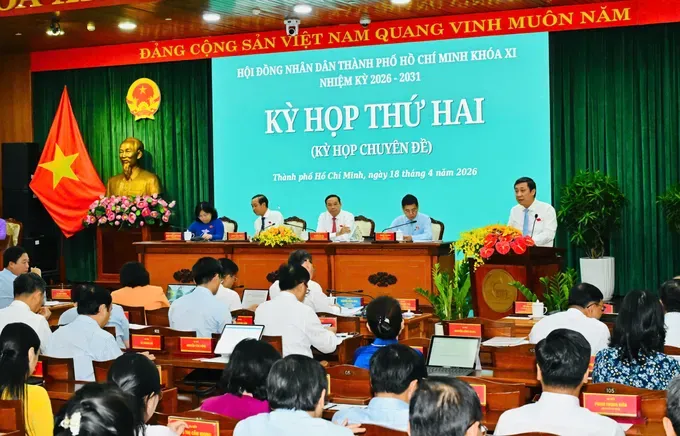
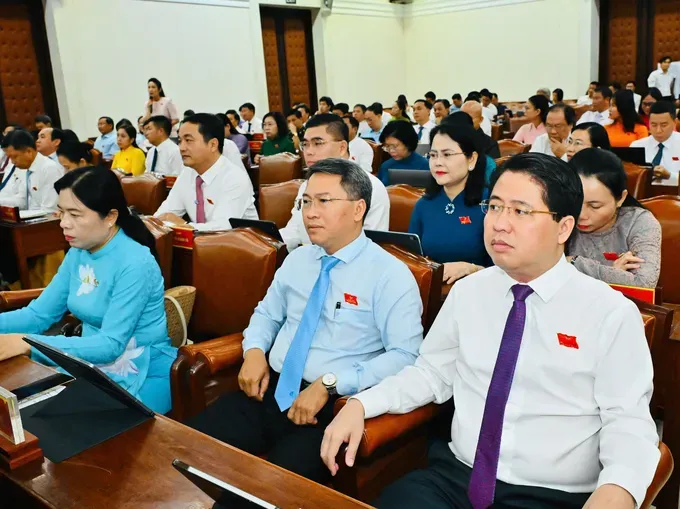
The decision was reached during the second session of the 11th Ho Chi Minh City People’s Council for the 2026–2031 term on April 18.
At the same session, delegates also approved the policy to convert the investment modality of the project to build the Symphony, Music, and Ballet Theater.
At the session, delegates approved key investment policies for major urban and cultural infrastructure projects.
During the meeting, delegates expressed strong consensus on the strategic necessity of the Central Square and Administrative Center. With a projected investment of approximately VND29.591 trillion. The project spans 46.72 hectares within An Khanh Ward, in the "golden core" of the Thu Thiem New Urban Area.
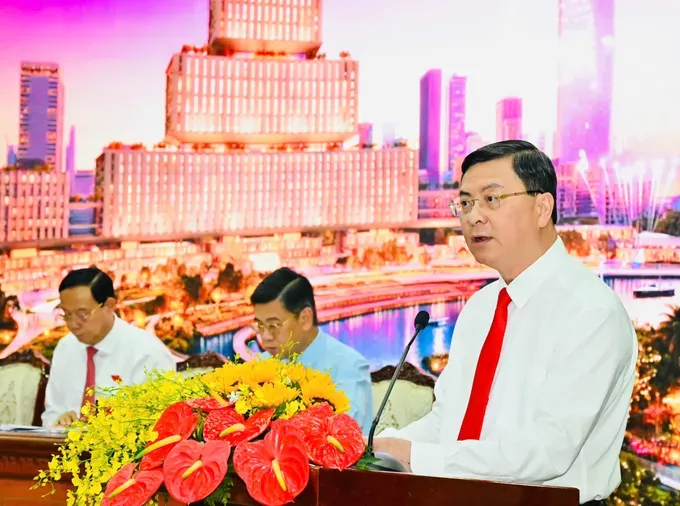
According to the proposed master plan, this architectural ensemble is envisioned as a complex that will integrate a centralized political-administrative hub with a convention and performing arts center, a sprawling central square, and an interconnected system of scenic waterfront parks. The design prioritizes a synchronized and contemporary spatial structure, aiming to redefine the city’s skyline and urban functionality.
The proposed investment comes amid significant changes in Ho Chi Minh City’s administrative and demographic scale following recent consolidation.
After the merger, the city has a population of nearly 14 million, covering an area of over 6,700 square kilometers and comprising 168 commune-level administrative units. The administrative apparatus has correspondingly expanded, with more than 8,000 officials, civil servants, and public employees currently working across multiple dispersed offices.
According to the Ho Chi Minh City People’s Committee, this situation has placed considerable pressure on office space, increased operational costs, and undermined the efficiency of inter-agency coordination as well as the implementation of modern governance models. Many existing office buildings, constructed decades ago, have deteriorated and lack adequate technological infrastructure, making it difficult to meet digital transformation requirements. Meanwhile, several facilities possess historical and architectural value that necessitates preservation.
Under the initial plan, the Ho Chi Minh City Administrative Center will have a total floor area of approximately 272,000 square meters, accommodating around 8,000 officials, civil servants, and public employees. The facility is also designed to serve between 1,500 and 2,000 citizens and businesses daily through a modern one-door administrative service system.
In addition, a conference and performance center with a capacity of about 2,000 seats is planned. The central square, together with parks, water features, and green spaces, will account for more than 60 percent of the total project area, contributing to the development of an ecological environment for the new central urban zone.
Under the submitted scheme, the project will be divided into four components, including the Administrative Center, the Conference and Performance Center, technical infrastructure and parks, and the Central Square.
The project is expected to be implemented under the public–private partnership (PPP) model, whereby the investor will mobilize 100 percent of the required capital, including 20 percent equity and 80 percent borrowed funds.
At the same session, the Ho Chi Minh City People’s Council approved a policy to change the investment modality for the Symphony, Music, and Ballet Theatre project.
Previously, the project had been approved in principle for investment using the city budget; however, it has yet to receive a formal investment decision from the competent authorities.
According to the project dossier, the theater is designed with a capacity of 1,700 seats, including a 1,200-seat main auditorium and a 500-seat smaller hall. The total construction floor area is projected at approximately 44,595 square meters, including basement levels, with a total investment of over VND1.508 trillion (US$57.4 million). The project is in An Khanh Ward and was supposed to start in 2018 and end in 2022.
After the investment policy was approved, the Management Board of Industrial and Civil Engineering Construction and Investment Projects of HCMC organized an architectural design competition, announced the selected design, and carried out several preparatory activities for the project, including securing necessary permits and engaging with stakeholders to ensure community support. To date, nearly VND4 billion (US$152,148) has been disbursed.
In early 2026, the Executive Committee of the Ho Chi Minh City Party Committee issued Resolution No. 05-NQ/TU, agreeing on the policy to implement the Political–Administrative Center project and the Central Lake green park area under the public–private partnership (PPP) model, applying a build–transfer (BT) contract with payment to be made through land resources.
According to the revised plan, the site of the Symphony, Music, and Ballet Theatre has been relocated from the Ba Son Bridge head area to a location adjacent to the Political–Administrative Center. In addition, the land parcel previously designated for the theater will be converted into a public green park and central square. The Theater–Performance–Conference complex will be developed under the public–private partnership (PPP) model, applying a build–transfer (BT) contract with payment made through land resources.
The Ho Chi Minh City People’s Committee has also issued a decision approving adjustments to the 1/2,000-scale subdivision zoning plan for sub-area No. 1 in the Thu Thiem New Urban Area. Accordingly, the land originally planned for the Symphony, Music, and Ballet Theatre at the Ba Son Bridge head has been redesignated from urban cultural land to public-use urban green space.



)