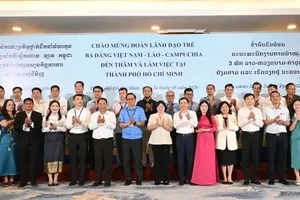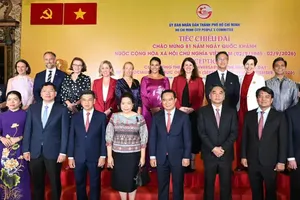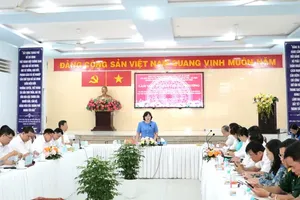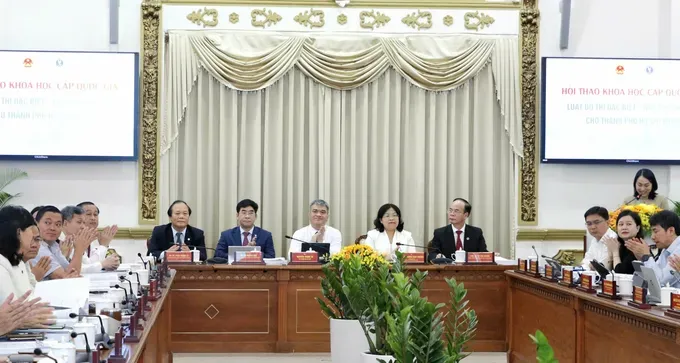
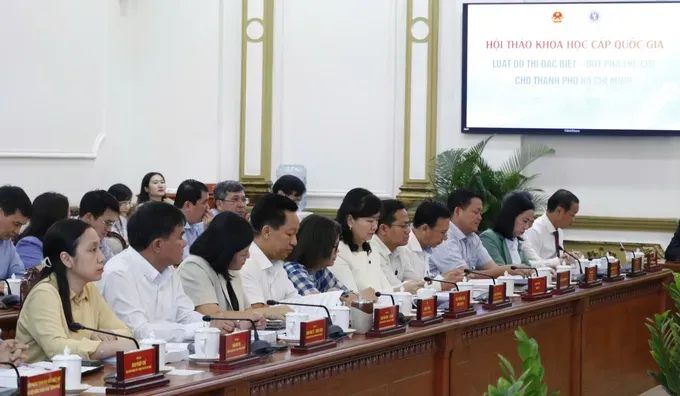
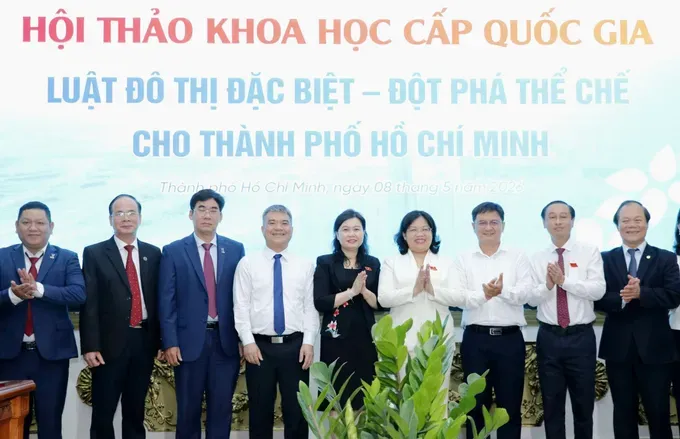
The conference was chaired by Deputy Minister of Justice Nguyen Thanh Tu; Vice Chairwoman of the Ho Chi Minh City People’s Council Nguyen Truong Nhat Phuong; Assoc. Prof. Dr. Vu Van Nhiem, Secretary of the Party Committee of Ho Chi Minh City University of Law; Dr. Le Truong Son, President of Ho Chi Minh City University of Law; and Prof. Dr. Phan Trung Ly, former Chairman of the National Assembly’s Committee on Legal Affairs.
Attending the conference were Mr. Nguyen Manh Cuong, Vice Chairman of the Ho Chi Minh City People’s Committee and member of the Steering Committee for research and proposals on the formulation of the Special Urban Law; Major General Ta Van Dep, Deputy Director of the Ho Chi Minh City Department of Public Security; Senior Colonel Tran Van Cu, Deputy Commander of the Ho Chi Minh City Command; among others.
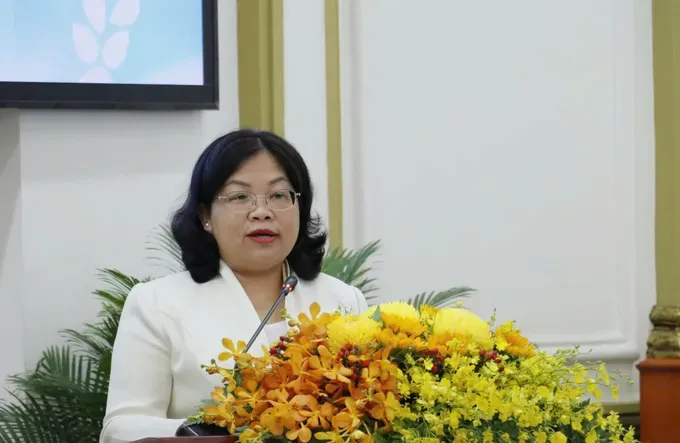
Speaking at the conference, Vice Chairwoman of the Ho Chi Minh City People’s Council, Nguyen Truong Nhat Phuong, emphasized that Ho Chi Minh City has consistently been identified as the nation’s and region’s center for economic, financial, commercial, scientific-technological, and innovative activities.
She noted that the Party and the State have always paid close attention to and created favorable conditions for the city through pilot implementation of several special mechanisms and policies. These efforts have delivered significant achievements and laid an important foundation for the city to effectively tap into and maximize its development potential.
However, practical experience has shown that pilot mechanisms are often limited in duration and, at times, lack synchronization with the broader legal framework. The transition from “pilot resolutions” to a sustainable legal instrument such as the Special Urban Law is therefore an urgent requirement to establish a stable, flexible institutional framework capable of meeting the city’s long-term development needs.
The conference also sought to gather opinions and recommendations from elected representatives and leaders of departments and agencies, as well as legal experts and the business community, in order to propose specific provisions for inclusion in the draft law.
At a working session with the Standing Committee of the Ho Chi Minh City Party Committee on April 27, Party General Secretary and State President To Lam affirmed the support of the Politburo, the National Assembly, and the Government for the city in developing the draft Special Urban Law.
The Ho Chi Minh City People’s Council expressed its hope that experts and scientists would engage in in-depth discussions and propose specific provisions for the draft law, focusing on several core areas. These include drawing from the operational outcomes of the two-tier local government model to recommend provisions aimed at improving Ho Chi Minh City’s governance structure in line with the requirements of modern, flexible, and effective administration; proposing mechanisms for further decentralization and delegation of authority to the city; and formulating provisions to enhance the city’s autonomy in finance, budgeting, and staffing, coupled with greater transparency and accountability, in line with the principle of “localities decide, localities implement, and localities take responsibility.”
In addition, participants discussed and proposed provisions for the draft Special Urban Law aimed at mobilizing and effectively utilizing the city’s resources, including land and financial resources, as well as solutions to attract private-sector participation in the development of transport infrastructure, social infrastructure, healthcare, and education.
The conference also called for proposals on enabling provisions that would foster new and breakthrough sectors in finance, science and technology, and innovation. These recommendations, it was stressed, should stem from practical bottlenecks and challenges encountered during the implementation of pilot mechanisms under resolutions providing special policies for the city.
Leaders of the Ho Chi Minh City People’s Council also expressed their hope that delegates would focus on proposing breakthrough mechanisms to attract leading experts and scientists, as well as mechanisms to ensure reasonable income policies for officials, civil servants, and public employees. These mechanisms, they noted, should be linked to job performance outcomes while also protecting those who dare to think innovatively and take bold actions for the common good.
Based on the outcomes of implementing special mechanisms and policies under the National Assembly’s Resolution No. 54/2017/QH14, Resolution No. 98/2023/QH15, and Resolution No. 260/2025/QH15, delegates proposed general provisions to ensure the consistent and substantive application of the preferential and breakthrough policies stipulated in the law, particularly in the implementation of pilot models and mechanisms.
The organizing committee of the conference received 66 papers from experts, scientists, and delegates. These papers offered diverse and multifaceted perspectives across various sectors while also providing specific recommendations for inclusion in the draft Special Urban Law.