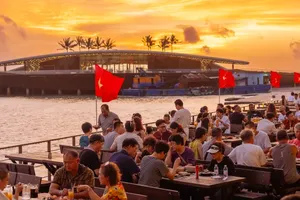
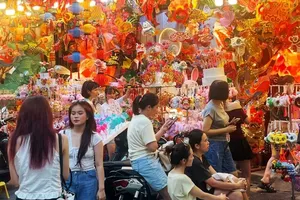
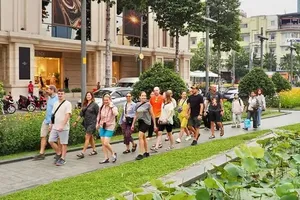
The Old Quarter and areas around Hoan Kiem Lake have become busier, with many accommodation establishments fully booked on weekends, while walking and food tours have also seen rising visitor numbers.
Scrambling to find accommodation
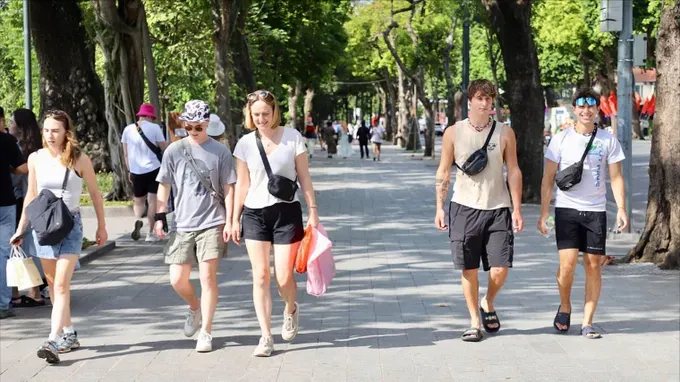
To find accommodation for a group of friends from Ho Chi Minh City visiting Hanoi this weekend, Nguyen Viet Ha, a Hanoi resident, contacted more than a dozen hotels in the Old Quarter, including those on Ma May, Ta Hien, Luong Ngoc Quyen, and Hang Bac streets in Hoan Kiem Ward. All told, they were fully booked. She eventually found a suitable room, but it was located quite far from the heart of the Old Quarter.
Speaking to Sai Gon Giai Phong (SGGP) Newspaper’s reporters about the weekend room shortage, Nguyen Ha Anh, owner of a hotel in Hoan Kiem Ward, said international visitor arrivals in Hanoi had begun to pick up again from mid-September following the summer low season.
Accommodation establishments in convenient locations, close to pedestrian streets, tourist attractions, and areas known for food and entertainment, such as Ma May, Ta Hien, Hang Be, Hang Hanh, and Hang Trong streets, often reach full occupancy by midweek.
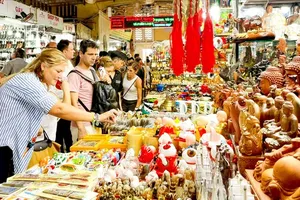
In recent weekends, the area around Hoan Kiem Lake and Hanoi’s Old Quarter has been bustling with residents and tourists coming to sightsee, stroll, and take photos. Long streams of visitors have been seen along streets including Dinh Tien Hoang, Hang Bai, Hai Ba Trung, Trang Tien, Cau Go, and Dinh Le.
The area around the Ho Chi Minh Mausoleum, St. Joseph’s Cathedral, and the railway-side cafes on Tran Phu Street has also attracted large numbers of foreign visitors. Many have taken the opportunity to photograph and explore Hanoi’s distinctive attractions.
Along with the rise in visitor numbers, many hotels and guesthouses around Hoan Kiem Lake and the Old Quarter have also been fully booked as reservations increase. However, Nguyen Ho Anh noted that the localized shortage of rooms at some hotels does not mean that the entire Old Quarter is overcrowded.
“Most accommodation establishments in the area are small- and medium-sized, mainly boutique hotels—small hotels with distinctive designs—or homestays, with around 10–25 rooms each. Therefore, some hotels may report being fully booked simply because of their limited room capacity. For visitors who have not made reservations, checking online booking platforms or booking early will help them make better arrangements,” he suggested.
Expanding the scope of tourism experiences
Do Minh Duy, a tour guide specializing in English-speaking visitors, said that over the past two weeks, his schedules for walking tours exploring the Old Quarter and street food tours have been almost fully booked.
European visitors particularly enjoy Hanoi’s autumn weather, so they tend to opt for walking tours through the Old Quarter’s narrow lanes, visits to Dong Xuan Market, and experiences such as egg coffee and bun cha (grilled pork and rice noodle salad), Minh Duy said.
However, he noted that the concentration of large numbers of visitors within a short period has also highlighted several limitations in the Old Quarter’s transport infrastructure and public spaces, including localized congestion at some narrow intersections and a shortage of parking areas for vehicles transporting visitors from the Old Quarter to attractions on the outskirts of the city.
Nguyen Tien Dat, Vice Chairman of the Hanoi Tourism Association, said that October onward is typically the period when Hanoi sees a surge in international visitors, continuing through the 2027 Lunar New Year holiday. As visitor numbers rise, the city center is also more likely to face pressure on accommodation, traffic, and services.
During peak periods, businesses can also gain a clearer understanding of what visitors are looking for: walking, dining, discovering old streets, admiring architecture, visiting a local market, or talking with residents. Driven by these preferences, walking and food tours in the Old Quarter are attracting more visitors.
According to Mr. Nguyen Tien Dat, these products can also be connected with other destinations so that a Hanoi trip is not limited to a few streets in the city center. “Visitors to Hanoi are now spending more time on experiences connected with local life,” he said.
Dr. Vu Huong Giang of the Faculty of Tourism at Hanoi Open University also said that what attracts international visitors can sometimes be found in very small experiences. A dish, a traditional craft street, an old house, or the way local people go about their daily lives can all leave visitors with lasting memories of Hanoi. From the Old Quarter, such journeys can extend to a traditional craft village, museum, market, or heritage site.
Visitors can still return to the Old Quarter to enjoy local dishes, sit at a small café or continue exploring its old streets, but between these stops lies a broader Hanoi with a wider range of experiences and destinations.
According to statistics, Hanoi welcomed approximately 27.5 million visitors in the first nine months of the year, up more than 6 percent year on year. International arrivals exceeded 6.6 million, up 22 percent, including 4.7 million staying overnight. Domestic visitors totaled 20.9 million, up 2 percent. Total tourism revenue was estimated at VND113.2 trillion (US$4.35 billion), an increase of more than 13 percent year on year.