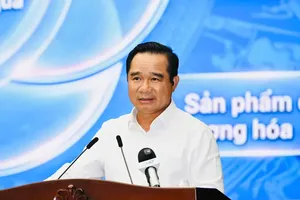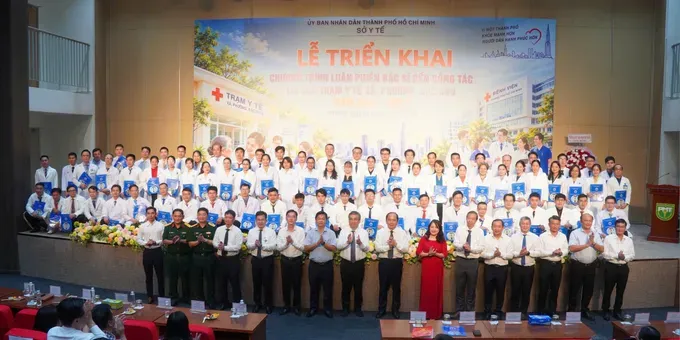
Attendees included Nguyen Phuoc Loc, Vice Secretary of the Party Committee and Chairman of the Vietnam Fatherland Front Committee of Ho Chi Minh City, and Le Van Minh, Standing Deputy Head of the Ho Chi Minh City Party Committee’s Commission for Information and Education.
According to Dr. Nguyen Van Vinh Chau, Deputy Director of the municipal Department of Health, the hospital-health station partnership program for 2026-2030 aims to strengthen grassroots healthcare capacity and shift from a largely reactive approach to medical examination and treatment toward proactive, continuous healthcare.
Under the program, all 168 commune-, ward-, and special zone-level health stations will be partnered with hospitals that provide professional support, assistance with management, and connections to specialized hospitals when necessary.
In the first phase, 79 doctors from 39 hospitals and regional medical centers will be rotated to 37 understaffed health stations, ensuring that each has at least five doctors. In addition to examining and treating patients, the doctors will transfer technical expertise, train local healthcare staff, manage chronic diseases, and facilitate medical consultations and patient referrals to higher-level facilities.
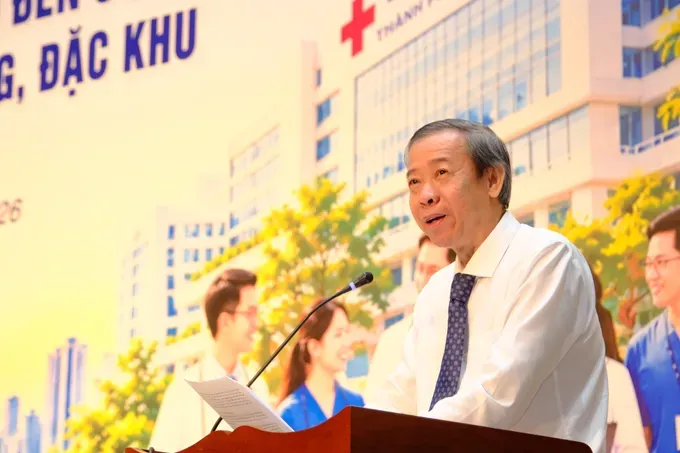
Speaking at the ceremony, Vice Secretary of the Ho Chi Minh City Party Committee Nguyen Phuoc Loc praised the proactive approach and strong sense of responsibility demonstrated by the municipal Department of Health, hospitals, and medical staff in implementing the program. He said the initiative was not merely intended to supplement staffing at grassroots healthcare facilities but also represented an important step toward improving primary healthcare and meeting the operational requirements of the two-tier local government model.
According to him, implementing the program at 37 health stations facing doctor shortages reflects the healthcare sector’s thorough, systematic preparations and strong sense of responsibility.
Notably, nearly half of the 79 doctors participating in this rotation phase hold Level II specialist qualifications. This represents an important human resource for strengthening examination and treatment capacity at grassroots facilities, enabling residents to access quality healthcare services where they live.
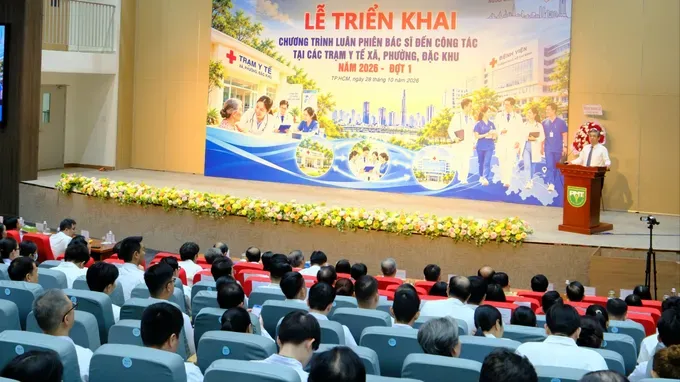
Deploying doctors with advanced expertise will help ensure timely treatment for many complex cases, avoid unnecessary referrals to higher-level facilities, ease pressure on upper-level hospitals, and strengthen public confidence in the healthcare system. Strengthening grassroots healthcare must be identified as a key, regular, continuous, and long-term task for the entire Ho Chi Minh City healthcare sector, he stressed.
He also called for the doctor rotation program to be closely integrated with partnerships between higher-level hospitals and health stations, guided by the principle of “placing health stations at the center, higher-level hospitals as the foundation, and rotating medical staff as the mainstay.”
He noted that strengthening grassroots healthcare must be part of the city’s broader strategy to develop a multi-center, multi-tier, and multi-polar healthcare system, alongside investment in facilities and equipment, human resource development, and expansion of the network of specialized healthcare services.

The city should also continue refining mechanisms and policies to support rotating doctors and attract highly qualified personnel to work at grassroots facilities on a long-term basis. Local authorities must ensure adequate working conditions, accommodation, and other essential facilities so that doctors can work with confidence. Communication efforts should also be stepped up to encourage residents to trust and proactively use healthcare services at local facilities.
The city hopes that hospitals under ministries and central agencies, as well as centrally managed hospitals based in Ho Chi Minh City, will join the initiative and help improve the quality of public healthcare. This is not simply about adding personnel to lower-level facilities; it also lays the foundation for building an equitable and comprehensive healthcare system in which every resident can receive care where they live, he emphasized.