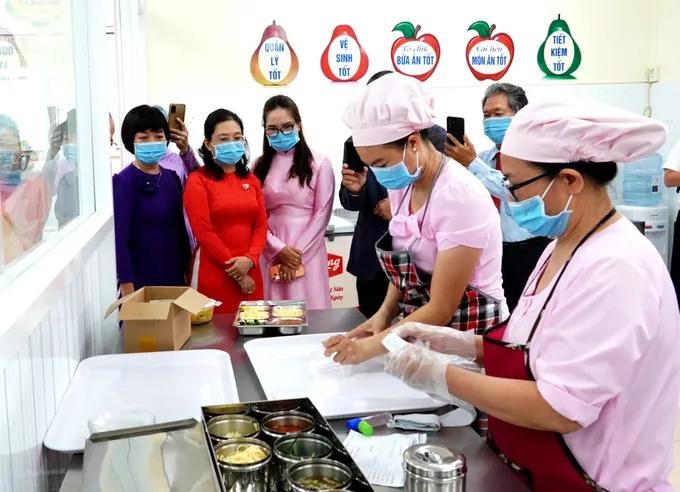
At the onset of the 2026-2027 academic year, parents of students in Ho Van Long Junior High School (Binh Tan Ward) urgently submitted an “Emergency Request” reporting spoiled, undercooked boarding meals.
The Binh Tan Ward People’s Committee immediately coordinated with the HCMC Department of Food Safety to jump into the fray. Subsequent verification explicitly revealed the meal provider utterly failed to guarantee sufficient operational capacity. Consequently, the school swiftly terminated the contract, expeditiously securing a replacement to ensure perfectly safe student meals.
Handling pressing reflections concerning student health simply can’t wait for multiple reporting tiers. Functional agencies must swiftly hit the ground, rigorously inspecting food sources to answer parents with tangible results. The HCMC Department of Education and Training explicitly demanded educational facilities review providers’ legal dossiers, tightly control supply chains, and definitively resolve complaints within 24 hours. This highly specific incident profoundly became the foundational baseline for tightening citywide procedures.
Over in Tan My Ward, following citizens’ complaints regarding an inconveniently arranged Public Administration Service Center, officials urgently reorganized the spatial layout. They strategically categorized reception counters, tracked processing progress, and proactively guided citizens regarding necessary documents.
Personnel were appropriately deployed to curb congestion; consequently, dossier submission wait times clock in under 20 minutes. Thanks to this, citizens drastically reduced travel frequency and can effortlessly grasp their dossier’s exact status. Diving into the work doesn’t mean doing everything for others; it’s about proactively spotting bottlenecks and never letting citizens wander around searching for whoever’s in charge.
That specific spirit vividly manifests in handling tasks that can’t be completed immediately. Officials must explicitly communicate what’s finished, which segments await feedback, and the projected timeline. This crystal-clear transparency helps citizens monitor progress while concurrently curbing the troubling trend of empty promises.
For exceptionally tough tasks, the head figure’s role becomes increasingly paramount, simply because they possess the sheer authority to untangle coordination bottlenecks and explicitly pinpoint individual responsibilities.
Resolution No. 31-NQ/TW strictly demands citizens’ petitions be meticulously handled to the very end. Feedback must be prompt, highly transparent, and inextricably linked to overall accountability. Lingering, deeply frustrating issues must be viewed as glaring warning signals regarding management quality.
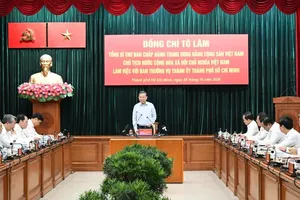
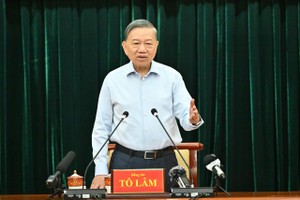
At a recent national conference, General Secretary and State President To Lam emphatically stressed that leadership decisions must possess a practical basis and be carefully tracked to final outcomes. Grassroots reflections regarding officials causing unnecessary hassles must be thoroughly reviewed by the Party organization to swiftly rectify the situation. Through resolving real-world tasks, organizations are heavily consolidated.
For a massive metropolis boasting a highly diverse socio-economic life like HCMC, Secretary of the HCMC Party Committee Tran Luu Quang demanded the government bear absolute responsibility for orchestrating concrete outcomes. Every single task must have a highly capable individual handling it. That specific ethos demands leaders don’t merely sit back receiving reports; they must know exactly where the work is bottlenecked, who is presiding, and precisely when it’ll be completed.
At Binh Phu Ward, that strict requirement is explicitly concretized from receiving to meticulously monitoring work resolution. The ward actively receives information via administration centers, voter discussion sessions, and digital portals. Reflections within their authority are handled immediately, while tasks exceeding it are swiftly forwarded to competent agencies and continuously urged along.
Vice Chairman of the Binh Phu Commune People's Committee Doan Quang Luan stated this proactive approach successfully tackled street lighting and fixed leaking garbage trucks, earning high praise from the local populace. The Ward People’s Council also successfully rolled out a digital map to strictly monitor voter petitions. Thanks to this cutting-edge tool, it’s possible to track who is handling a task, exactly which stage it’s stuck in, and whether it’s overdue. Forwarding a document can’t be considered completed if the core issue remains unresolved.
Over in Long Truong Ward, Sky 9 Apartment Complex residents repeatedly petitioned to open a rear gate to Lien Phuong Street, allowing two-wheeled vehicles to avoid dangerous crowding.
By June 1, 2026, following practical field surveys, the HCMC Department of Construction explicitly supported opening the route with stringent safety conditions. Residents highly appreciate that functional agencies directly hit the ground and explicitly communicated necessary conditions, actively helping them know exactly how far their proposal has progressed.
Every single resolved issue essentially represents an instance where the apparatus rigorously self-checks its methodology. Former Deputy Minister of Home Affairs Nguyen Tien Dinh argued the new apparatus must shift from a sheer management mindset toward a deeply service-oriented one. Officials can’t merely wait for citizens to reflect on issues; they need to proactively grasp pressing needs. That sheer proactiveness is exceptionally necessary for marginalized households currently bogged down in prolonged dossier issues.
A processing cycle is strictly finalized only when the citizen receives the outcome and the agency practically re-verifies the on-the-ground reality. Recurring reflections must be categorically viewed as crucial data to evaluate methodology.
Building and renovating the Party according to Resolution 31-NQ/TW include thoroughly grasping the viewpoint of taking the people as the sheer root. According to Dr Nhi Le, Former Deputy Editor-in-Chief of the Communist Review, this intrinsic self-renewal process must begin within the daily workload of every single official. Words must inextricably go hand in hand with concrete actions yielding tangible products. A leader needs to listen, spearhead difficult tasks, and firmly subject themselves to the people’s rigorous supervision. Dodging responsibility will inevitably erode an official’s major prestige.