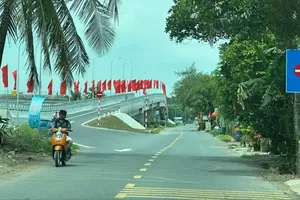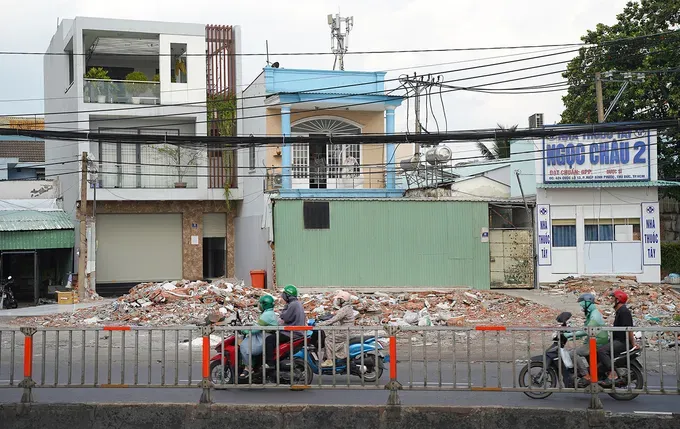
HCMC has broken ground on the project to upgrade and expand National Highway 13. Along the route, numerous houses situated close to the street have been dismantled to hand over the premises. In Hiep Binh Ward, 1,041 cases are heavily affected, encompassing 213 total clearance and 828 partial clearance cases. By the commencement date, the locality successfully handed over more than 80 percent of the site to investors.
One specific instance involves Mr. Nguyen Van Cuong, whose house required a 13-meter setback. For Mr. Cuong, personalized dialogue made all the difference. After meeting with officials who thoroughly explained policies and discussed repairing the remaining structure, his family promptly handed over the premises.
Vice Chairman Pham Van Hung of the Hiep Binh Ward People’s Committee noted that each case possesses unique characteristics regarding land origin, compensation, and resettlement. Therefore, the ward systematically assigns officials to work directly with households to pinpoint lingering hurdles. “You absolutely have to go down and meet the people to actually know where each household is stuck, so you can accurately explain and persuade them,” he said.
In Phuoc Thang Ward, the Hang Dieu 4 road project boasts an investment of VND473.9 billion (US$18.1 million), reclaiming over 32,614 square meters and involving 290 households.
For Mr. Nguyen Vu Hung, a homeowner facing total displacement, the initial prospect brought considerable anxiety regarding compensation levels and accommodation support. Faced with his petition, authorities didn’t hesitate to directly meet with the family to provide nuanced explanations. Once bottlenecks had been clarified, it effectively helped the family understand their inherent rights and build consensus. Subsequently, they proactively relocated their assets, handing over the entire premises.
Chairman Nguyen Viet Dung of the Phuoc Thang Ward People’s Committee stressed that the locality is determined to grasp every single case. They intensely focus on untangling inquiries wherever residents are stuck. By June 2026, the final 25 cases had reached a consensus, voluntarily dismantling structures. The entire reclaimed area was successfully handed over to deploy the project.
Reality demonstrates that persuasion only holds true convincing power when coupled with transparent policy disclosures, clear responses to petitions, and the timely resolution of citizens’ legitimate rights. This is exactly the approach Dong Hoa Ward is currently executing to clear the site serving the HCMC National University Urban Area project, an endeavor that has dragged on endlessly for several years and still harbors numerous complex files.
Across the ward’s jurisdiction, there are reportedly 785 cases affected by the project. As of mid-August, 140 cases hadn’t yet handed over their premises, and roughly 150 cases hadn’t executed the tallying process.
Dong Hoa Ward People’s Committee Chairman Vo Trong Tai informed that the locality is currently reviewing each file and directly meeting with residents to understand their anxieties regarding compensation, resettlement, and post-relocation livelihoods, thereby selecting a suitable method for resolution and persuasion.
The family of Mr. Duong Van Thang, residing in Tan Lap Neighborhood, owns 31 boarding rooms spread across an area of 875 square meters, and they were initially anxious about the financial obligations attached to the resettlement slot.
Through a meticulous review, the ward relied on the previous regulations of the former Binh Duong Province, which explicitly determined that the investor bears the responsibility for executing land allocation procedures, certificate issuance dossiers, relevant taxes, fees, charges, and land use levies according to strict regulations.
The ward actively collaborated with the tax authority to handle the recording of financial obligation debts for the households. By August 13, Tax Unit No.26 officially confirmed the erasure of tax debts for 11 households that had voiced feedback, and it continues to process the remaining cases. Once the bottleneck had been resolved, Mr. Thang’s household and other related families agreeably handed over the premises.
For households enduring highly specific circumstances, the ward mobilizes additional resources to provide dedicated care. For instance, 88-year-old Tran Van Truong received profound attention from the Tan Lap Neighborhood Executive Board and the Dong Hoa Ward People’s Committee, who collectively mobilized philanthropists to pitch in and comprehensively resolve social welfare policies for him.
Beyond the mandatory compensation and support stipulated by regulations, the ward utilized social funds to help his family rent a new place to live, simultaneously arranging vehicles to dismantle and transport their assets off the cleared land to hand over the site for the project.
According to Chairman Vo Trong Tai, state officials must clearly identify issues within their jurisdiction to resolve them immediately. Meanwhile, problems demanding coordinated resolution can’t just be ignored, as they must be transferred to the correct agencies and diligently tracked until results are achieved. Any matters exceeding their authority must be promptly reported, proposing processing directions to avoid letting files drag on endlessly while residents anxiously wait.