Eighty-one years later, historic sites such as Tan Tuc Communal House, Tao Dan Park, the Nguyen Van Hao Theater (now Cong Nhan Theater) and the former Dinh Doc Ly (now the headquarters of the Ho Chi Minh City People's Committee) still stand amid the modern cityscape, preserving memories of those historic autumn days.
Memories of the historic August days
In August 1945, revolutionary fervor quickly spread to many localities across the country. In Saigon, Cho Lon and Gia Dinh, following the General Uprising order issued by the National Uprising Committee, the Standing Committee of the Tien Phong Regional Party Committee established an Uprising Committee on August 15, 1945, with Regional Party Committee Secretary Tran Van Giau as its chairman. Preparations to seize power were urgently undertaken.
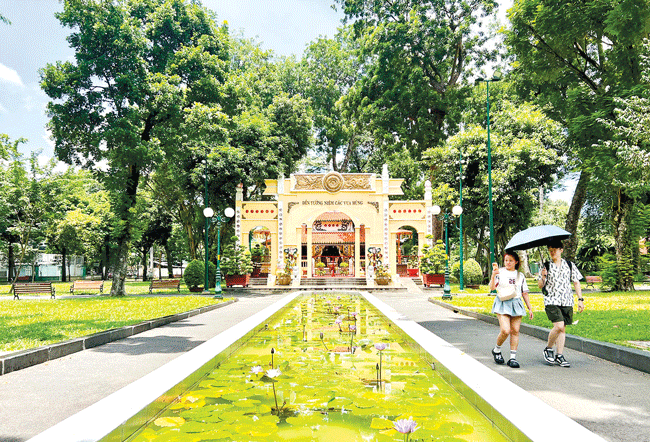
One of the first places to become a gathering point for the masses was Ong Thuong garden, now Tao Dan Park. On the morning of August 18, 1945, a hammer-and-sickle flag was raised in front of the medical clinic of Dr. Pham Ngoc Thach, Secretary-General of the Thanh nien Tien phong (Vanguard Youth) organization. That afternoon, Thanh nien Tien phong (Vanguard Youth) held its second oath-taking ceremony at Ong Thuong garden, awaiting the opportunity to launch the uprising.
From a green space in the heart of the city, Ong Thuong garden became a place where revolutionary fervor spread and patriotic spirit was awakened among large numbers of people.
If Ong Thuong garden helped ignite the revolutionary spirit, the Nguyen Van Hao Theater, later known as Cong Nhan (Workers) Theater, became the next focal point. The book Lich su Nam Bo khang chien (History of the Southern Resistance War) (Volume 1, 1945-1954) records that on August 19, 1945, two consecutive rallies organized by the Viet Minh Front Committee and the Tien Phong Regional Party Committee were held there, encouraging the masses to rise up at this decisive moment.
In the book Saigon khau lai manh thoi gian (Saigon stitches back a fragment of time), author Le Van Nghia also mentions the Nguyen Van Hao Theater as a renowned address in the city's cultural life. The area around the theater was known among journalists and artists as the “international crossroads,” where numerous newspaper offices, printing houses, cafes and teahouses were located and where members of the arts community often gathered.
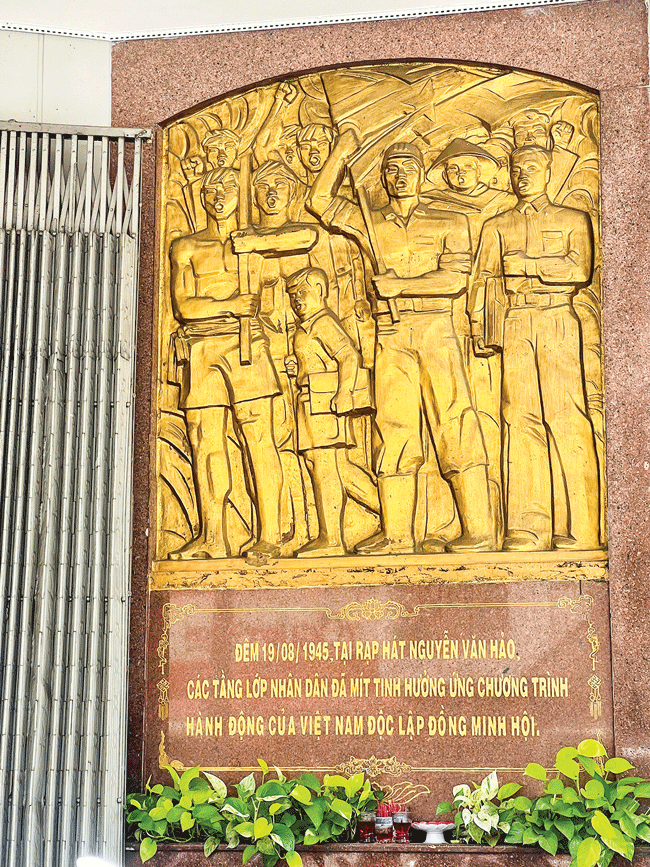
From a familiar cultural venue, the Nguyen Van Hao Theater entered history as a place where people publicly expressed their aspirations for independence.
At 6:00 p.m. on August 24, 1945, the Southern Uprising Committee issued the order to launch the uprising in accordance with the agreed-upon plan that was to complete the occupation of all government offices between dusk and midnight. From midnight onwards, hundreds of thousands of people including those from the Cho Dem area in what is now Tan Nhut Commune, Ho Chi Minh City streamed into the city center.
Tan Tuc Communal House is situated on a vital waterway connecting Saigon via Cho Dem to Ben Luc and the Vam Co Dong River; consequently, it held a special place in local life and revolutionary activities. During the resistance war, the communal house served as a site for gathering, meetings, and the concealment and support of revolutionary forces.
In the early years of the resistance against the French, it housed the Administrative-Resistance Committee and served as the base for the Tan Tuc Company (part of the Cho Dem Force) and the national guard; it was also a staging point and supply hub for the Cho Dem front.
In the early hours of August 25, 1945, residents from the inner city, suburbs, and neighboring provinces converged on the center of Saigon, carrying flags, banners, and slogans. Formerly serving as the Doc Ly Palace and currently functioning as the headquarters of the Ho Chi Minh City People's Committee, the structure emerged as a central hub during the uprising. The surrounding streets were awash with red flags featuring yellow stars, while the melodies of Quoc te ca (The Internationale), Len Dang (Marching Forth), and Thanh Nien Hanh Khuc (Youth March) rang out across the city.
Saigon sites keep alive echoes of revolution and resistance
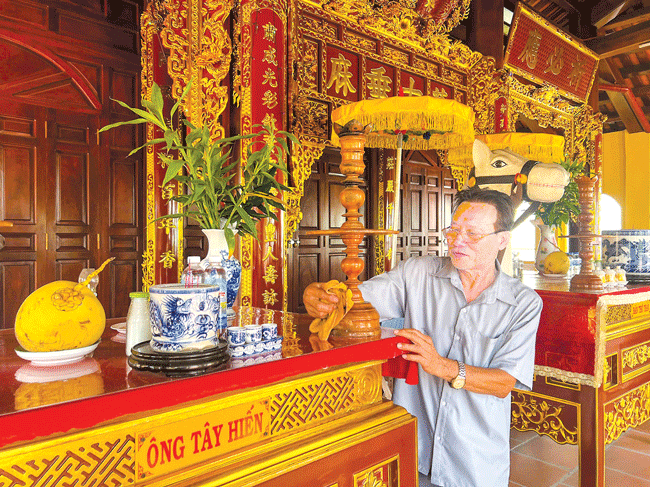 Mr. Huynh Van Ha carefully takes care of exhibits in Tan Tuc Communal House
Huynh Van Ha—aged 65 and affectionately known as Uncle Chin Ha—has been closely connected to Tan Tuc Communal House since 1981. He is intimately familiar with every corner of the courtyard, the altar room, and the artifacts preserved across generations.
Stories from the wartime era also live on in his family memories. He recalled that his family used to live right next to Tan Tuc Communal House. Many members of his family and extended clan participated in the revolution, so he heard many stories about the site. Back then, the area around the communal house served as a gathering point; boats transporting provisions would pass along the Cho Dem River, and there were camouflaged paths at the rear allowing forces to retreat during emergencies.
Over more than 45 years of dedication to the communal house, the man has become accustomed to sweeping, tending the plants, preparing for ceremonies, and welcoming visitors. He carefully preserves the old artifacts because, as he puts it, they are legacies left by his forebears and embody the memories of the entire region.
Eighty-one years after the August Revolution, the city has transformed. Roads that were once quiet now teem with traffic, and sparsely populated areas have evolved into bustling neighborhoods. Amidst this hectic pace of life, traces of August 1945 remain, safeguarding the city's treasure trove of memories.
Chairwoman Le Tu Cam of the Ho Chi Minh City Heritage Association shares that recalling Tao Dan evokes not merely a political event, but memories of youthful strolls through the park in a Saigon far less congested than it is today. To her, the park was a place where young people walked with minds sparkling with personal thoughts and dreams; it was also a venue for gathering and spreading the spirit of revolutionary struggle.
Ms. Le Tu Cam also mentioned a location in the Nga Bay area—the small headquarters of a young workers' organization on Ly Thai To Street. Such sites served as starting points for many struggles waged by the people of Saigon. A particularly memorable event was the demonstration on May 1, 1966, when the slogan "US go home" appeared, painted right onto the street surface in the heart of the city.
Today, visitors to the Cong Nhan Theater at 30 Tran Hung Dao Street can still see a relief sculpture bearing the inscription: "On the night of August 19, 1945, at the Nguyen Van Hao Theater, people from all walks of life gathered to rally in support of the action program of the League for the Independence of Vietnam (Viet Minh)."
The Nguyen Van Hao Theater also witnessed numerous forms of artistic activism in the years that followed. On the night of December 19, 1955, during a performance of the play Lap song Gianh (Filling the Gianh River), a grenade was thrown onto the stage, causing casualties. Although the incident sent shock waves through the community, it failed to dampen the patriotic spirit of Saigon’s artists and intellectuals.
Ho Chi Minh City seeks to revitalize 200 heritage sites beyond records
As of 2025, Ho Chi Minh City boasts 200 classified heritage sites, comprising two special national monuments, 58 national monuments, and 140 city-level monuments. Among the 140 city-level sites are 54 historical monuments, alongside numerous locations linked to the struggle for national independence. The city is certainly not lacking in such "red sites"—places of revolutionary significance but the challenge lies in how to move them beyond mere administrative records, tell their stories more vividly, and transform them into vibrant destinations within modern urban life. Ms. Le Tu Cam believes that preservation is only half the story.
"Preserving a monument does not simply mean leaving it in place to be worshipped like an altar. A family’s death anniversary holds meaning because descendants gather to reconnect and recount their ancestors' stories. Heritagesites are much the same; if we merely maintain their physical state without telling their stories or creating opportunities for future generations to engage with them, the heritage's full value remains unrealized," Ms. Cam observed.
Envisioning a “map of memories,” one can trace a historical route through the heart of Ho Chi Minh City, guided by its monuments and landmarks. The journey begins at Tao Dan Park, where the Thanh nien Tien phong (Vanguard Youth) —a mass youth organization founded in Cochinchina on June 1, 1945—once gathered. From there, the path leads to the Cong Nhan Theater, continues past sites tied to the city’s resistance movements, and culminates at the Ho Chi Minh City People’s Committee headquarters. Formerly known as the Hôtel de Ville or Doc Ly Palace, this building was the stage where the Southern Administrative Committee was formally introduced to the public on August 25, 1945.
Alternatively, a route extending southward from the center could link Tan Tuc Communal House with the Cho Dem area, telling the story of the revolutionary rear base, waterway transport, and the participation of suburban residents during the days when power was seized. The value of each destination becomes more apparent when history is conveyed through specific stories rather than merely through static information boards.
Technology can also open up new ways of engagement. At Tao Dan Park, the story of the Thanh nien Tien phong (Vanguard Youth) could be brought to life through audio and visual materials. At the Cong Nhan Theater, projection technology could transport audiences back to the golden age of cai luong (Southern reformed theater), helping them understand how a stage play could serve as a powerful message of national unity. Near the Ho Chi Minh City People's Committee headquarters, augmented reality could recreate the atmosphere of August 25, 1945. Meanwhile, at Tan Tuc Communal House, the history of the Cho Dem River, secret meetings, and the local people's support for revolutionary forces could be told through digital maps, images, and firsthand accounts from residents.
According to Chairwoman Le Tu Cam of the Ho Chi Minh City Heritage Association—herself a living witness—the voices of those who experienced the war firsthand remain an invaluable source of historical insight. Their presence during heritage tours offers a unique resonance, as they recount stories that no textbook can fully capture. On occasion, visitors have even left guided groups to seek out these witnesses directly, drawn by the authenticity of their memories.
“Yet time waits for no one,” Ms. Le Tu Cam emphasized. “The number of people who lived through the war is dwindling. That is why the digitization of memories must be pursued urgently whether through recording audio and video testimonies, building databases of photographs, maps, and memoirs, digitizing artifacts, or developing audio tours and virtual reality experiences. Even when a witness can no longer stand before students to tell their story, their voice and memories can still be preserved and passed on. Ho Chi Minh City already has the foundation in place for this approach.”





)