For Ho Chi Minh City, this requirement carries particular significance, including reorganizing its economic space, connecting resources, and generating greater synergies for the country’s economic powerhouse.
Restructuring development space
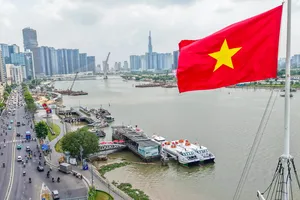
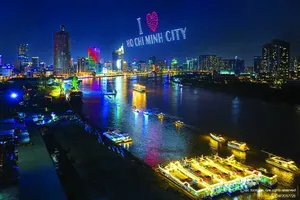
 "Tourists join a sunset cruise on the Saigon River as part of Ho Chi Minh City's night-time economy and river tourism initiatives.")
Since July 1, 2025, the merger of Ho Chi Minh City, Binh Duong, and Ba Ria - Vung Tau has created a new economic structure that previously could only be coordinated through inter-provincial linkages.
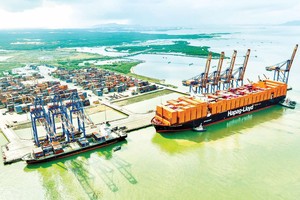
The former Ho Chi Minh City had strengths in finance, trade, services, science and technology, innovation, and a highly skilled workforce. Binh Duong had a strong industrial base, industrial parks, and a well-developed manufacturing ecosystem, while Ba Ria-Vung Tau was home to deep-water seaports, logistics, the energy industry, and a marine economy. Bringing these three spaces together within a unified entity offers enormous potential.
The challenge is to integrate these three advantages into a complete value chain, with the financial, service, and innovation hub linked to industrial production areas and, in turn, directly connected to the seaport system and international markets. If this can be achieved, Ho Chi Minh City could establish a development structure that few other localities in Vietnam can match, bringing finance, technology, industry, logistics, seaports, and services under a single governance framework.
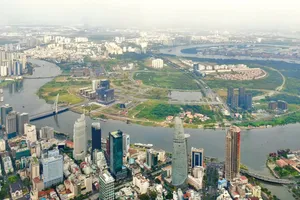
Current planning orientations are also positioning the city around an integrated structure, with the Saigon-Cho Lon-Thu Thiem area focusing on finance, trade, and services; the Binh Duong area leveraging its strengths in smart and high-tech industries; the Ba Ria-Vung Tau area developing the marine economy; and Con Dao combining conservation with high-quality ecotourism and cultural tourism.
Thus, expanding the development space is only a necessary condition; effectively governing the new space is the sufficient condition.
Preventing resources from operating in silos
If the planning of each area remains poorly connected, transport infrastructure is not synchronized, management data remain fragmented, administrative procedures differ across jurisdictions, and industrial parks, urban areas, seaports, airports, and logistics centers are not integrated into a common development chain, the expansion of administrative boundaries cannot be fully translated into a new growth driver. Therefore, the priority is to connect infrastructure.
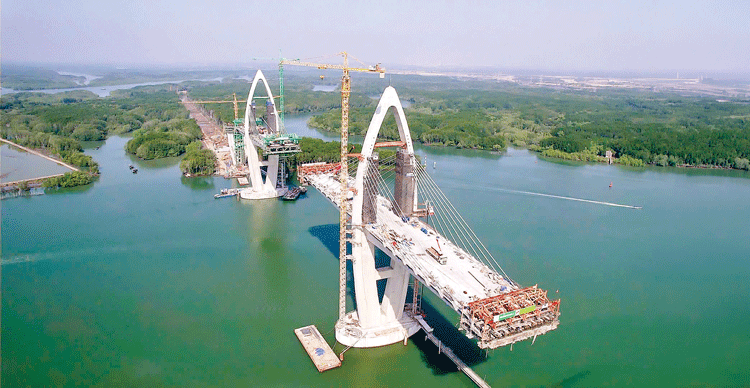
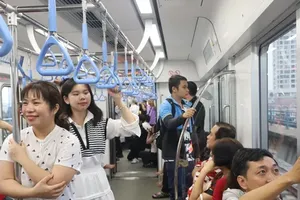
Ring roads, expressways, urban railways, rail links to seaports, Long Thanh International Airport, the Cai Mep-Thai Vai port complex, and logistics centers must be viewed as a single, integrated network. Infrastructure projects cannot be developed in isolation; instead, they must be planned with a view to creating economic corridors and integrated supply chains. The question is no longer simply “how much capital should be invested,” but rather “how much additional development capacity can each Vietnamese dong of investment generate for the city as a whole?”
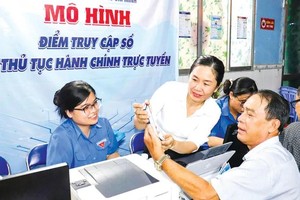
Alongside infrastructure, greater integration is needed in land-use planning, urban development, investment attraction, and digital transformation. In particular, the city needs to establish a shared data system early. A megacity cannot operate efficiently if “data silos” persist across sectors and geographical areas.
Unified governance does not mean that everything must be centralized under a single authority. On the contrary, the larger the city becomes, the greater the need for decentralization while ensuring that “tasks, authority, resources, responsibilities, and outcomes are clearly defined.” Tasks that can be effectively handled at the grassroots level should be delegated decisively. However, issues involving master planning, strategic transport infrastructure, the allocation of major resources, environmental management, data governance, and inter-regional projects must be coordinated in a unified manner.
Creating synergies across the Southern region
Ho Chi Minh City can fully leverage its role when placed within a network of linkages with Dong Nai, Tay Ninh, the Mekong Delta, the Central Highlands and, more broadly, international economic corridors. The city should not take on every development function. More importantly, it should serve as a hub for organizing and connecting the flows of capital, goods, technology, human resources, and services across the entire Southern region.
The city should shift decisively toward high-value-added functions such as finance, research and development, innovation, the digital economy, high-tech industries, international logistics, and high-quality services, while strengthening connectivity with surrounding localities to build complementary production, urban, and service networks rather than competing through similar projects.
To achieve higher and more sustainable growth, the city needs to move decisively from simply pooling resources to multiplying their value. Resources must not be constrained by administrative boundaries, advantages must not be fragmented by management mechanisms, and major infrastructure projects must not be allowed to exist as “investment islands.”
If these advantages can be transformed into an integrated development ecosystem, Ho Chi Minh City will gain not merely a larger development space but an entirely new growth driver. This is the essence of “unified governance of development space”: not mechanically adding up existing resources, but organizing them more effectively to generate greater value.
For Ho Chi Minh City, successfully making this transition will determine the growth momentum of the megacity while helping create a new driving force for the Southeastern region, the southern economic region, and the Vietnamese economy as a whole.
The 3rd Plenum of the 14th Party Central Committee called for policy decisions to deliver strategic breakthroughs. A key shift is to “ensure unified governance of development space and maximize the effectiveness of national resources.” This represents an important change in development thinking, as the Party Central Committee has pointed out that resources remain fragmented in practice, while decentralization in some areas has not been fully matched by the necessary resources, data, implementation tools, and accountability.
In simple terms, if development was previously organized primarily along administrative boundaries, the new phase requires the economy to be viewed as an interconnected space in which capital, land, labor, infrastructure, data, science and technology, and markets are allocated based on development efficiency rather than being fragmented by local boundaries.