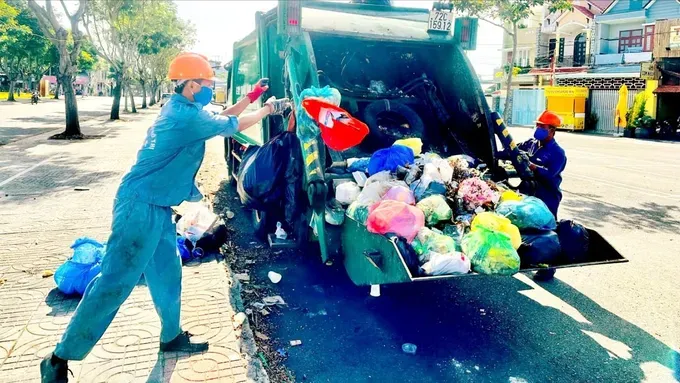
For Ms. Nguyen Thi Hong in Phu Tho Hoa Ward, the new garbage collection rates under Decision 65/2026 make practical sense. “Calculating fees based on household members will be far more reasonable than slapping a flat rate on everyone like before,” she explained. Smaller households generating less garbage logically see a reduction. For instance, her two-person family previously paid around VND90,000 ($3.45) monthly for waste collection. With the new rates, they’ll only fork out about VND40,000 ($1.53).
Conversely, Ms. Nguyen Thi Bich Lien in Rach Dua Ward sees a slightly different situation. Prior to September 1, her family paid VND50,000 ($1.92) a month. Under the new structure, she’s required to pay VND71,000 ($2.72) monthly because her household officially has four members, even though two rarely come home.
Meanwhile, for Ms. Vo Thi Thua in Vung Tau Ward, the new cost isn’t overly burdensome, but it absolutely requires a clear informational mechanism regarding the provider’s explicit responsibilities. She suggested fee collection should be inextricably linked to actual service quality. It appears residents strongly desire that alongside price adjustments, overall domestic waste collection quality will be elevated.
According to Mr. Luong Chi Vi, a local restaurant owner, calculating service fees by volume could generate additional motivation to cut down on waste. This fundamentally forces businesses to pay closer attention to sorting garbage on-site. Ultimately, this represents a profound paradigm shift from a “pay to have it collected” mindset to proactively controlling waste volume for cost reductions.
The HCMC Department of Agriculture and Environment shared that for the first time, household fees are divided into two distinct groups, namely households with two members or fewer, and those with three members or more.
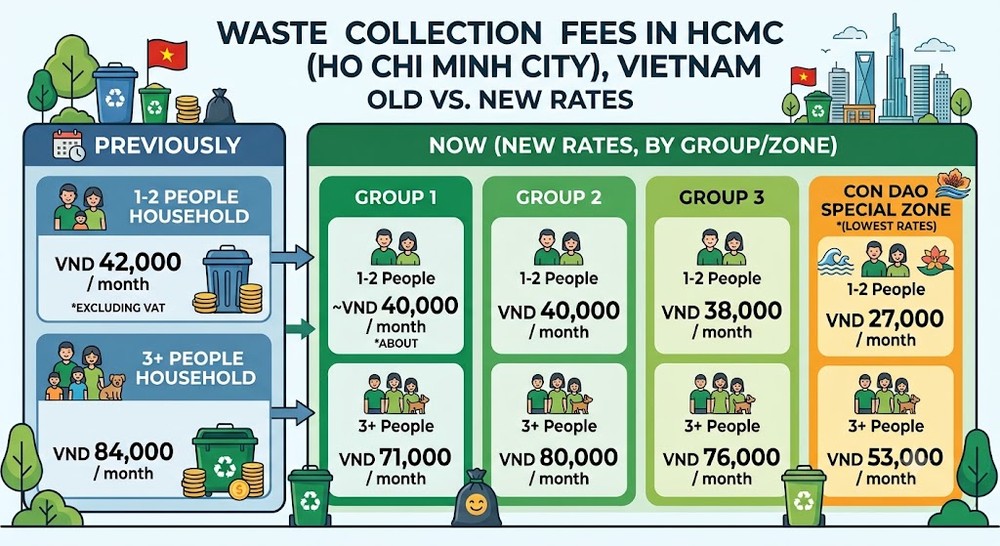
Previously in the HCMC area, a household with a maximum of two people had to pay VND31,000 ($1.19) a month for collection fees and VND11,000 ($0.42) a month for transport fees, totaling VND42,000 ($1.61) a month, excluding VAT. Meanwhile, a household with three or more members was required to pay VND84,000 ($3.22) a month.
Over in other regions of HCMC, the collection rates are also segmented based on demographic scale. Group 2 applies a rate of VND40,000 ($1.53) a month for households with up to two members and VND80,000 ($3.06) for those with three or more. Group 3 sees rates of VND38,000 ($1.46) and VND76,000 ($2.91) respectively. Con Dao Special Zone boasts the lowest rates, corresponding to VND27,000 ($1.03) and VND53,000 ($2.03) per month.
Under this calculation method, smaller households in areas formerly belonging to HCMC will enjoy a reduction of about 50 percent, whereas the group of households with three or more members essentially maintains their original fee levels.
Regarding business establishments, services, and organizations generating no more than 300kg of garbage daily, if they opt to be managed like a household, the collection and transport prices are systematically divided into varying volume tiers.
The collection rates fluctuate between VND38,000 and 182,000 ($1.38-$6.97) per month for collection fees, and VND15,000-68,000 ($0.57-$2.6) per month for transport fees. Notably, in the former HCMC urban area, the group generating between 250 and 500kg a month must pay a grand total of VND250,000 ($9.57) a month.
Once the generated waste volume exceeds 500kg but remains under 9 tonnes per month, the calculation method decisively pivots to actual weight. Collection prices range from VND453-486 ($0.018-$0.02) per kg, while transport costs hover between VND147-180 ($0.005-$0.08) per kg, depending entirely on the specific area.
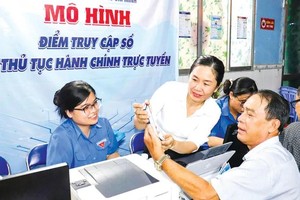
Head Bui Truong Son of the Binh Hung Commune People’s Committee Economic Division informed that following a recent conference, they immediately directed local police, hamlet heads, and collection units to seamlessly coordinate. Their primary goal is to accurately determine household demographics to implement fee collection under Decision 65/2026.
At a recent deployment conference, Deputy Director Nguyen Hong Nguyen of the HCMC Department of Agriculture and Environment stated the department is advising the HCMC People’s Committee to promulgate uniform regulations. These strictly include guidelines on managing domestic and medical solid waste, alongside a comprehensive at-source classification plan.
The department aims to issue these crucial documents by late 2026 for full implementation in 2027. Particularly, from 2027 onwards, HCMC will rigorously enforce garbage classification directly at the source to get the ball rolling.
Parallel to policy formulation, the department is perfecting a shared domestic solid waste management software spanning all administrative levels. Once officially launched, it’ll significantly aid agencies in tracking data, identifying waste generators, and determining applicable service rates.
Currently, they’re soliciting feedback on a draft decision regulating the collection of service fees across the city’s households and individuals. The draft is fundamentally geared toward establishing a unified mechanism, ensuring fee collection is executed transparently, and targeting the right subjects at the correct price points. Concurrently, it stipulates using service receipts as official vouchers, thereby resolving persistent administrative bottlenecks.
In the end, the new scheme lays a solid foundation for transitioning from flat-rate garbage fees to calculating costs reliant on demographics and actual waste volumes. Ultimately, this will decisively determine whether the policy can genuinely foster fairness and alter residents' disposal behaviors.