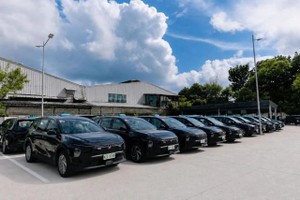
The latest report records that the country currently has 61,171 electric taxis out of a total of 86,274 operating taxis, reaching a rate of 70.9 percent. This figure confirms that electric taxis have established an overwhelming presence in the structure of urban transport vehicles.
This growth momentum continues to be fueled by major partnerships between pioneering enterprises. For instance, in August 2026, VinFast Vietnam Joint Stock Company, Green and Smart Mobility Joint Stock Company (GSM), and Quick Car Vietnam Corporation signed a business cooperation memorandum of understanding.
Under the agreement, from now through 2027, Quick Car Vietnam Corporation will equip 3,000 VinFast electric cars, including Minio Green, EC Van, Limo Green, VF 5, and Herio Green models, to operate services on the Green SM Platform in Ho Chi Minh City, Dong Nai, and Tay Ninh.
Le Thi Oanh, Global B2B Sales Director of VinFast, affirmed that the order of 3,000 vehicles is clear evidence of transport enterprises' trust in the product quality and operational efficiency of VinFast electric cars. To date, GSM and VinFast have accompanied and supported more than 100 transport enterprises nationwide in transitioning to green vehicles.
At the consultation conference on the report reviewing the implementation of Decision No. 876/QD-TTg organized by the Ministry of Construction in September 2026, road transport and urban traffic were evaluated as the sectors showing the clearest pace of electric vehicle transition. According to the report by Nguyen Thi Phuong Hien, Deputy Director of the Academy of Strategy and Training of Construction Managers, as of June 2026, electric vehicles accounted for about 6.1 percent of more than 6.3 million total vehicles.
Among them, passenger cars accounted for 97.3 percent of total electric vehicles, while electric motorbikes maintained a growth rate of about 28 percent per year. In other vehicle categories, the country recorded 3,893 electric trucks, 47 electric tractor trucks, 2,502 electric passenger buses (primarily urban buses), and 8 specialized electric vehicles, opening up significant room for conversion among long-distance trucks and passenger coaches in the coming time.
It should be noted that an important foundation helping remove operational barriers for service vehicles is the rapid development of charging infrastructure. The country currently possesses 15,024 charging stations and ports including 5,331 fast-charging points and 9,693 slow-charging points, covering 34 out of 34 provinces and cities. This network also appears across 125 out of 215 expressways and national highways, ensuring conditions for taxi fleets to operate continuously and stably.
The breakthrough of electric taxis as well as infrastructure not only contributes to reducing emissions and noise pollution in urban areas, but also strongly spreads green mobility habits within the community—a noteworthy shift.