In a recent commentary for Sai Gon Giai Phong (SGGP), Associate Professor Tran Le Hung, a lecturer and researcher at France’s Gustave Eiffel University, argues that genuine breakthroughs in education require substantive, meaningful reform rather than superficial changes.
Innovation more than just changing curricula

In higher education, foundational knowledge remains paramount. Engineering students, for instance, must master mathematics, mechanics, physics, and core disciplinary principles. Yet, such knowledge only gains true value when learners know how to apply, verify, and further develop it.
Throughout his experience teaching subjects related to mechanics and structural engineering, both in France and in Vietnam, he has consistently focused on the gap between theoretical models and the actual behavior of structures. True scientific thinking requires more than technical execution; it demands that students grasp why a specific model is selected, interrogate its underlying assumptions, and weigh the fallout of flawed conclusions. Ultimately, intellectual honesty, knowing the boundaries of one's expertise and taking accountability for results, defines a rigorous mind.
From this perspective, educational innovation is not merely about replacing textbooks, updating software, or increasing practical training hours. It must begin by redefining educational objectives: what should learners know, why should they know it, and how and under what conditions can that knowledge be applied? In Vietnam, teaching methodologies have already begun to shift, with positive developments in assessment and evaluation practices that align with modern trends and better support student growth.
It is essential to integrate assessments of foundational knowledge with evaluations of analytical, reasoning, and problem-solving capabilities. This is entirely achievable. For example, a major assignment could utilize real-world data; a graduation project could be derived from the specific needs of a business; or a small-scale research project could offer students their first experience in the process of generating new knowledge. Most importantly, students should be encouraged to ask questions, allowed to experiment, and allowed to learn from their mistakes. An educational system that prioritizes only the "correct" answer will struggle to cultivate individuals who have the courage to seek out new solutions.
France’s lessons for Vietnam’s education reform
Resolution No. 71-NQ/TW on breakthroughs in the development of education and training provides a clear roadmap for advancing science, technology, innovation, and national digital transformation. It calls for a comprehensive overhaul of the education system through a triple-helix model - a framework for understanding how academia (universities), industry (businesses), and government interact to drive innovation and economic growth.
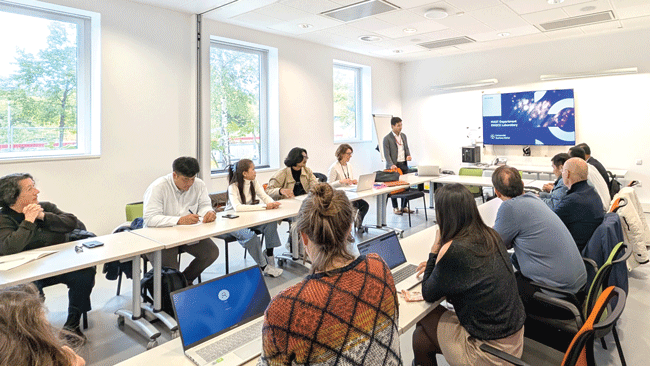
While this represents a new wave for educational development in Vietnam, in France, such collaboration has long existed in various forms and across different educational levels, demonstrating a diverse range of mechanisms for linking academic institutions, research laboratories, and the professional world.
A notable educational model in France is the "alternance" (work-study) system, where students alternate between academic study and professional work within a company, following a structured and supervised program. Through this, students not only acquire specialized knowledge but also gain insight into organizational operations, participate in real-world projects, and develop the adaptability required for professional roles.
At the doctoral level, France bridges academia and industry through the CIFRE program (Conventions Industrielles de Formation par la Recherche), a model established in 1981. Under this state-subsidized framework, companies hire PhD candidates to conduct thesis research in direct partnership with university laboratories. The tripartite arrangement creates a mutual win: businesses drive technological innovation, labs safeguard scientific rigor, and doctoral students gain real-world industry experience alongside advanced academic training.
Beyond individual programs, France actively cultivates university-centered innovation ecosystems that unite schools, research institutes, businesses, and technology transfer offices. The key takeaway is clear: companies should not merely wait at the finish line to recruit graduates, but rather embed themselves directly in training and research from the start.
For Vietnam, the lesson is not to copy foreign models wholesale, but to build tailored mechanisms where stakeholders share resources, risks, and rewards, replacing short-lived and trend-driven initiatives with durable and long-term partnerships.
Scientific research as an integral part of the educational process
What the French model makes clear is that teaching and scientific inquiry cannot thrive in isolation, a reality Vietnam must confront as it reforms its universities. Currently, the two pillars often operate on parallel tracks, with professors delivering standardized lectures by day and conducting research on the side to check career advancement boxes.
True academic vitality, however, isn't measured solely by publication tallies. It comes from letting active research breathe life into the syllabus and ignite a sense of discovery in the classroom. By bringing students directly into the lab, universities shift education from passive absorption of textbook findings to firsthand participation in the creation of knowledge.
Consequently, domestic educational institutions should proactively establish mechanisms to involve students in research at an earlier stage through research groups, projects linked to real-world applications, or short-term research programs under the guidance of faculty members and industry experts. Furthermore, the role of basic research must be properly recognized, as not every scientific endeavor is required to yield an immediate commercial product. A nation that aspires to master technology must be committed to building research capacity from the ground up, for the foundational knowledge of today may well serve as the bedrock for the technological breakthroughs of tomorrow.
An advanced education system is measured not merely by its position in international rankings, the volume of its scientific publications, or the scale of its facilities. More importantly, it must equip people to think independently, master knowledge, innovate in technology, and address the country’s challenges.
Associate Professor Tran Le Hung