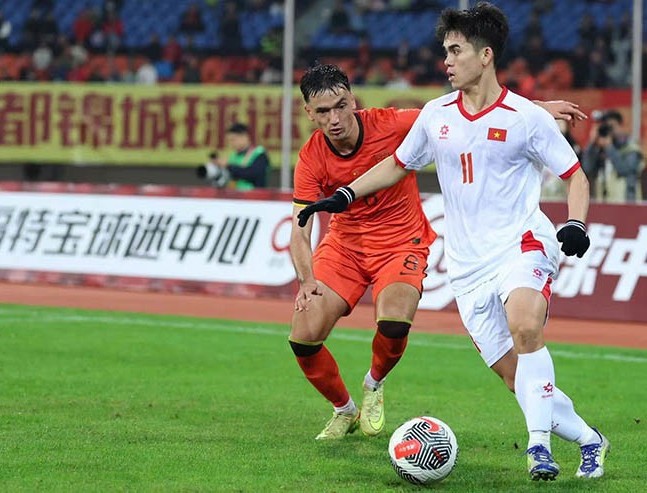
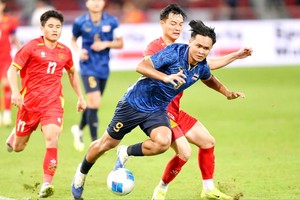
While Vietnam U23 is chasing a second appearance in the final of this tournament, this marks China U23’s first time reaching the continental youth semifinals since 2004. Beyond its historical significance, the match is also a tactical duel between two contrasting styles of play, and a litmus test of the mettle of a new generation of Vietnamese players who have stepped out of the shadow cast by their celebrated predecessors at the 2018 tournament in Changzhou.
Vietnam U23 enters the semifinal on the back of an impressive campaign. They topped Group A after defeating Jordan U23 2-0, Kyrgyzstan U23 2-1, and host Saudi Arabia U23 1-0. In the quarterfinals, Head Coach Kim Sang-sik’s side edged past UAE U23 in a dramatic 3-2 victory after 120 minutes. Beyond the results, Vietnam’s performances have drawn praise for their inventive attacking play and rapid transitional phases.
China U23, by contrast, has endured a more arduous path. They finished second in Group C and produced a major upset in the quarterfinals by holding Uzbekistan U23 to a 0-0 draw over 120 minutes before prevailing 4-2 in the penalty shootout. China arrived at the semifinal via an unusual route: scoring just one goal in four matches, yet remaining the only team in the tournament not to have conceded.
From a tactical perspective, the semifinal promises to be a genuine battle of wits. Vietnam U23 favor proactive, attack-minded football, exploiting pace and swift transitions, while China U23 are more defensively inclined. The Asian Football Confederation (AFC) has noted that the most significant difference between the two sides lies in their “approach to possession”: Vietnam seeks to dominate the ball, whereas China prefers a counterattacking setup.
Vietnam U23 approaches the match with the mindset of challengers, unafraid of established opposition. However, having seen Uzbekistan struggle to break down China U23, Coach Kim Sang-sik and his players know they cannot rely solely on momentum. The South Korean coach struck a cautious note, “China is a strong team with a high level of discipline. We need to maintain focus and make the most of set-piece situations.”
Projected line-ups
Vietnam U23 (3-4-3): Trung Kien; Ly Duc, Hieu Minh, Nhat Minh; Minh Phuc, Xuan Bac, Thai Son, Van Khang; Ngoc My, Thanh Nhan, Le Phat.
China U23 (4-5-1): Li Hao; Hu Hetao, He Yiran, Umidjan Yusup, Xu Bin; Mutellip Iminqari, Peng Xiao, Li Zhenquan, Behram Abduweli, Wang Yudong; Yang Xi.
If the match unfolds according to China’s preferred script—slow tempo and limited clear-cut chances—the burden will weigh heavily on Vietnam’s attacking line, which thrives in open spaces. Conversely, if Vietnam can assert control in midfield, frequently switch the point of attack, and, in particular, capitalize on set pieces, the balance could tilt early in favor of Vietnamese players.
History favors China, with Vietnam having lost all previous official U23-level encounters between the two sides. China’s Head Coach, Antonio Puche, has stressed that his team “has studied Vietnam very carefully” and will not allow emotions to disrupt their focus. Chinese media have also shown considerable respect for the Vietnam U23. Sina, for instance, warned of the threat posed by four Vietnamese pillars: Khuat Van Khang (captain, leadership, and long-range shooting), Nguyen Dinh Bac (pace and finishing), Nguyen Thai Son (midfield control), and Nguyen Thanh Nhan (penetration down the flanks).
Physically, China U23 holds a slight edge, boasting an average height of 1.82 meters compared to Vietnam’s 1.77 meters. The presence of players of mixed heritage, such as Behram Abduweli and Wang Yudong, further enhances their physicality. However, China will be without key holding midfielder Yang Haoyu due to suspension—a small crack in their defensive structure that could provide an opening for Coach Kim Sang-sik’s “secret weapons” to make the difference.
Anticipation builds for the Japan–Korea semifinal
The other semifinal, between Japan U23 and South Korea U23 (6:30 p.m., January 20), is widely viewed as a tightly balanced contest. Both teams have reached the final twice, with Japan lifting the trophy on both occasions, while South Korea’s lone title came after finishing runners-up once, losing to Japan in the 2016 final.
Despite fielding a squad largely made up of U21 players, Japan has delivered a highly impressive campaign, particularly in the group stage where their forwards displayed formidable attacking firepower. South Korea U23, meanwhile, was less convincing in the group phase but came to life in the quarterfinals with an emphatic 4-2 victory over Uzbekistan.


)




